
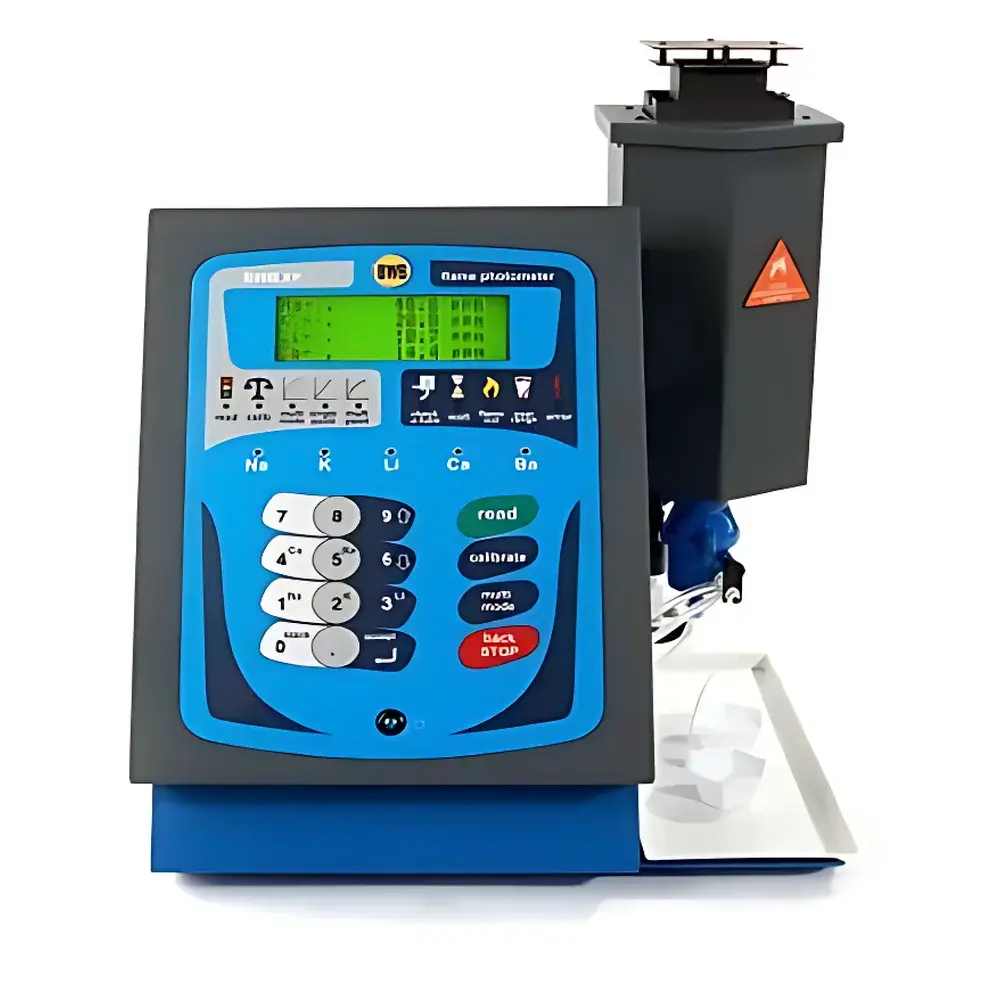
BWB XP Five-Channel Simultaneous Flame Photometer
| Brand | BWB |
|---|---|
| Origin | United Kingdom |
| Model | BWB-XP |
| Detection Elements | Na, K, Li, Ca, Ba |
| Calibration Modes | Two-point, Multi-point, Multi-ion |
| Output Options | 0–1 V analog, RS232, USB |
| Air Supply | Integrated silent air compressor (switchable to external source) |
| Sample Uptake Rate | 3.0–5.5 mL/min |
| Repeatability | CV <1% at ≤100 ppm over 20 injections (≥10 min post-stabilization) |
| Detection Limits | Na/K: 0.02 ppm |
| Li | 0.05 ppm |
| Ca | 1.0 ppm |
| Ba | 10 ppm |
| Linear Range (multi-point) | Na/K: 0.05–1000 ppm |
| Li | 0.1–1000 ppm |
| Ca | 2.5–1000 ppm |
| Ba | 30–3000 ppm |
| Response Time | <15 s (from sample introduction to stable signal) |
| Drift | ≤1% after 30 min stabilization |
| Interference (Na/K/Li at <100 ppm) | <0.5% |
| Display Mode | Real-time simultaneous readout of all five elements (ranked high-to-low) |
| Software | FP-PC v3.x with GLP-compliant reporting, audit trail, data export (up to 10-sample reports), operator/sample metadata tagging, network archiving |
| Compliance | CE-marked |
Overview
The BWB XP Five-Channel Simultaneous Flame Photometer is a precision optical emission instrument engineered for quantitative elemental analysis of alkali and alkaline earth metals in liquid samples. It operates on the fundamental principle of flame atomic emission spectroscopy (FAES): analyte solutions are nebulized into a stable, stoichiometric air-propane or air-natural gas flame, where thermal energy excites valence electrons of metal atoms (Na, K, Li, Ca, Ba). Upon relaxation, these atoms emit characteristic wavelengths—filtered through high-transmission, narrow-band interference filters—and detected by a photomultiplier tube. Unlike sequential or single-channel systems, the BWB XP employs five parallel optical paths with dedicated filters and detectors, enabling true real-time, simultaneous quantification without time-multiplexing artifacts. This architecture eliminates carryover-induced calibration drift and ensures inter-element ratio integrity—critical for applications such as soil exchangeable cation analysis or biological fluid electrolyte profiling. Designed and assembled in the UK, the instrument integrates a Class II-certified silent air compressor, eliminating dependency on external compressed air infrastructure while maintaining consistent nebulization pressure (±0.5 psi) across analytical runs.
Key Features
- True five-channel parallel detection: Simultaneous measurement and display of Na, K, Li, Ca, and Ba concentrations—no sequential scanning or channel switching delays.
- Integrated air management system: Built-in oil-free, low-vibration air compressor with pressure regulation and optional bypass for external air supply (e.g., lab-grade nitrogen-dried air).
- Multi-mode calibration capability: Supports two-point linear, multi-point non-linear (up to 8 standards), and multi-ion calibration—allowing correction for spectral overlap and matrix effects without manual coefficient entry.
- Configurable concentration units and resolution: Selectable output in ppm, mg/L, mmol/L, or meq/L; digital resolution adjustable to 0.001–1.0 unit increments per element.
- Automated safety and diagnostics: Flame-out detection triggers immediate gas cutoff and audible alert; power-on self-test verifies detector linearity, filter wheel position, and air pressure stability.
- Regulatory-ready connectivity: RS232 and USB interfaces support bidirectional communication with LIMS; analog 0–1 V output enables integration with legacy chart recorders or PLC-based process monitoring systems.
- Robust mechanical design: Stainless-steel burner head, corrosion-resistant nebulizer chamber, and sealed optical bench minimize maintenance frequency and extend service intervals beyond 12 months under routine QC use.
Sample Compatibility & Compliance
The BWB XP accepts aqueous solutions with total dissolved solids (TDS) ≤0.5% w/v and viscosity ≤3 cP. Samples requiring acid digestion (e.g., soils, plant tissues, cement) must be diluted to meet matrix compatibility thresholds prior to analysis. The instrument complies with EN 61326-1:2013 (EMC) and EN 61010-1:2010 (safety), bearing full CE marking. Its hardware architecture and FP-PC software support alignment with ISO/IEC 17025:2017 clause 7.7 (result reporting) and GLP principles—including electronic signature-capable audit trails, user-defined permission levels, and immutable raw-data archiving. When deployed within validated laboratory IT environments, the system meets traceability requirements for FDA 21 CFR Part 11 Subpart B (electronic records and signatures), provided appropriate access controls and backup protocols are implemented.
Software & Data Management
FP-PC software (v3.4+) provides native Windows 10/11 support with TLS 1.2-secured network sharing. It features a dual-view interface: real-time chromatogram-style emission intensity plots alongside tabular concentration readouts ranked by magnitude. Each analysis session logs operator ID, sample ID, dilution factor, calibration curve metadata (R², residuals), and environmental parameters (ambient temperature, barometric pressure). Reports conform to GLP templates—PDF export includes header/footer with lab name, instrument ID, date/time stamps, and digital signature fields. Batch reporting supports up to ten samples per print job with customizable headers (e.g., project code, method reference). All raw intensity values and processed results are stored in encrypted SQLite databases with automatic daily backup to network drives or cloud storage endpoints configured via Group Policy.
Applications
The BWB XP delivers validated performance across regulated and research-driven domains. In agricultural testing laboratories, it quantifies exchangeable K⁺ in soil extracts (ASTM D5099) and Na⁺ in irrigation water per APHA Standard Method 3111B. Cement producers apply it for alkali content screening (ASTM C150 Annex A3), while food safety labs use it for Ca²⁺ in dairy products (AOAC 978.01) and Na⁺ in beverages (ISO 11840). Clinical research facilities employ it for serum/plasma electrolyte panels where flame photometry remains a reference method per CLSI EP9-A3. Additional validated uses include Li⁺ in lubricating greases (ASTM D4927), Ba²⁺ in drilling muds (API RP 13B-1), and multi-cation profiling in hydroponic nutrient solutions (ISO 11260). Its simultaneous acquisition mode is particularly advantageous for kinetic studies—e.g., monitoring Na⁺/K⁺ flux during ion-exchange resin regeneration cycles.
FAQ
What gas sources are compatible with the BWB XP?
Propane, butane, LPG, and natural gas are all supported. Gas pressure must be regulated to 10–15 psi at the instrument inlet; built-in pressure sensors trigger alarms if deviation exceeds ±10%.
Can the BWB XP quantify elements beyond Na, K, Li, Ca, and Ba?
No—the optical path is fixed with five certified interference filters. Custom filter replacement is not supported due to alignment-critical optical bench construction.
How does the instrument handle spectral interference between Na and Ca at high concentrations?
The multi-ion calibration mode applies empirically derived correction factors based on co-calibration standards; users must prepare at least one mixed standard containing both elements at representative ratios.
Is routine maintenance required between analyses?
Nebulizer capillaries should be inspected weekly; burner head cleaning is recommended after every 500 samples or upon visible salt deposition. No recalibration is needed unless filter alignment verification fails during monthly diagnostic checks.
Does FP-PC software support automated report generation for regulatory submissions?
Yes—GLP reports include embedded instrument log files, calibration certificate references, and timestamped audit trails. Exported PDFs retain digital signatures when paired with enterprise PKI infrastructure.






