
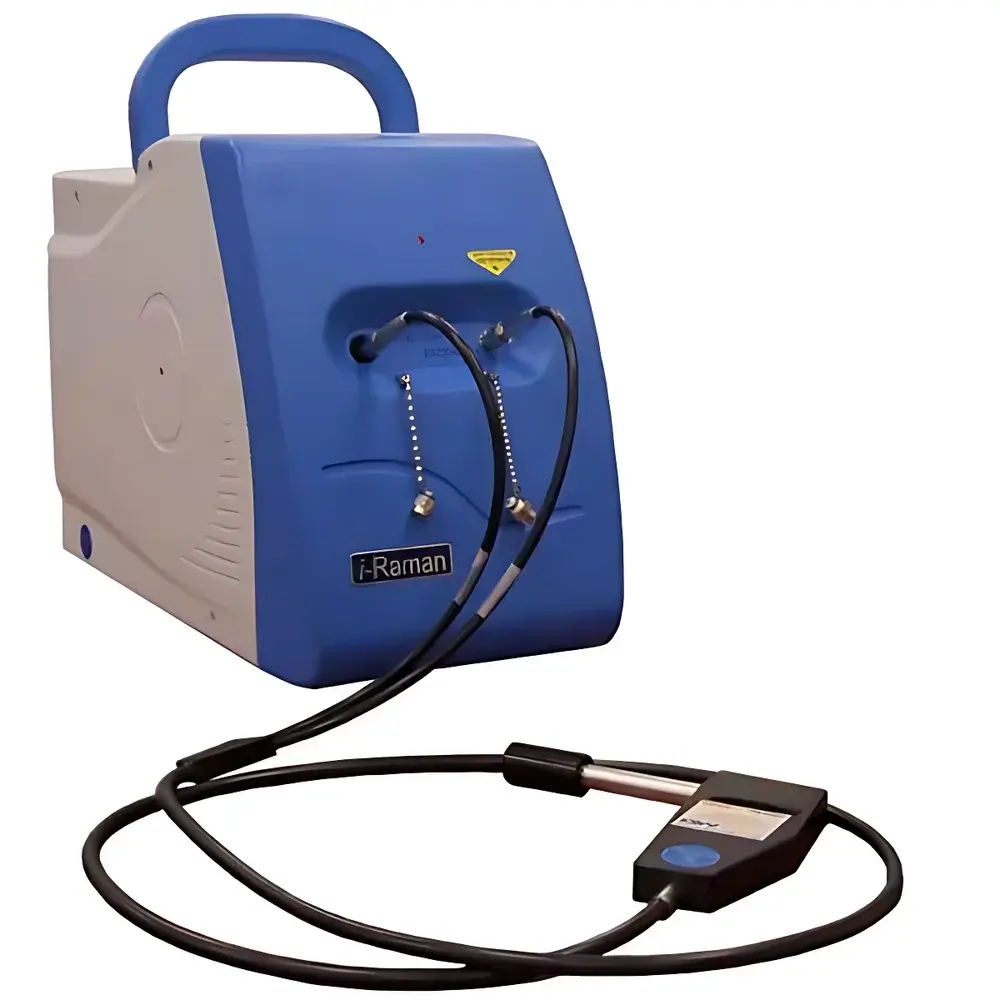
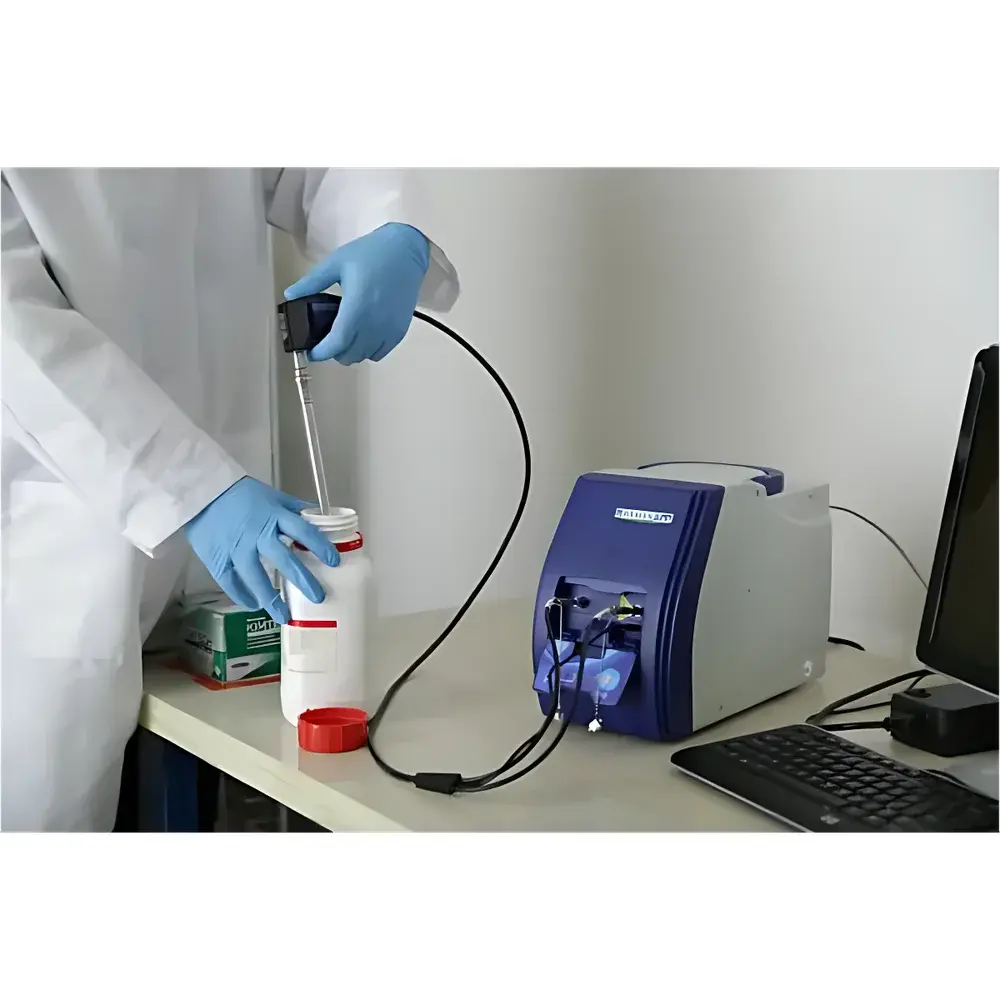
BWTEK i-Raman-785S Portable Raman Spectrometer
| Brand | BWTEK |
|---|---|
| Origin | USA |
| Instrument Type | Handheld/Portable Raman Spectrometer |
| Laser Wavelength | 785 nm (≤300 mW) |
| Spectral Range | 150–3250 cm⁻¹ |
| Spectral Resolution | 4.5 cm⁻¹ |
| Detector | TE-cooled 2048-pixel CCD array |
| Dynamic Range | 1300:1 |
| A/D Resolution | 16-bit |
| Integration Time | 5 ms – 16 min |
| Dimensions | 17 × 34 × 23.4 cm |
| Weight | 3 kg |
| Cooling | TEC to −10 °C |
| Sensitivity (cyclohexane) | >800 counts/mW/s |
| Laser Linewidth | ≤0.01 nm (CleanLaze™ stabilized) |
Overview
The BWTEK i-Raman-785S is a field-deployable, high-performance portable Raman spectrometer engineered for quantitative molecular identification and structural analysis in non-laboratory environments. Based on dispersive Raman spectroscopy with 785 nm excitation, the system leverages the inherent advantages of near-infrared laser excitation—reduced fluorescence interference, minimized photodegradation of organic and biological samples, and improved signal-to-noise ratio for complex matrices. Its integrated optical architecture combines a thermoelectrically cooled 2048-pixel CCD detector, a high-throughput Czerny–Turner spectrograph, and a narrow-linewidth CleanLaze™ diode laser (≤0.01 nm FWHM), enabling reproducible acquisition of high-fidelity spectra across the low-wavenumber region (150 cm⁻¹) up to 3250 cm⁻¹. Unlike benchtop systems requiring vibration isolation and climate control, the i-Raman-785S maintains spectral fidelity under ambient conditions through rigid mechanical design, passive thermal management, and real-time dark-current compensation—making it suitable for GLP-compliant field screening, process monitoring, and forensic documentation.
Key Features
- Integrated hardware platform: fully self-contained unit with embedded touchscreen tablet, onboard battery option (optional), and USB 3.0 interface for direct PC connectivity.
- CleanLaze™ 785 nm laser source: wavelength-stabilized, low-noise diode laser with active power regulation and TTL-triggered modulation for time-resolved or gated acquisition protocols.
- TE-cooled 2048-pixel CCD detector: operated at −10 °C to suppress thermal noise; supports integration times from 5 ms to 16 minutes for flexible dynamic range optimization.
- High optical throughput spectrograph: optimized for Raman scattering efficiency, delivering consistent resolution of ≤4.5 cm⁻¹ (FWHM) across the full spectral window.
- Fiber-optic sampling flexibility: standard SMA 905 connector enables rapid interchange of probes—including contact reflectance, non-contact standoff, immersion, and fiber-coupled microscope objectives—for diverse sample geometries and containment requirements.
- Ruggedized enclosure: IP54-rated housing with shock-absorbing elastomer feet and reinforced magnesium alloy chassis for transport resilience and operational stability on uneven surfaces.
Sample Compatibility & Compliance
The i-Raman-785S accommodates solid, liquid, gel, and powder samples without destructive preparation. Its 150 cm⁻¹ low-frequency cutoff permits detection of lattice modes, phonons, and intermolecular vibrations critical in pharmaceutical polymorph screening, mineral phase identification, and semiconductor crystal quality assessment. The instrument complies with IEC 61326-1 (EMC for laboratory equipment) and meets essential safety requirements per IEC 60825-1 (Class 3B laser product). Data integrity workflows support audit trails, electronic signatures, and user-access controls compatible with FDA 21 CFR Part 11 implementation when used with BWTEK’s BWSpec® software in validated environments. It is routinely deployed in accordance with ASTM E1840 (Standard Guide for Raman Shift Standards), ISO 8601 (date/time stamping), and USP (Raman spectroscopy for pharmaceutical raw material verification).
Software & Data Management
Controlled via BWSpec® v4.x (Windows-based), the system provides real-time spectral preview, automated baseline correction (Asymmetric Least Squares), peak fitting (Voigt/Gaussian models), multivariate analysis (PCA, PLS-DA), and library search against NIST, BioRad, and custom-built spectral databases. All raw and processed data are stored in HDF5 format with embedded metadata (laser power, integration time, detector temperature, calibration coefficients), ensuring traceability and FAIR (Findable, Accessible, Interoperable, Reusable) data principles. Batch processing scripts, API access via Python SDK, and OPC UA server integration enable seamless inclusion into MES/SCADA platforms for continuous manufacturing (ICH Q8/Q9/Q10) and PAT (Process Analytical Technology) frameworks.
Applications
- Pharmaceutical QA/QC: raw material identity testing, counterfeit drug detection, blend uniformity analysis, and crystallinity monitoring during lyophilization or granulation.
- Forensic science: non-destructive analysis of narcotics, explosives residues, inks, paints, and trace evidence at crime scenes or in mobile labs.
- Geosciences: in situ mineral identification (e.g., quartz polymorphs, carbonates, sulfides), fluid inclusion characterization, and planetary analog studies.
- Materials science: graphene layer counting, stress/strain mapping in thin films, doping verification in SiC/GaN wafers, and degradation assessment of polymer electrolytes.
- Food & agriculture: adulterant screening (e.g., melamine in milk powder), authenticity verification (olive oil, honey), and pesticide residue semi-quantification on produce surfaces.
- Biomedical research: label-free cell typing, tissue margin assessment during surgery, and real-time monitoring of protein conformational changes in solution.
FAQ
What is the minimum detectable Raman shift and why does it matter?
The i-Raman-785S achieves a low-wavenumber cutoff of 150 cm⁻¹, enabling observation of skeletal deformations, interlayer vibrations, and acoustic phonon modes—critical for distinguishing polymorphs and characterizing layered materials.
Can this instrument be used for quantitative analysis?
Yes—when calibrated with certified reference standards and operated under controlled illumination geometry, the system delivers linear response over four orders of magnitude in concentration for validated assays (e.g., API content in tablets, ethanol in beverages).
Is spectral calibration traceable to NIST standards?
Each unit ships with factory calibration verified against NIST-traceable rare-earth oxide standards (e.g., KGd(WO₄)₂), and users can perform daily recalibration using built-in silicon reference peak (520.7 cm⁻¹).
How is data security handled in regulated environments?
BWSpec® supports role-based access control, encrypted project files, timestamped audit logs, and electronic signature workflows compliant with 21 CFR Part 11 Annex 11 when deployed on validated IT infrastructure.
What accessories extend its functionality for specialized measurements?
Optional configurations include transmission cuvette holders, angle-resolved reflection stages, fiber-coupled microprobes (10×–50× magnification), and explosion-proof enclosures for hazardous area deployment (ATEX/IECEx certified variants available).





