
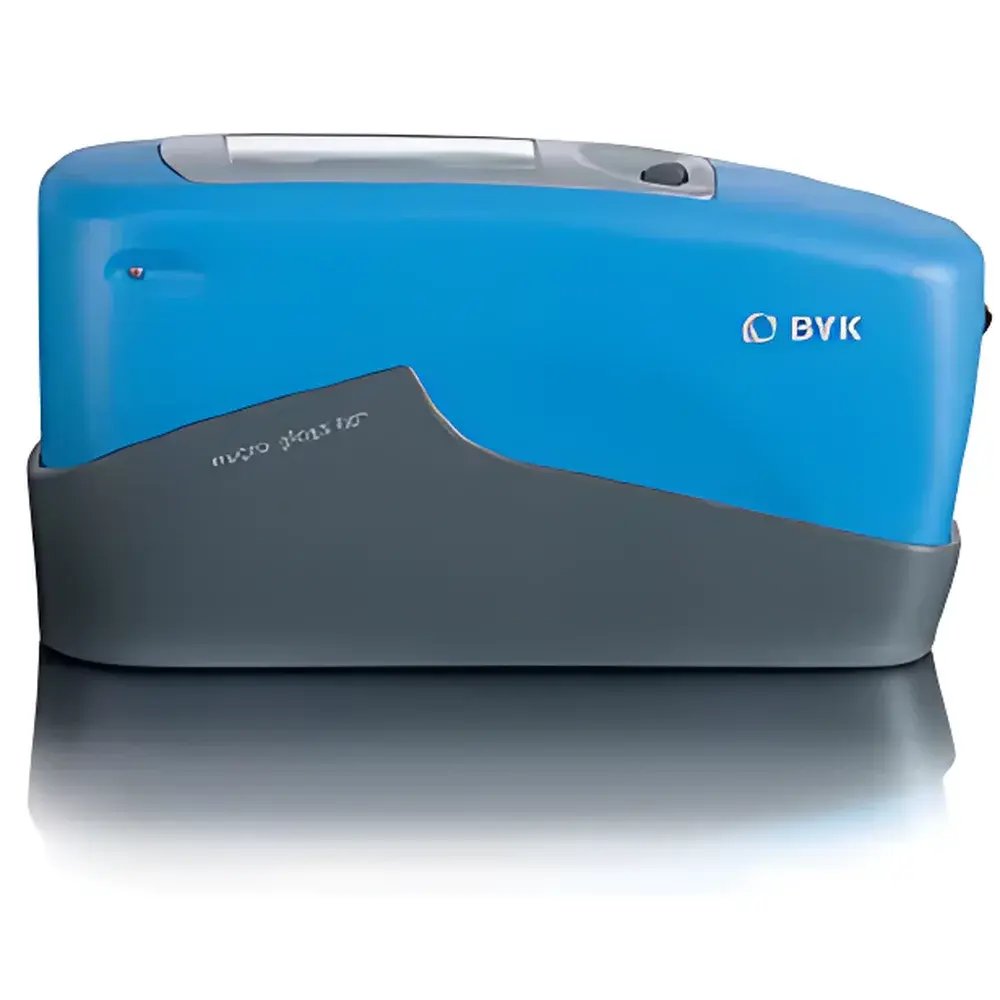
BYK-GARDNER BYK4564 Micro-Tri-Gloss Meter
| Brand | BYK-GARDNER |
|---|---|
| Origin | Germany |
| Model | BYK4564 |
| Type | Automatic Tri-Angle Gloss Meter |
| Gloss Angles | 20°, 60°, 85° |
| Measurement Area (per angle) | 10×10 mm (20°), 9×15 mm (60°), 5×38 mm (85°) |
| Gloss Range | 0–2000 GU |
| Repeatability | ±0.1 GU (0–20 GU), ±0.2 GU (20–100 GU), ±0.2% (100–2000 GU) |
| Reproducibility | ±0.2 GU (0–20 GU), ±0.5 GU (20–100 GU), ±0.5% (100–2000 GU) |
| Compliance | ISO 2813, ASTM D523, DIN 67530, JIS Z8741, BS 3900-E7 |
| Software Compatibility | smart-lab Gloss, smart-process Gloss |
| Data Interface | USB |
| Power | Rechargeable Li-ion battery |
| Operating Temperature | 10–40 °C |
| Storage Temperature | –10–50 °C |
Overview
The BYK-GARDNER BYK4564 Micro-Tri-Gloss Meter is a precision-engineered optical instrument designed for rapid, repeatable, and traceable measurement of specular gloss across three standardized incident angles—20°, 60°, and 85°—in a single handheld unit. Based on the principle of specular reflectance, the device quantifies the ratio of reflected luminous flux to incident luminous flux under controlled geometric conditions, as defined by ISO 2813 and ASTM D523. Unlike conventional single-angle gloss meters, the BYK4564 integrates all three angles into one compact, ergonomic housing—enabling immediate comparative assessment of high-, medium-, and low-gloss surfaces without instrument swapping or recalibration. Its optical architecture features stabilized LED illumination, temperature-compensated photodetectors, and real-time self-diagnostic routines that monitor calibration integrity, standard plate cleanliness, and sensor drift. The meter is calibrated against NIST-traceable standards and supplied with a certified reference tile housed in a protective calibration base—ensuring metrological continuity from factory to field.
Key Features
- Ergonomic tri-angle design: Simultaneous 20°, 60°, and 85° measurements in one instrument—eliminating cross-angle variability and operator-induced error.
- High-resolution color display with intuitive menu navigation and tactile scroll wheel for glove-compatible operation in production environments.
- Auto-diagnostic system: Continuously validates calibration status, alerts user when recalibration is required, and detects contamination on the reference standard.
- Extended gloss range: 0–2000 GU with optimized resolution across sub-ranges (0–20 GU, 20–100 GU, 100–2000 GU) to maintain accuracy for ultra-matte automotive interiors and high-gloss OEM clearcoats alike.
- Multi-surface compatibility: Magnetic and non-magnetic probe variants support direct measurement on ferrous and non-ferrous substrates—including steel, aluminum, and composite panels—without adhesive fixtures.
- Statistical evaluation mode: Calculates mean, range, and standard deviation from ≥3 readings per sample—supporting ISO/IEC 17025-compliant quality reporting and intra-batch uniformity analysis.
- Continuous scanning mode: Enables real-time gloss profiling across large surfaces (e.g., vinyl wall cladding, coated paper rolls) at user-defined intervals.
Sample Compatibility & Compliance
The BYK4564 is validated for use on diverse industrial substrates including solvent- and waterborne coatings, thermoset plastics, leather, anodized aluminum, ceramic glazes, and laminated films. Its angular configuration aligns with international test standards governing surface appearance: 20° for high-gloss finishes (e.g., automotive clearcoats per ASTM D523); 60° for general-purpose evaluation (ISO 2813, DIN 67530); and 85° for low-gloss and textured surfaces (e.g., instrument panels, matte-finish textiles). For specialized applications, optional accessories enable compliance with ASTM C346 (ceramic tile), TAPPI T 480 (paperboard), and JIS Z8741 (plastic films). All measurements meet GLP/GMP documentation requirements when paired with smart-process Gloss software, which enforces audit trails, electronic signatures, and 21 CFR Part 11–compliant data archiving.
Software & Data Management
The BYK4564 interfaces seamlessly with two dedicated software platforms: smart-lab Gloss for R&D and QC laboratories, and smart-process Gloss for inline manufacturing control. Both support USB-connected data transfer, batch-level metadata tagging (operator ID, lot number, environmental conditions), and automated report generation in PDF or Excel formats. smart-process Gloss includes SPC charting tools (X-bar/R, Cp/Cpk), alarm thresholds for out-of-spec readings, and integration-ready APIs for MES/SCADA systems. Calibration history, instrument firmware version, and measurement timestamps are embedded in every exported dataset—ensuring full traceability for ISO 9001, IATF 16949, and FDA audits. Software licensing permits concurrent installation on up to two workstations; trial access is granted for 30 days post-download.
Applications
This instrument serves critical quality assurance functions across regulated and high-precision sectors. In automotive OEM and Tier-1 supply chains, it verifies gloss consistency across painted body panels, injection-molded trim, and leather-wrapped dashboards—reducing rework caused by metamerism or batch-to-batch variation. In packaging, it monitors gloss uniformity of metallized PET films and UV-cured offset inks on folding cartons—ensuring brand-identical visual perception across global SKUs. Coating formulators employ its statistical mode to correlate gloss response with pigment dispersion efficiency and rheological modifiers. Aerospace maintenance depots use it to validate refurbishment of composite radomes and cabin interior panels against OEM gloss tolerances (±0.5 GU). Additionally, it supports accelerated weathering studies where gloss loss (ΔGU) is a primary degradation metric per ASTM G154 and ISO 4892-3.
FAQ
Does the BYK4564 require annual recalibration?
Yes—while the built-in auto-diagnostic system monitors calibration stability, annual recalibration against NIST-traceable standards is recommended to maintain ISO/IEC 17025 accreditation.
Can the instrument measure curved or textured surfaces?
It accommodates gentle curvature (radius ≥50 mm) and fine textures (Ra ≤3 µm); however, highly irregular or deeply embossed surfaces may require averaging multiple readings per ISO 2813 Annex A.
Is the USB interface compatible with Windows 11 and macOS?
Yes—the included drivers support Windows 10/11 (64-bit) and macOS 12–14; no virtual machine or legacy OS emulation is required.
What is the warranty coverage?
Standard 2-year limited warranty covers parts and labor; extended service plans (up to 5 years) include priority technical support and loaner instrument provisioning during repair.
How does the BYK4564 handle ambient light interference?
Its optical head incorporates dual-shutter synchronization and pulsed LED excitation to reject ambient irradiance—validated per CIE Publication 171:2006 for operation under 10,000 lux fluorescent lighting.






