
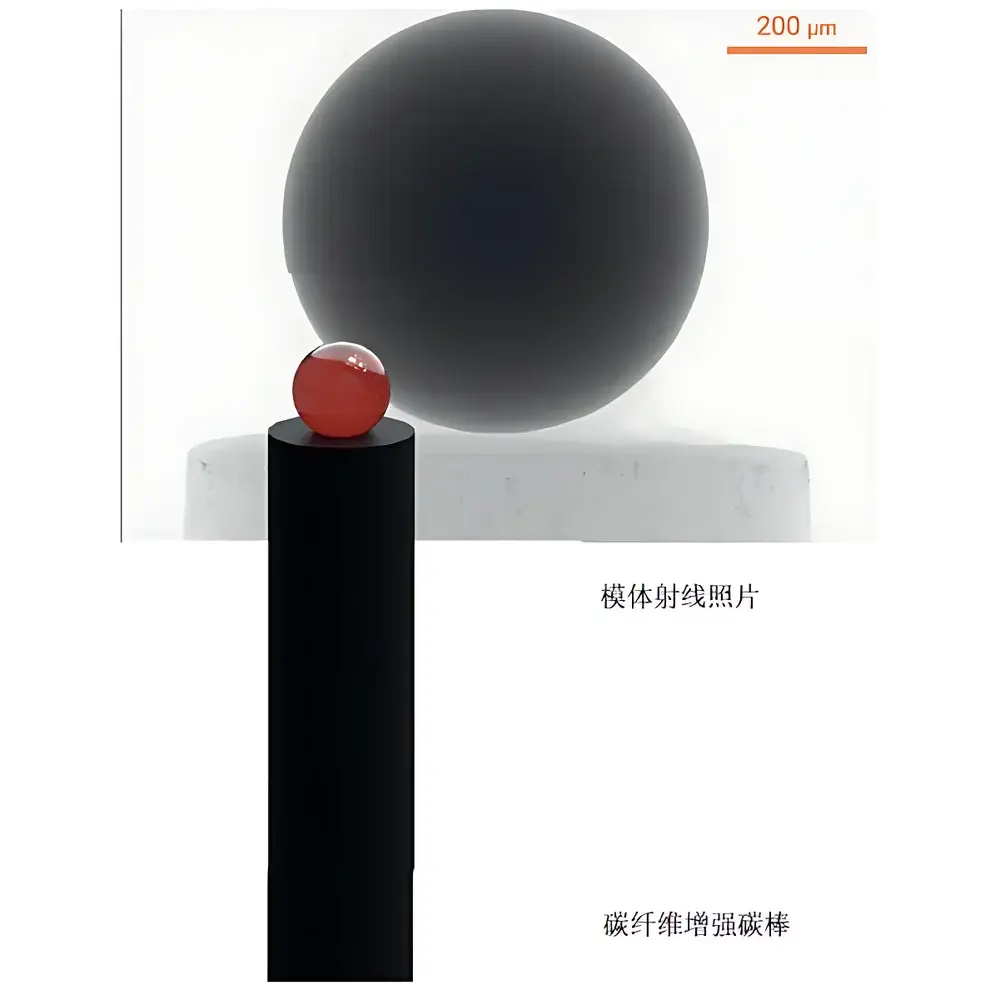
CactuX Spirit Resolution Micro- and Nano-CT Spatial Resolution Test Phantom
| Brand | CactuX |
|---|---|
| Origin | Czech Republic |
| Model | Spirit Resolution |
| Component Type | Optical Calibration Phantom |
| Compliance | ASTM E1695-95 |
| Material | Synthetic Ruby & Carbon |
| Voxel Size Range | < 1 µm to > 10 µm |
| Ball Diameters | 0.5 / 1.0 / 2.5 / 5.0 mm |
| Maximum Feature Widths | 1.0 / 2.0 / 5.0 / 10.0 mm |
| Mounting Post Dimensions | Ø1.5 / Ø1.5 / Ø3.0 / Ø5.0 mm × 50.0 mm (L) each |
Overview
The CactuX Spirit Resolution Test Phantom is a metrologically traceable, high-precision calibration standard engineered for quantitative spatial resolution assessment in laboratory-based micro-computed tomography (µCT) and synchrotron or electron-beam nano-CT (nCT) systems. It operates on the principle of edge-spread function (ESF) and modulation transfer function (MTF) derivation via high-contrast, geometrically defined spherical features embedded in a low-scatter, dual-material matrix. Unlike generic line-pair or bar-pattern phantoms, the Spirit Resolution series employs spherically symmetric ruby and carbon elements—materials selected for their stable X-ray attenuation contrast across a broad energy range (5–120 keV), minimal beam hardening artifacts, and long-term dimensional stability under repeated irradiation. Each phantom variant is manufactured using ultra-precision diamond turning and coordinate-measuring machine (CMM)-verified metrology, ensuring certified feature tolerances ≤ ±0.25 µm for sub-micron CT validation workflows.
Key Features
- Four-tiered resolution verification scale: Covers voxel sizes from sub-micron (10 µm), enabling cross-platform performance benchmarking.
- Material-optimized contrast design: Synthetic ruby (Al₂O₃:Cr³⁺) provides high-Z, high-contrast edges; carbon rods serve as low-Z reference structures—enabling simultaneous evaluation of both high- and low-contrast detectability per ASTM E1695-95 Annex A2.
- Modular, rotationally symmetric mounting posts: Stainless-steel-compatible Ø1.5–5.0 mm cylindrical mounts with 50 mm length ensure rigid, repeatable positioning in standard CT sample stages without parasitic motion or tilt-induced blurring.
- No proprietary software dependency: Fully compatible with open-source (e.g., ImageJ/Fiji with MTF plugins) and commercial CT reconstruction platforms (VGStudio MAX, Dragonfly, Avizo, Thermo Scientific Amira).
- NIST-traceable dimensional certification: Each unit ships with a manufacturer’s calibration report referencing ISO/IEC 17025-accredited measurements, including certified sphere diameters, center-to-center spacing, and post concentricity.
Sample Compatibility & Compliance
The Spirit Resolution phantom is validated for use with polychromatic and monochromatic X-ray sources, including microfocus tube systems (≤5 µm focal spot), synchrotron beamlines (ID19, TOMCAT), and electron-beam nCT setups (e.g., Zeiss Xradia Ultra). Its physical footprint and material composition comply with ISO 15732:2022 (CT performance testing) and ASTM E1695-95 (Standard Test Method for Measurement of Computed Tomography (CT) System Performance). The phantom supports GLP-compliant validation protocols—including IQ/OQ/PQ documentation—and meets essential requirements for FDA-regulated preclinical imaging studies where spatial fidelity must be auditable per 21 CFR Part 11 data integrity standards.
Software & Data Management
No dedicated driver or firmware is required. Raw projection or reconstructed volume data are processed using standard image analysis pipelines. Recommended workflows include: (1) ROI extraction around each sphere pair; (2) line-profile generation perpendicular to the sphere tangent; (3) ESF → LSF → MTF computation via Fourier transform; (4) reporting of limiting resolution (10% MTF cutoff) and full-width-at-half-maximum (FWHM) of point-spread function. All outputs are exportable in CSV, TIFF, or NIfTI formats. Audit trails, user annotations, and version-controlled processing scripts can be integrated into ELN/LIMS environments supporting ALCOA+ principles.
Applications
- Preventive maintenance validation: Routine monitoring of focal spot drift, detector pixel response non-uniformity, and mechanical stage repeatability.
- Multi-institutional study harmonization: Enables cross-laboratory resolution normalization for longitudinal bone microarchitecture or battery electrode porosity studies.
- Algorithm benchmarking: Ground-truth reference for evaluating iterative reconstruction (SART, MBIR), deep-learning denoising (RED-CNN, U-Net variants), and phase-contrast enhancement techniques.
- Regulatory submission support: Provides objective, standards-aligned evidence for spatial resolution claims in ISO 13485 quality dossiers or FDA 510(k) technical files.
- Education & training: Used in university-level medical physics and materials science labs to teach CT metrology fundamentals and uncertainty propagation in volumetric imaging.
FAQ
Can the Spirit Resolution phantom be used for phase-contrast CT?
Yes—its sharp ruby-carbon interfaces generate strong edge-enhancement signals under propagation-based or grating-based phase-contrast modalities, provided the setup maintains sufficient coherence.
Is sterilization or cleaning required before use?
No. Synthetic ruby and carbon are chemically inert; wipe only with lint-free isopropanol cloth if surface particulates are present.
Does it require recalibration over time?
No—material aging effects are negligible within typical lab lifetimes (≥10 years); however, annual verification against a reference standard is recommended for GMP environments.
Can I customize the sphere arrangement or material composition?
CactuX offers OEM customization under NDA, including tungsten-ruby hybrids for higher-energy applications (>150 keV) or additively manufactured polymer variants for dose-sensitive biological samples.
How does it differ from the older Spirit 2.0 phantom series?
Spirit Resolution introduces tighter CMM-certified tolerances (±0.25 µm vs. ±0.5 µm), expanded low-voxel-size coverage down to 0.3 µm, and dual-material alignment verification not available in prior generations.




