
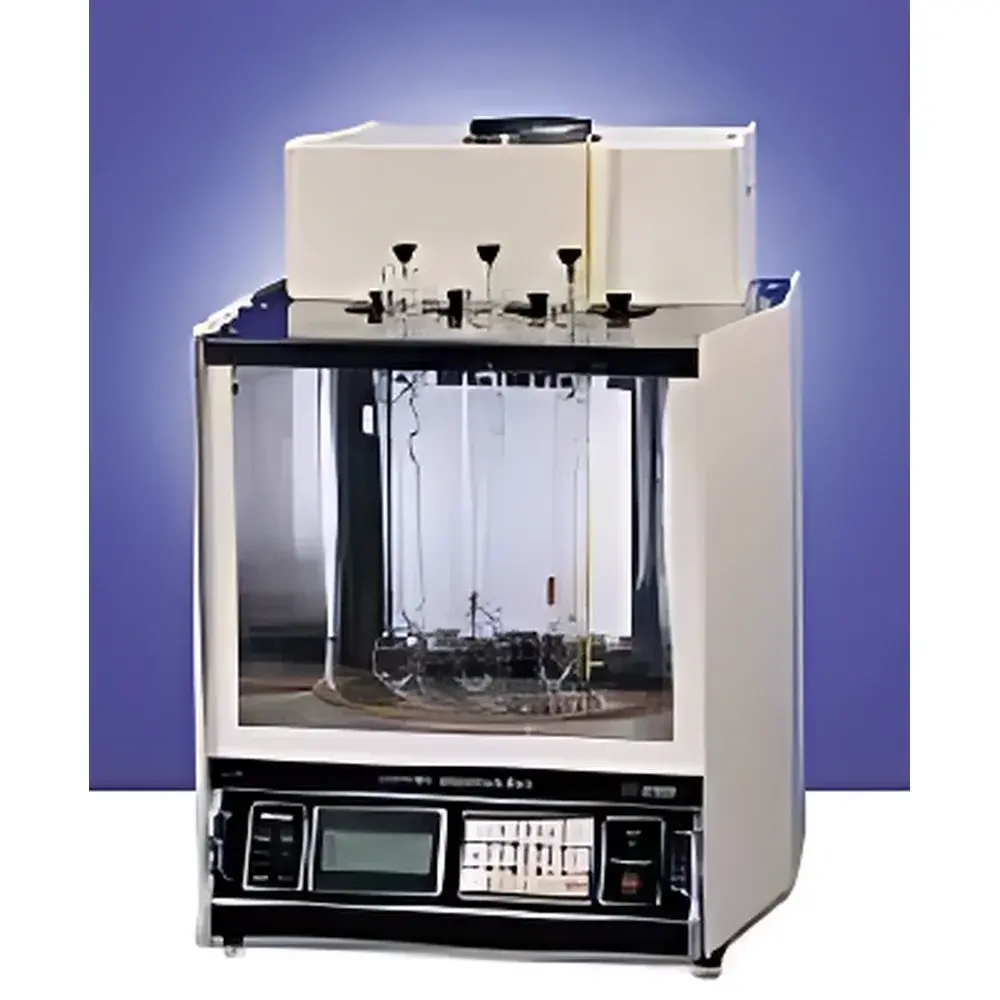
CANNON CT-2000F Constant-Temperature Bath for Capillary Viscometry
| Brand | CANNON |
|---|---|
| Origin | USA |
| Model | CT-2000F |
| Instrument Type | Fixed-Position Constant-Temperature Bath |
| Application | Capillary Viscometry |
| Temperature Range | 10 °C to 100 °C |
| Temperature Resolution | 0.01 °C |
| Temperature Accuracy | ±0.01 °C |
| Bath Capacity | 17 L |
| Power Supply | 240 V, 50/60 Hz, 1400 W |
| Dimensions (W×D×H) | 438 mm × 464 mm × 584 mm |
| Net Weight | 51.4 kg |
| Compliance | ASTM D445, ISO 3104 |
Overview
The CANNON CT-2000F Constant-Temperature Bath is an engineered thermal platform designed specifically for high-precision kinematic viscosity measurements using glass capillary viscometers—most notably Ubbelohde, Cannon-Fenske, and Ostwald types. It operates on the principle of maintaining a thermally stable, optically transparent fluid medium (typically silicone oil or water) at a rigorously controlled temperature, enabling accurate time-of-flow determinations in accordance with standardized capillary viscometry protocols. The bath’s core function is to eliminate thermal gradients across the viscometer column, thereby ensuring reproducible measurement conditions required by regulatory and quality control frameworks. Its microprocessor-based temperature regulation system delivers stability within ±0.01 °C over the operational range of 10 °C to 100 °C—fully satisfying the stringent thermal uniformity requirements of ASTM D445 and ISO 3104 for kinematic viscosity determination in petroleum products, lubricants, polymers, and industrial fluids.
Key Features
- Microprocessor-controlled temperature regulation with dual digital display: setpoint and real-time bath temperature shown simultaneously on a four-line LCD interface.
- High-resolution temperature control (0.01 °C resolution) and certified accuracy (±0.01 °C), validated across the full 10–100 °C range.
- Optimized optical design: 300 mm diameter × 300 mm height borosilicate glass bath vessel with integrated stainless-steel baffle for consistent background contrast and unobstructed visual alignment of capillary columns.
- Dual fluorescent lighting system (one tube per side) provides glare-free, uniform illumination—critical for manual timing and automated video-based flow detection.
- Seven standardized 51 mm-diameter ports for viscometer mounting plus two dedicated ports for reference thermometers; custom port configurations available upon order.
- Triple-layer safety architecture: (1) dual redundant thermistors for overtemperature cutoff, (2) open-circuit protection on primary sensor, and (3) liquid-level interlock that prevents heater activation unless minimum fill volume is detected.
- Full compliance with electrical safety standards (UL/CSA-listed components) and electromagnetic compatibility (EMC) directives for laboratory environments.
Sample Compatibility & Compliance
The CT-2000F is compatible with all standard ASTM- and ISO-compliant glass capillary viscometers, including but not limited to ASTM D445-conforming Ubbelohde viscometers (e.g., Cannon 50, 100, 200 series), Cannon-Fenske routine viscometers, and suspended-level viscometers used in refinery QC labs. It supports both manual and automated timing workflows. All wetted parts—including bath vessel, baffle, and port collars—are constructed from electropolished 316 stainless steel to resist corrosion from organic solvents, hydrocarbons, and high-temperature silicone oils. The unit meets the thermal uniformity, stability, and calibration traceability criteria defined in ASTM D445 Annex A1 and ISO 3104 Clause 6. It is routinely deployed in GLP-compliant laboratories and supports audit-ready documentation when integrated with validated data acquisition systems.
Software & Data Management
The CT-2000F features RS-232 and RS-485 serial interfaces for bidirectional communication with external PCs or LIMS platforms. These ports enable remote temperature setpoint adjustment, real-time temperature logging, and synchronization with automated viscometer timers or image-analysis software. Firmware supports ASCII command protocol for integration into custom LabVIEW, Python, or MATLAB control environments. While the instrument itself does not include embedded data storage, its communication architecture facilitates full 21 CFR Part 11 compliance when paired with validated third-party software—enabling electronic signatures, audit trails, and user-access controls for regulated pharmaceutical or fuel testing applications.
Applications
- Kinematic viscosity testing of base oils, finished lubricants, and aviation fuels per ASTM D445, IP 71, and ISO 3104.
- Quality assurance in polymer solution characterization (e.g., PVC, PET, polyacrylates) where solvent viscosity correlates directly with molecular weight distribution.
- Refinery process control for distillate fractions, residual fuels, and bio-diesel blends requiring repeatable low-uncertainty viscosity data.
- Research-grade rheological screening of Newtonian and near-Newtonian fluids where capillary methods remain the metrological reference.
- Calibration verification of digital viscometers and rotational rheometers using certified reference oils traceable to NIST SRMs.
FAQ
What temperature calibration standards are supported?
The CT-2000F accepts user-input correction offsets for mercury-in-glass or platinum resistance thermometers, stored in non-volatile memory for traceable recalibration.
Can the bath operate below ambient temperature?
Yes—when connected to an external chiller or tap-water cooling loop via the integrated coolant inlet/outlet ports, the system maintains stability down to 10 °C even in warm laboratory environments.
Is the unit suitable for use with halogenated solvents?
All wetted surfaces are 316 stainless steel and borosilicate glass; however, prolonged exposure to aggressive halogenated solvents (e.g., chloroform, carbon tetrachloride) is not recommended without prior compatibility validation.
Does the CT-2000F support multi-bath networked control?
Yes—RS-485 enables daisy-chained configuration of up to 32 units on a single bus, allowing centralized temperature scheduling and status monitoring via Modbus RTU protocol.
What maintenance intervals are recommended for long-term accuracy?
Annual verification of temperature uniformity (per ASTM D445 Appendix X2) and biannual cleaning of heating elements and coolant passages are advised; no consumable parts require replacement under normal operation.



