
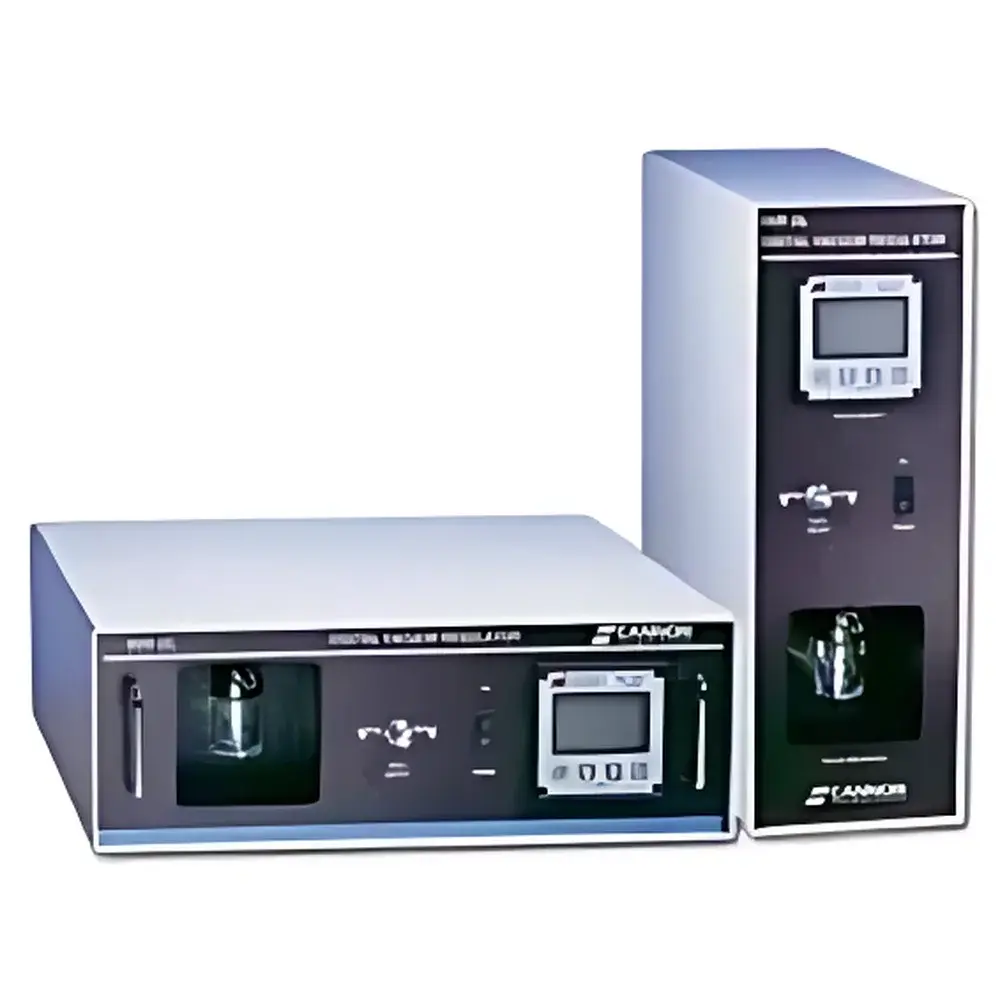
CANNON DVR-1000 Digital Vacuum Viscometer
| Brand | CANNON |
|---|---|
| Origin | USA |
| Model | DVR-1000 |
| Instrument Type | Fixed-Position Vacuum Viscometer |
| Operating Temperature Range | 0–40 °C |
| Vacuum Accuracy | ±0.5 mmHg at 300 mmHg setpoint |
| Compliance | ASTM D2171 |
| Display | Digital LED |
| Control Interface | Front-panel membrane keypad |
| Sensing Element | Solid-state pressure transducer (mercury-free) |
| Application Focus | Bitumen and asphalt viscosity testing under controlled vacuum |
Overview
The CANNON DVR-1000 Digital Vacuum Viscometer is a precision-engineered, fixed-position instrument designed specifically for determining the kinematic viscosity of bituminous materials—including paving-grade asphalts and roofing bitumens—under standardized vacuum conditions. It operates on the principle of capillary flow under reduced pressure, in strict accordance with ASTM D2171, “Standard Test Method for Viscosity of Asphalts by Vacuum Capillary Viscometer.” Unlike conventional gravity-driven viscometers, the DVR-1000 applies a precisely regulated vacuum to accelerate fluid flow through calibrated glass capillaries, enabling reliable measurement of high-viscosity bitumen at elevated temperatures while minimizing thermal degradation and oxidation artifacts. Its solid-state vacuum control architecture eliminates mercury-based manometers, supporting modern laboratory safety protocols and regulatory compliance (e.g., RoHS, EPA mercury reduction guidelines). The system is optimized for use in asphalt QC laboratories, state DOT materials testing facilities, and independent pavement research centers where repeatability, traceability, and method adherence are critical.
Key Features
- Mercy-free solid-state vacuum regulation using a high-stability silicon piezoresistive transducer, delivering long-term drift <0.1 mmHg/month and eliminating calibration dependency on ambient barometric pressure.
- Digital LED display with intuitive front-panel membrane keypad for direct vacuum setpoint entry (default: 300 mmHg absolute), real-time vacuum readout, and unit toggle between mmHg and kPa.
- Integrated temperature monitoring interface compatible with ASTM D2171-specified water or silicone oil baths; supports external PT100 probe input for bath temperature validation and logging.
- Rigid aluminum chassis with vibration-dampened base plate and enclosed vacuum manifold, engineered for stable operation in shared lab environments with HVAC-induced pressure fluctuations.
- Pre-aligned capillary holder assembly accepting standard ASTM D2171 Ubbelohde-type viscometers (e.g., Cannon-Fenske Routine, Cannon-Manning) with quick-release clamping and optical centering guides.
- No internal moving parts beyond solenoid valves; maintenance intervals exceed 10,000 operational cycles per valve, reducing downtime and technician intervention.
Sample Compatibility & Compliance
The DVR-1000 is validated exclusively for Newtonian and near-Newtonian bituminous binders within the kinematic viscosity range of 100–100,000 mm²/s (cSt) when used with appropriate capillary viscometers and ASTM D2171-compliant test temperatures (typically 60 °C, 135 °C, or 165 °C). It is not intended for polymer-modified asphalts requiring shear-rate-dependent analysis or non-Newtonian rheological characterization. The instrument meets all mechanical, vacuum stability, and timing requirements specified in ASTM D2171 Section 7 (Apparatus) and Section 9 (Procedure), including vacuum hold tolerance (300 ± 0.5 mmHg), pressure decay limit (<0.5 mmHg over 60 s), and capillary immersion depth control. It supports GLP documentation workflows via optional RS-232 output for timestamped vacuum and temperature event logging into LIMS or ELN systems.
Software & Data Management
The DVR-1000 operates as a standalone hardware platform without embedded firmware-based data storage. However, its analog vacuum output (0–5 V DC proportional to absolute pressure) and TTL-compatible timing pulse output (synchronized with flow initiation) enable seamless integration with third-party data acquisition systems (e.g., LabVIEW, MATLAB, or custom PLC controllers). When paired with CANNON’s optional DVR-Link interface module, users gain access to ASCII-formatted serial telemetry including vacuum setpoint, actual pressure (mmHg), elapsed flow time (ms), and status flags—formatted for direct ingestion into CSV or SQL databases. All digital I/O signals comply with IEC 61000-4-5 surge immunity standards and support FDA 21 CFR Part 11 audit-trail readiness when configured with validated timestamping and user authentication layers in host software.
Applications
- Quality control of virgin and recycled asphalt binders per AASHTO M 226 and ASTM D2171 specifications.
- Viscosity grading of Performance Graded (PG) asphalt binders during production certification and contract acceptance testing.
- Research evaluation of oxidative aging effects (e.g., RTFO and PAV conditioning) on binder flow behavior under vacuum.
- Calibration verification of capillary viscometers using NIST-traceable reference oils under vacuum-controlled conditions.
- Supporting ASTM D7497 (viscosity of warm-mix asphalt additives) when adapted with low-temperature bath configurations.
FAQ
Does the DVR-1000 include a built-in temperature bath or heating system?
No—the DVR-1000 is a vacuum control and measurement subsystem only. Users must supply an externally calibrated, thermostatically controlled bath (water or silicone oil) meeting ASTM D2171 temperature uniformity and stability requirements.
Can the DVR-1000 be used with non-ASTM capillary viscometers?
Only ASTM D2171-specified capillary types (Ubbelohde geometry, certified calibration constants) are supported. Use of non-compliant viscometers invalidates ASTM conformance and compromises measurement traceability.
Is vacuum calibration traceable to NIST standards?
Yes—CANNON provides optional factory calibration certificates traceable to NIST Standard Reference Material (SRM) 2190a (vacuum gauge calibration kit) upon request, with uncertainty budgets compliant with ISO/IEC 17025.
What maintenance is required for long-term reliability?
Annual verification of vacuum transducer linearity and zero offset is recommended; no routine lubrication or seal replacement is needed due to solid-state design and sealed solenoid valves.
Does the instrument support automated pass/fail reporting against specification limits?
Not natively—but when integrated with validated third-party software (e.g., WinWedge or custom Python-based QA modules), real-time pass/fail logic based on ASTM D2171 tolerances can be implemented and logged with electronic signatures.



