
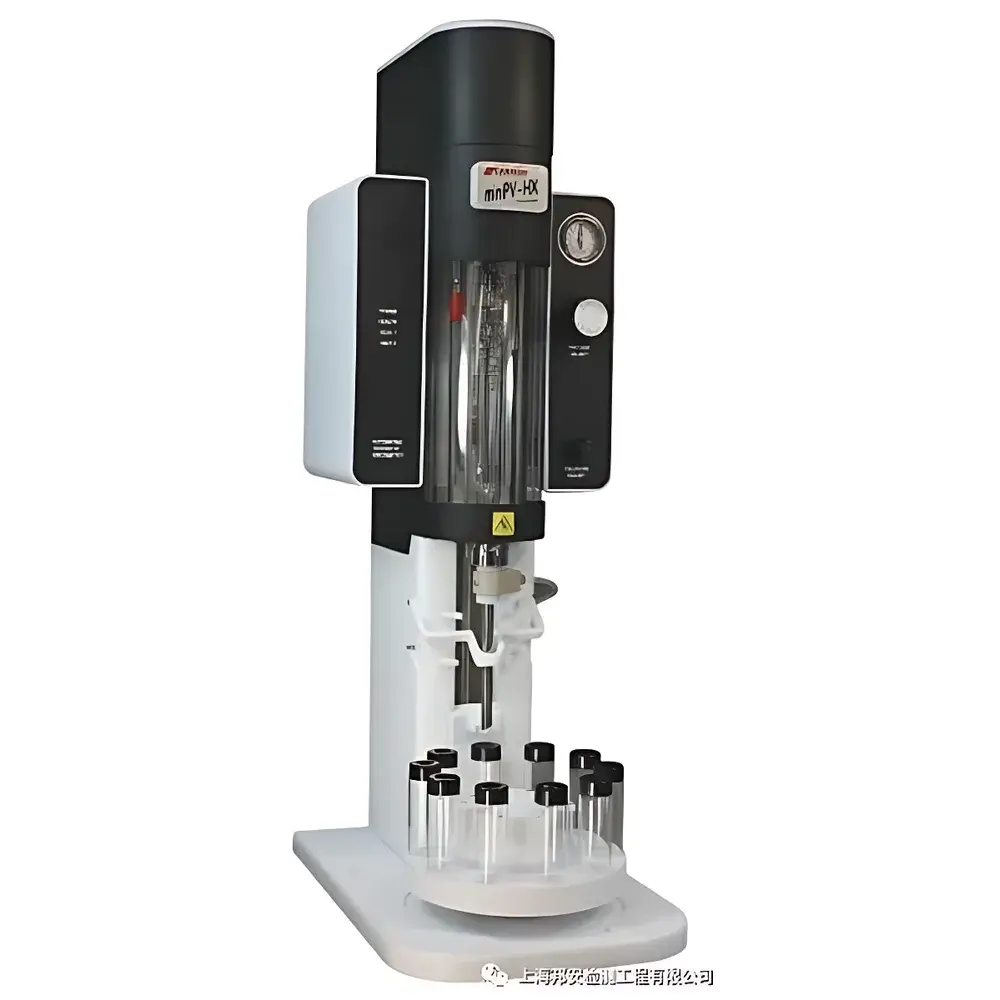
CANNON miniPV-HX Polymer Dilute Solution Viscometer
| Brand | CANNON |
|---|---|
| Origin | USA |
| Model | miniPV-HX |
| Instrument Type | Capillary Viscometer (Ubbelohde-type, modified) |
| Mounting | Benchtop Fixed System |
| Operating Environment | Ambient Temperature |
| Viscosity Range | 0.3–1,200 mm²/s (cSt) |
| Temperature Range | 15–100 °C |
| Temperature Resolution | 0.001 °C |
| Temperature Accuracy | ±0.01 °C |
| Flow Time Resolution | 0.01 s |
| Sample Volume | ~15 mL |
| Sample Capacity | 10-position autosampler |
| Cleaning | Dual-solvent rinse + compressed-air drying |
| Thermal Control | Peltier-based cooling/heating (no external chiller required) |
Overview
The CANNON miniPV-HX is a precision benchtop capillary viscometer engineered for the accurate and reproducible measurement of intrinsic viscosity, relative viscosity, specific viscosity, and inherent viscosity of polymer dilute solutions. Based on the fundamental principle of Poiseuille flow through a calibrated Ubbelohde-type capillary tube, the instrument determines kinematic viscosity (ν, in mm²/s or cSt) by measuring the efflux time of a fixed volume of solution under gravity-driven laminar flow. Its design adheres to classical capillary viscometry theory—where ν = K·t (K = capillary constant; t = efflux time)—and integrates modern thermal control and automation to meet stringent regulatory and methodological requirements for polymer characterization in QC, R&D, and regulatory submission laboratories.
Key Features
- Modified Ubbelohde capillary geometry optimized for polymer solution rheology, minimizing wall effects and ensuring first-order Newtonian behavior across the specified viscosity range (0.3–1,200 cSt).
- Peltier-based temperature regulation system enabling precise, drift-free control from 15 °C to 100 °C with ±0.01 °C accuracy and 0.001 °C resolution—critical for temperature-sensitive polymers and high-precision Mark–Houwink coefficient determination.
- 10-position automated sample carousel reduces manual handling, improves inter-operator reproducibility, and minimizes exposure to hazardous solvents (e.g., phenol/o-chlorophenol, trifluoroacetic acid, hexafluoroisopropanol).
- Dual-solvent cleaning protocol followed by compressed-air drying ensures capillary bore integrity and eliminates carryover between measurements—essential for multi-solvent workflows and trace-level polymer analysis.
- Benchtop footprint comparable to an analytical balance (~30 × 40 × 45 cm), facilitating integration into space-constrained labs without compromising thermal stability or mechanical isolation.
- Gravity-driven flow path with optical detection ensures compliance with ASTM D445, ISO 3104, and USP , eliminating pump-induced shear artifacts common in pressurized systems.
Sample Compatibility & Compliance
The miniPV-HX supports a broad spectrum of polymer–solvent systems, including but not limited to polystyrene in toluene, polyethylene oxide in water, polyacrylonitrile in DMF, cellulose derivatives in cupriethylenediamine (CED), and poly(lactic acid) in chloroform. It is validated for use with aggressive media such as concentrated sulfuric acid (ASTM D1243), hydrochloric acid solutions (ASTM D4243), and halogenated phenols (ISO 1628-1/3). The instrument meets or exceeds requirements for ASTM D2857 (intrinsic viscosity of poly(vinyl chloride)), ISO 1628 (generic polymer series), TAPPI T230 (pulp viscosity), SCAN-CM 15:99 (cellulose), and PAPTAC G.24P (kraft pulp). All thermal and timing parameters are traceable to NIST-certified references and support GLP/GMP audit readiness.
Software & Data Management
VISCPRO II® software provides full instrument control, real-time efflux monitoring, automatic viscosity calculation (including Huggins and Kraemer linearizations), and export of raw timing data with metadata (temperature, bath ID, operator, timestamp). It supports 21 CFR Part 11-compliant user authentication, electronic signatures, and immutable audit trails. Calculated results include relative viscosity (ηrel), specific viscosity (ηsp), inherent viscosity ([η]inh), and intrinsic viscosity ([η]) via single-point or multi-concentration extrapolation. Data files conform to ASTM E1447 and ISO/IEC 17025 reporting standards and export natively to CSV, PDF, and LIMS-compatible XML formats.
Applications
- Quality control of synthetic polymers (e.g., PET, nylon, ABS) and biopolymers (e.g., alginate, chitosan, hyaluronic acid) during synthesis and post-processing.
- Determination of molecular weight distribution proxies via Mark–Houwink–Sakurada relationships in routine QC environments where SEC/GPC is impractical.
- Stability assessment of polymer solutions under thermal aging or solvent degradation protocols.
- Regulatory dossier preparation for pharmaceutical excipients (e.g., methylcellulose, hydroxypropyl methylcellulose) per USP and EP 2.2.33.
- Characterization of thermoplastic elastomers (TPEs), prepolymers, and reactive resins prior to crosslinking or extrusion.
FAQ
What capillary calibration standards are supported?
The miniPV-HX accepts certified glass capillaries traceable to NIST SRM 2782 (kinematic viscosity standards) and is compatible with CANNON’s proprietary K-factor kits for polystyrene/toluene and cellulose/CED systems.
Can the system operate below ambient temperature without external chillers?
Yes—the integrated Peltier module achieves stable operation down to 15 °C regardless of lab ambient conditions, eliminating dependency on recirculating chillers or ice baths.
Is VISCPRO II® validated for regulated environments?
Yes—software validation documentation (IQ/OQ/PQ protocols), change control logs, and 21 CFR Part 11 configuration reports are provided with each system.
How is capillary fouling mitigated during high-molecular-weight polymer testing?
The dual-solvent rinse cycle (e.g., primary solvent + low-boiling clearance solvent) combined with timed compressed-air purge removes residual polymer films and prevents buildup across >200 consecutive runs.
Does the instrument support multi-concentration viscosity series for intrinsic viscosity calculation?
Yes—VISCPRO II® automates sequential dilution-based measurements, performs Huggins and Kraemer plot fitting, and reports extrapolated [η] with confidence intervals per ISO 1628-1 Annex B.



