
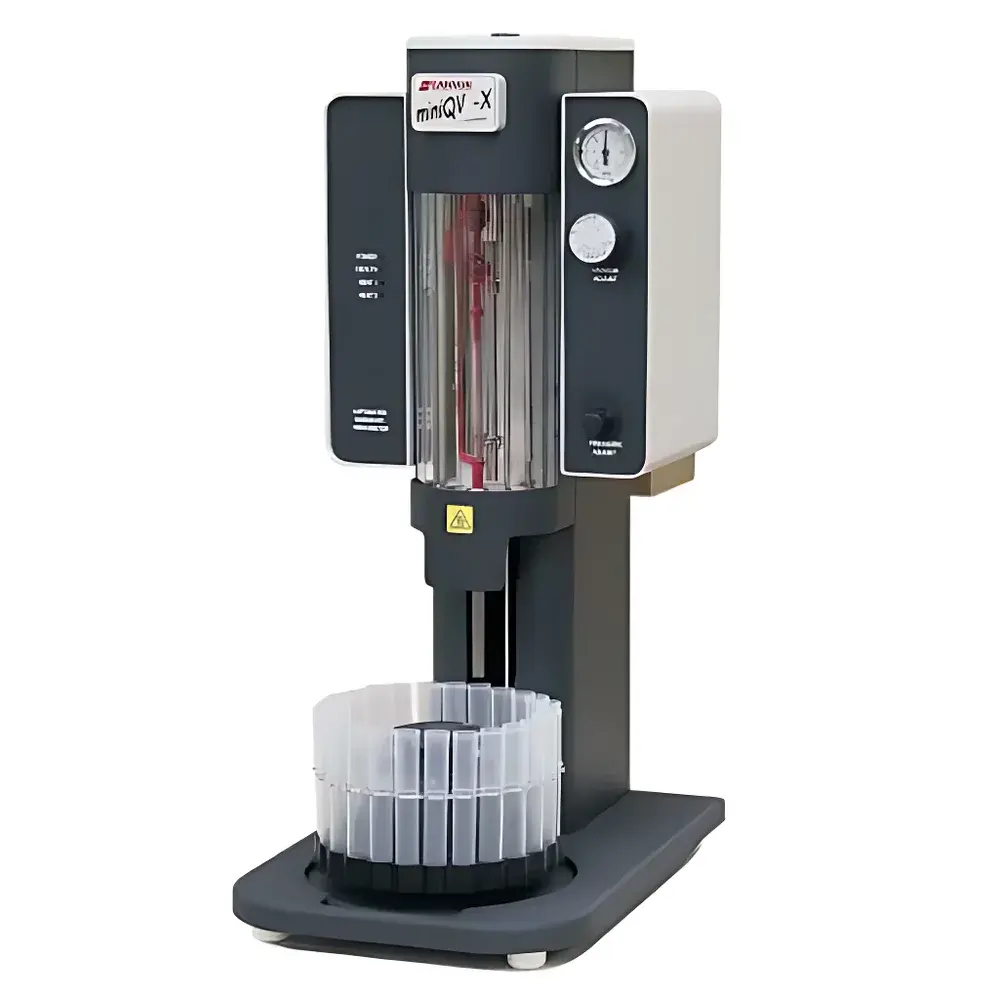
CANNON miniQV-X Automated Capillary Viscometer
| Brand | CANNON |
|---|---|
| Origin | USA |
| Model | miniQV-X |
| Instrument Type | Fixed-Position Capillary Viscometer |
| Operating Environment | Ambient Temperature |
| Viscosity Range | 0.5–10,000 mm²/s |
| Compliance | ASTM D445 |
| Sample Throughput | <3 min per sample |
| Automation | 25-position Rotating Autosampler with Integrated Cleaning & Drying |
| Configuration | Sample-to-Sample Mode |
| Category | Physical Property Testing Instrument / Capillary Viscometer |
Overview
The CANNON miniQV-X Automated Capillary Viscometer is an engineered solution for high-throughput, standardized kinematic viscosity measurement in routine quality control and condition monitoring laboratories. Based on the capillary flow principle—where kinematic viscosity (ν) is derived from the efflux time of a fixed volume of liquid under gravity through a calibrated glass capillary tube—the miniQV-X implements ASTM D445 “Standard Test Method for Kinematic Viscosity of Transparent and Opaque Liquids (and Calculation of Dynamic Viscosity)” with full procedural fidelity. Unlike rotational or vibrational viscometers, capillary-based systems provide traceable, primary-standard-level accuracy for Newtonian fluids such as mineral oils, synthetic lubricants, fuels, and solvents. The miniQV-X integrates gravimetric timing, temperature-controlled bath immersion (via external thermostatic bath, not built-in), and automated fluid handling to eliminate operator-dependent variability while maintaining strict adherence to the physical constraints defined in ASTM D445—particularly capillary selection, fill volume, meniscus detection, and timing window validation.
Key Features
- 25-position rotating autosampler enabling unattended batch analysis without manual vial repositioning or pipetting
- Integrated capillary cleaning and drying cycle using precision solvent flush and heated nitrogen purge—minimizing carryover and residue buildup between samples
- Sample-to-sample measurement architecture: each test runs independently with dedicated timing and thermal equilibration, ensuring no cross-contamination or thermal drift accumulation
- Compact footprint comparable to benchtop rotational viscometers—designed for integration into space-constrained QC labs or mobile service laboratories
- Full compliance with ASTM D445 operational requirements, including capillary calibration certificate support, efflux time validation windows, and temperature stability monitoring interfaces
- Robust mechanical architecture optimized for long-term reliability in high-cycle industrial environments, with sealed optical sensors and corrosion-resistant fluid pathways
Sample Compatibility & Compliance
The miniQV-X is validated for transparent and opaque Newtonian liquids within the specified kinematic viscosity range of 0.5–10,000 mm²/s at standard test temperatures (commonly 40 °C and 100 °C per ASTM D445). Compatible sample matrices include used engine oils, turbine oils, hydraulic fluids, diesel fuels, base stocks, and biodiesel blends. It supports Ubbelohde, Cannon-Fenske, and suspended-level capillaries (calibrated per ISO 3105 and ASTM D2515), with automatic capillary ID recognition via barcode or RFID (optional configuration). All measurement data logs include mandatory metadata per ASTM D445 Section 11: ambient barometric pressure, bath temperature (±0.01 °C), efflux time (±0.01 s), and capillary constant. The system architecture supports audit-ready documentation required under GLP and GMP frameworks, with optional 21 CFR Part 11-compliant electronic signatures and audit trail modules.
Software & Data Management
The miniQV-X operates with CANNON’s proprietary ViscoLink™ software, providing real-time efflux time visualization, automatic kinematic viscosity calculation (ν = c × t, where c is capillary constant and t is efflux time), and dynamic viscosity derivation (η = ν × ρ) when density input is provided. Data export conforms to ASTM E1382 and ISO/IEC 17025 reporting templates, generating CSV, PDF, and LIMS-compatible XML outputs. Software features include method templating (predefined temperature sets, capillary types, and pass/fail limits), trend analysis over time-series oil analysis (TOA) datasets, and automated flagging of outliers based on repeatability criteria (ASTM D445 Section 13: ±0.35% RSD for duplicate runs). Raw timing data and system event logs are stored with immutable timestamps, supporting forensic review during regulatory inspections.
Applications
- Used oil analysis (UOA) programs for predictive maintenance in power generation, marine propulsion, and heavy-duty fleet operations
- In-process viscosity verification in petroleum refining and specialty chemical manufacturing
- Quality release testing of new lubricants against OEM specifications (e.g., SAE J300, API categories)
- Research and development of viscosity index improvers and shear-stable formulations
- Third-party certification labs requiring ISO/IEC 17025-accredited kinematic viscosity measurements
- Regulatory compliance testing for fuel specifications (e.g., ASTM D975, EN 590)
FAQ
Does the miniQV-X include an integrated temperature bath?
No—the miniQV-X requires connection to an external thermostatically controlled bath (e.g., CANNON Model 700 Series or equivalent) meeting ASTM D445 temperature stability requirements (±0.02 °C at test setpoint).
Can it measure non-Newtonian fluids?
No—capillary viscometry per ASTM D445 assumes Newtonian behavior; non-Newtonian samples require rotational rheometry (e.g., Brookfield DVNext or TA Instruments AR-Series).
Is calibration traceable to NIST standards?
Yes—each supplied capillary includes a NIST-traceable calibration certificate issued by an A2LA-accredited laboratory, with documented uncertainty budgets per ISO/IEC 17025.
What maintenance intervals are recommended?
Capillary inspection every 500 runs; solvent filter replacement every 3 months; nitrogen dryer cartridge replacement every 6 months under continuous operation.
Does the system support remote diagnostics or service access?
Yes—ViscoLink™ includes secure remote desktop capability for CANNON Field Service Engineers, enabled only via customer-initiated, time-limited authentication tokens.



