
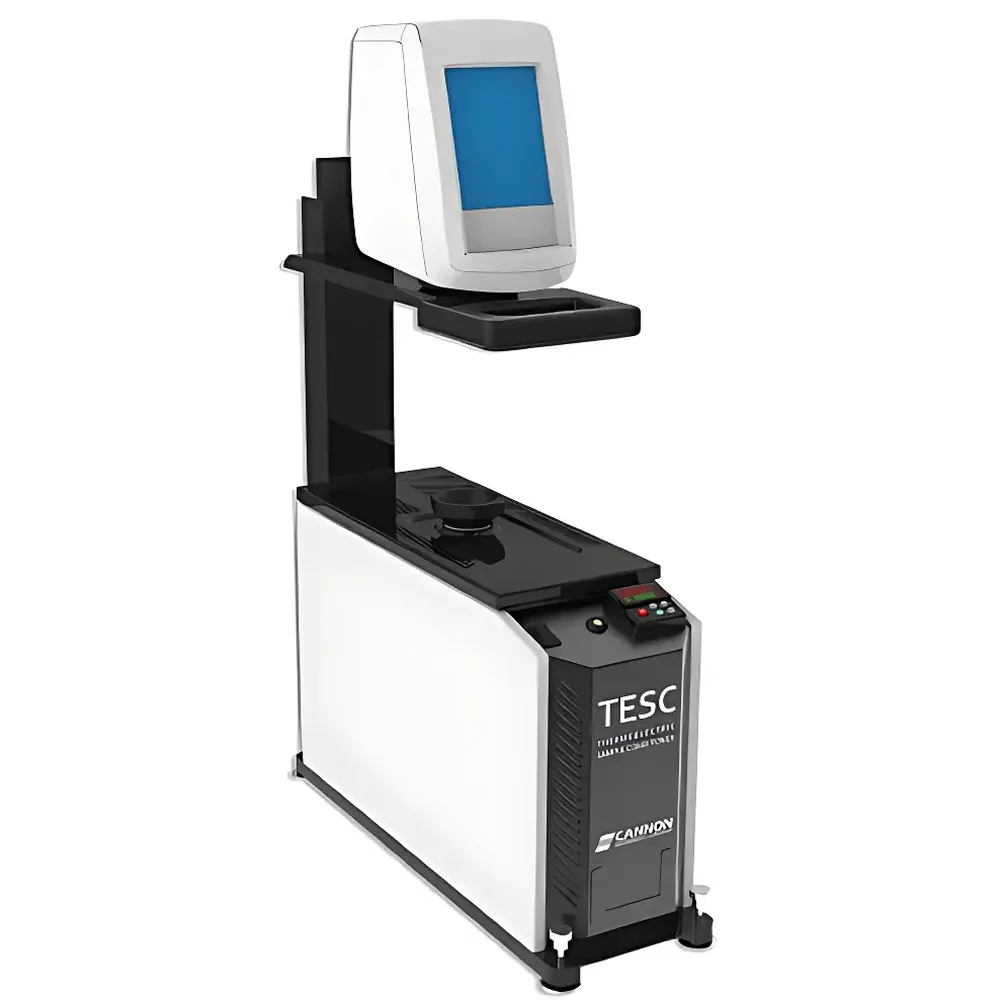
Cannon TESC Automated Low-Temperature Brookfield Viscometer
| Brand | Cannon |
|---|---|
| Origin | USA |
| Model | TESC |
| Instrument Type | Rotational Viscometer (Fixed-Base, Benchtop) |
| Viscosity Range | 0.1–10,000 mPa·s |
| Temperature Range | −40 °C to +90 °C |
| Temperature Resolution | 0.1 °C |
| Temperature Accuracy | ±0.1 °C |
| Compliance | ASTM D2983, GB/T 11145 |
| Cooling Method | Solid-State Thermoelectric (Peltier) |
| Rotor Adjustment | Motorized, Tool-Free |
| Footprint | Compact, Multi-Unit Stackable |
Overview
The Cannon TESC Automated Low-Temperature Brookfield Viscometer is an engineered solution for precise, reproducible viscosity measurement of lubricants, base oils, and functional fluids under rigorously controlled thermal conditions. Based on the well-established cone-and-plate and spindle-based rotational viscometry principle—governed by Newtonian and non-Newtonian shear stress/strain rate relationships—the TESC integrates high-fidelity thermoelectric (Peltier) cooling and heating with closed-loop digital temperature regulation. Unlike conventional bath-based systems, the TESC eliminates external coolant circulation, thermal lag, and spatial gradients by embedding temperature control directly within the instrument’s sample chamber. This architecture enables stable, uniform thermal equilibration across the full operational range of −40 °C to +90 °C—critical for low-temperature pumpability testing, pour point correlation, and cold-cranking simulation per ASTM D2983 and GB/T 11145.
Key Features
- Integrated solid-state thermoelectric temperature control delivering ±0.1 °C accuracy and 0.1 °C resolution across the entire −40 °C to +90 °C range
- Automated thermal profiling: pre-cool, isothermal hold, ramp, and post-test warm-up sequences programmable via embedded controller
- Motorized, tool-free spindle selection and insertion—eliminating manual alignment errors and reducing operator intervention
- Benchtop-fixed mechanical design with rigid torque-sensing shaft and low-inertia drive system optimized for high signal-to-noise ratio at low shear rates
- Compact footprint (W × D × H: 320 × 360 × 410 mm) enabling multi-unit deployment on standard laboratory benches without shared thermal cross-talk
- Compliance-ready architecture: audit trail logging, user access levels, and timestamped parameter recording aligned with GLP/GMP documentation requirements
Sample Compatibility & Compliance
The TESC accommodates standard Brookfield-compatible spindles (e.g., LV, RV, HA, HB series) and optional cone-plate geometries for structured fluid characterization. It supports sample volumes from 0.5 mL (micro-spindle) to 20 mL (standard cylindrical cup), with integrated sample cup retention and anti-vibration mounting. All thermal and rotational protocols adhere strictly to ASTM D2983 “Standard Test Method for Low-Temperature Viscosity of Lubricants Measured by Brookfield Viscometer” and its harmonized Chinese counterpart GB/T 11145. The system’s temperature stability profile—verified per ISO 17025 calibration practices—ensures traceable conformity for regulatory submissions, OEM specification validation, and internal QC release testing.
Software & Data Management
Control and data acquisition are managed through Cannon’s TESC Control Suite—a Windows-based application supporting both standalone operation and networked deployment. The software provides real-time viscosity vs. temperature curve generation, automated pass/fail evaluation against user-defined specification limits, and export of raw torque, speed, temperature, and time-stamped datasets in CSV and ASTM E1382-compliant formats. Audit trail functionality records all parameter changes, user logins, calibration events, and test executions—including IP address and workstation ID where deployed in enterprise environments. Full compatibility with FDA 21 CFR Part 11 is achieved via electronic signature workflows, role-based permissions, and immutable data archiving options.
Applications
- Low-temperature viscosity grading of engine oils (SAE J300), gear oils, and hydraulic fluids
- Pumpability assessment of multigrade lubricants during cold-start simulation
- Quality control of synthetic esters, polyalphaolefins (PAO), and bio-based lubricants across wide thermal excursions
- R&D screening of viscosity index improvers (VII) and pour point depressants (PPD)
- Stability monitoring of greases and semi-solid formulations during thermal cycling
- Supporting ASTM D5293 (CCS), D4684 (MRF), and D6896 (HTHS) ancillary test preparation
FAQ
Does the TESC require external chiller or refrigerant lines?
No. The system uses self-contained Peltier modules with passive heat dissipation and optional forced-air cooling—no glycol loops, compressors, or hazardous refrigerants.
Can the TESC perform ASTM D2983-compliant tests without manual intervention?
Yes. Fully automated execution includes pre-cooling to target temperature, 2-hour thermal soak, viscosity measurement at specified shear rates, and auto-shutdown—all governed by ASTM D2983 Annex A1 logic.
Is calibration traceable to NIST standards?
Yes. Factory calibration includes NIST-traceable temperature sensors (PT100 Class A) and torque verification using certified reference oils (CRM-100, CRM-500, CRM-1000).
What spindle configurations are supported out-of-the-box?
Standard LV/RV/HA/HB spindles; optional SC4-18, CP-52, and UL adapter kits for small-volume or non-Newtonian samples.
How is data integrity maintained during long-duration low-temperature tests?
Continuous sensor health monitoring, redundant temperature feedback channels, and cyclic checksum validation ensure no data loss over 72+ hour continuous operation.



