
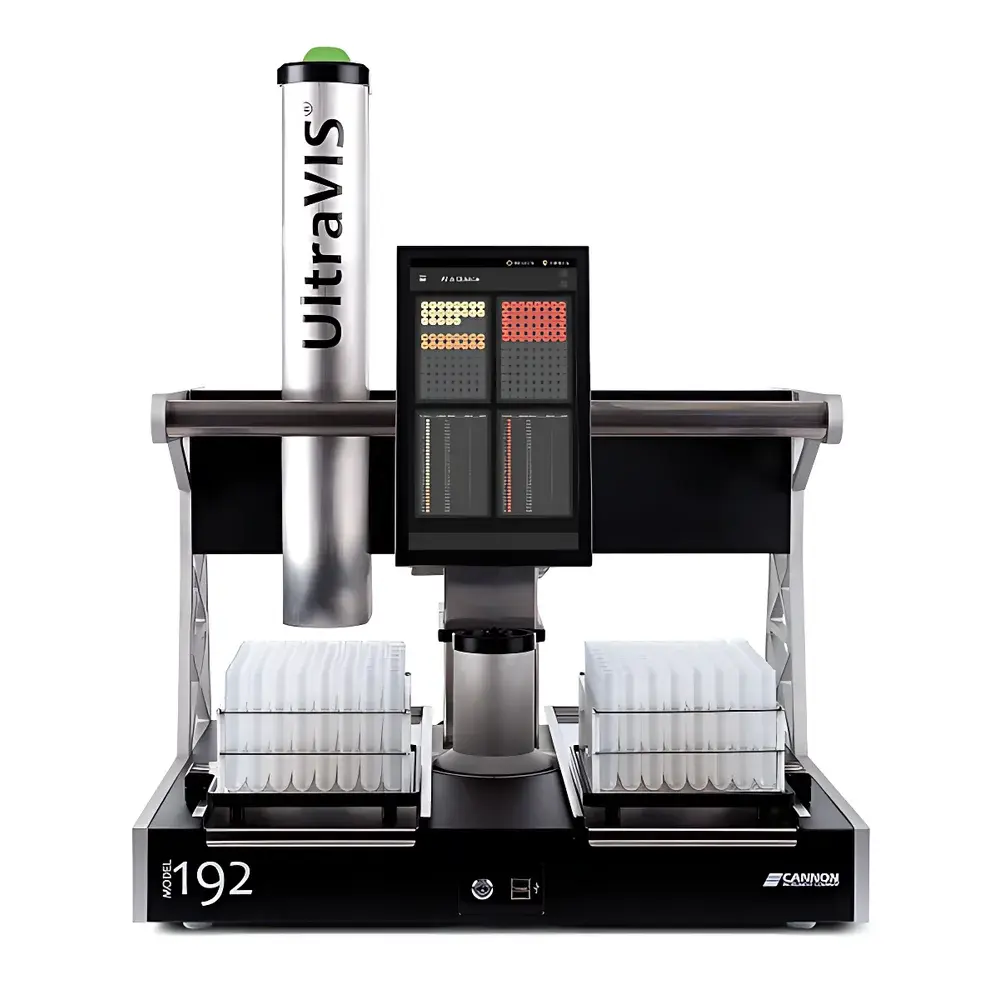
CANNON UltraVIS192 Solvent-Free Kinematic Viscometer
| Brand | CANNON |
|---|---|
| Origin | USA |
| Model | UltraVIS192 |
| Instrument Type | Capillary Viscometer (Fixed-Station) |
| Operating Environment | Ambient Temperature |
| Kinematic Viscosity Range | 5–50 mm²/s (cSt) @ 100 °C |
| Temperature Setpoints | 40 °C and 100 °C |
| Temperature Accuracy | ±0.01 °C |
| Temperature Resolution | ±0.01 °C |
| Sample Volume | 4–5 mL per test |
| Throughput | Up to 240 samples in 8 hours |
| Compliance | ASTM D445 |
| Control Interface | Touchscreen + PC (up to 4 units per host) |
| LIMS Integration | Supported |
| Sample Capacity | Dual 96-position removable sample trays (192 total) |
Overview
The CANNON UltraVIS192 is a fully automated, solvent-free kinematic viscometer engineered for high-throughput, precision measurement of transparent and low-viscosity liquids in accordance with ASTM D445—Standard Test Method for Kinematic Viscosity of Transparent and Opaque Liquids (and Calculation of Dynamic Viscosity). Unlike conventional Ubbelohde or Cannon-Fenske capillary viscometers requiring constant bath maintenance, solvent rinsing, and manual timing, the UltraVIS192 eliminates all external bath fluids and cleaning solvents through an integrated, thermostatically controlled air-jacketed capillary module. This design ensures stable thermal equilibrium, minimizes operator intervention, and removes risks associated with solvent handling, disposal, and contamination—making it ideal for regulated QC laboratories operating under GLP or GMP frameworks.
Key Features
- True solvent-free operation: No silicone oil, water baths, or organic rinse solvents required—reducing consumable costs, waste generation, and environmental compliance burden.
- Dual 96-position removable sample trays support unattended 192-sample batch processing; tray indexing and capillary priming are fully automated.
- High-precision temperature control at 40 °C and 100 °C with ±0.01 °C accuracy and resolution, validated per ASTM D445 Annex A1 requirements for thermal stability.
- Optical flow-time detection with LED illumination and photodiode sensing enables repeatable, operator-independent timing—critical for achieving <0.35% repeatability (as defined in ASTM D445 Section 9).
- Integrated touchscreen interface with guided workflow, real-time viscosity calculation, and on-device data review; supports multi-language UI (English, Spanish, German, Chinese).
- PC-based instrument manager software allows centralized control of up to four UltraVIS192 units simultaneously, with configurable audit trails, user access levels, and electronic signature support compliant with FDA 21 CFR Part 11.
Sample Compatibility & Compliance
The UltraVIS192 is optimized for kinematic viscosity determination of mineral oils, synthetic lubricants, base stocks, diesel fuels, jet fuels (e.g., Jet A-1), and other Newtonian or near-Newtonian transparent liquids within its specified range. It accommodates samples with viscosities from 5 mm²/s (cSt) to 300 mm²/s (cSt), depending on temperature setpoint. Each test requires only 4–5 mL of sample—minimizing material consumption for high-value or limited-availability fluids. The system meets ASTM D445 performance criteria for timing accuracy, temperature uniformity, and capillary calibration traceability. All temperature sensors are NIST-traceable, and capillary constants are certified per ISO 3104 and ASTM D2161 protocols. The instrument architecture supports full audit trail generation, metadata tagging (operator, timestamp, method ID), and raw flow-time export for third-party validation.
Software & Data Management
CANNON ViscoLink™ software provides comprehensive data acquisition, reporting, and integration capabilities. Raw flow times are automatically converted to kinematic viscosity using the calibrated capillary constant and temperature-corrected density (if provided). Reports conform to ASTM D445 formatting, including uncertainty estimation per ISO/IEC 17025 guidelines. Data export options include CSV, PDF, and XML formats compatible with enterprise LIMS platforms (e.g., LabWare, Thermo Fisher SampleManager, Siemens Opcenter). Role-based permissions, electronic signatures, and 21 CFR Part 11-compliant audit logs ensure regulatory readiness for pharmaceutical, aviation, and energy-sector applications. Optional IQ/OQ documentation packages are available for installation and operational qualification under GxP environments.
Applications
- Quality control of turbine oils, hydraulic fluids, and engine oils per OEM specifications (e.g., GEK 32568, SAE J183, ISO 3448).
- Batch release testing of aviation fuels (ASTM D1655 Annex A2) and marine distillate fuels (ISO 8217).
- Research and development of low-viscosity synthetic esters and polyalphaolefins (PAOs) where solvent carryover could compromise analytical integrity.
- Refinery process monitoring of naphtha fractions and light cycle oils where rapid turnaround and minimal sample volume are critical.
- Contract testing laboratories serving API, ASTM, and ISO-certified accreditation scopes requiring documented traceability and reproducibility.
FAQ
Does the UltraVIS192 require calibration with standard reference oils?
Yes—capillary calibration must be performed using NIST-traceable kinematic viscosity standards (e.g., Cannon Standard Reference Oils) per ASTM D445 Section 6. Calibration constants are stored per capillary module and recalled automatically during method execution.
Can the instrument handle opaque or particulate-containing samples?
No—the UltraVIS192 relies on optical flow-time detection and is designed exclusively for transparent, particle-free liquids. For opaque or suspended-phase samples, alternative methods such as rotational viscometry (ASTM D2983) or automated falling-ball viscometry should be considered.
Is remote monitoring supported?
Yes—ViscoLink™ includes secure HTTP-based remote status viewing and email/SNMP alerting for run completion, error conditions, or temperature deviation events.
What maintenance is required beyond routine capillary cleaning?
Capillaries are cleaned automatically using dry nitrogen purge between samples; no solvent flush is needed. Annual verification of temperature sensor accuracy and optical sensor alignment is recommended per ISO/IEC 17025 preventive maintenance schedules.
How is compliance with ISO/IEC 17025 addressed?
The UltraVIS192 supports full traceability via digital calibration records, instrument-specific metadata logging, uncertainty propagation in reports, and configurable electronic signatures—all documented in the optional GxP Compliance Package.



