
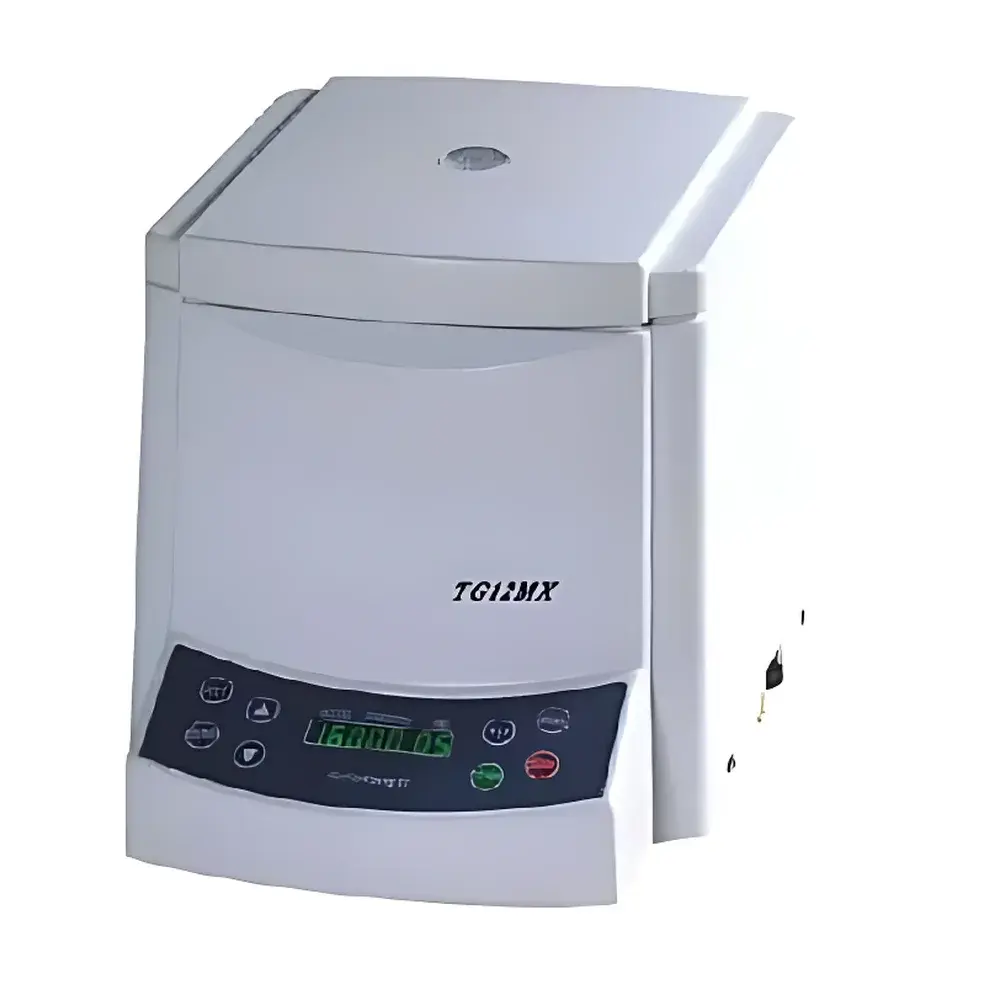
Capillary Blood Centrifuge TG12MX
| Origin | Shanghai, China |
|---|---|
| Manufacturer Type | Authorized Distributor |
| Origin Category | Domestic (PRC) |
| Model | TG12MX |
| Price | Upon Request |
| Max Speed | 12,000 rpm |
| Rotor Capacity | 24 capillary tubes |
| Timer Range | 0–99 min |
| Power Supply | AC 220 V, 50 Hz, 5 A |
| Dimensions (L×W×H) | 330 × 420 × 275 mm |
| Weight | 15 kg |
| Medical Device Registration Certificates | Xiangchang Yaoguanxie (Zhun) Zi 2003 No. 1410036–1410039 |
| Production Filing No. | Xiang Yaoguanxie Shengchan Bei 20030027 |
| ISO 9001 | 2000 Certified (Certificate No.: EWC61104Q) |
Overview
The Capillary Blood Centrifuge TG12MX is a precision-engineered benchtop centrifuge specifically designed for hematocrit (Hct) determination and micro-volume sample separation in clinical laboratories, point-of-care settings, and blood bank quality control environments. It operates on the principle of sedimentation-based separation under controlled centrifugal force, enabling rapid and reproducible stratification of whole blood into packed red blood cells (RBCs), white blood cells (WBCs)/platelets (buffy coat), and plasma within standardized capillary tubes. Its optimized rotor geometry and calibrated acceleration/deceleration profiles ensure consistent g-force delivery across all 24 positions—critical for achieving accurate hematocrit readings per CLSI EP5-A2 and ISO 15189:2022 requirements. The unit complies with IEC 61010-1:2010 safety standards for laboratory electrical equipment and incorporates fail-safe mechanical and electronic safeguards to maintain operational integrity during routine use.
Key Features
- Microprocessor-controlled operation with high-resolution digital display for real-time monitoring of speed, time, and remaining runtime
- Brushless DC motor delivering maintenance-free performance, low noise (<65 dB(A)), and extended service life
- Programmable protocol storage supporting up to 10 user-defined methods for repeatable workflow execution
- Electronically interlocked safety door with automatic rotor deceleration upon lid opening
- Dual-layer protection system: mechanical over-speed cutoff and electronic imbalance detection with auto-halt functionality
- Compact footprint (330 × 420 × 275 mm) suitable for laminar flow hoods, hematology workstations, or mobile diagnostic units
- CE-marked power supply interface compatible with standard 220 V / 50 Hz mains; includes surge and thermal overload protection
Sample Compatibility & Compliance
The TG12MX accommodates standard 75 mm or 100 mm heparinized or EDTA-coated capillary tubes (internal diameter: 1.0–1.2 mm), conforming to CLSI H26-A3 specifications for hematocrit measurement. It supports both sealed and open-end tube configurations and is validated for use with venous, capillary, and cord blood specimens. Regulatory documentation includes four valid Class II medical device registration certificates issued by the Hunan Provincial Medical Device Administration (registration numbers: Xiangchang Yaoguanxie (Zhun) Zi 2003 No. 1410036–1410039) and production filing authorization (Xiang Yaoguanxie Shengchan Bei 20030027). The device is manufactured under an ISO 9001:2000–certified quality management system (Certificate No.: EWC61104Q), ensuring traceability of components, calibration records, and final inspection reports. While not FDA 510(k)-cleared, its design aligns with essential principles outlined in FDA Guidance for Industry: Class II Special Controls Guidance Document: Hematocrit Analyzers (2018).
Software & Data Management
The TG12MX operates as a standalone instrument without proprietary software dependencies. All operational parameters are set directly via front-panel keypad input, eliminating driver installation or network connectivity requirements—ideal for GLP-regulated environments where software validation burdens must be minimized. Audit trails are maintained manually through operator logbooks referencing batch-specific run records (date, time, operator ID, tube lot number, observed hematocrit value). For laboratories implementing electronic lab notebooks (ELN) or LIS integration, timestamped analog output signals (optional RS-232 interface available upon request) can feed centrifugation event metadata—including start/stop times and actual achieved rpm—into compliant data acquisition systems meeting 21 CFR Part 11 requirements when paired with appropriate validation protocols.
Applications
- Determination of hematocrit (packed cell volume, PCV) in human whole blood per CLSI EP5-A2 and ISO 15189:2022
- Separation of micro-volume biological samples (≤100 µL) including serum, plasma, cerebrospinal fluid (CSF), and synovial fluid
- Pre-analytical processing for point-of-care coagulation testing (e.g., PT/INR, APTT) requiring platelet-poor plasma
- Quality assurance in blood donation centers for donor screening and component preparation verification
- Research applications involving small-animal blood sampling, neonatal diagnostics, and pediatric hematology workflows
- Calibration verification of automated hematocrit analyzers using reference centrifugation methodology
FAQ
What capillary tube dimensions are supported?
The TG12MX accepts standard hematocrit capillaries measuring 75 mm or 100 mm in length with internal diameters of 1.0–1.2 mm. Tubes must comply with CLSI H26-A3 dimensional tolerances.
Is the rotor autoclavable?
No—the aluminum rotor assembly is not designed for steam sterilization. Cleaning is performed using 70% ethanol or isopropyl alcohol wipes; avoid immersion or ultrasonic cleaning.
Does this model meet IVD regulatory requirements for EU markets?
The TG12MX holds Chinese Class II medical device registration but does not carry CE marking under IVDR 2017/746. Export to EU requires local authorized representative engagement and technical file adaptation.
Can the timer be paused mid-run?
No—once initiated, the programmed cycle executes to completion. Interruption requires manual stop and restart, resetting elapsed time.
What maintenance schedule is recommended?
Visual inspection of door latch integrity and rotor threads every 100 runs; full calibration verification annually or after any impact event, per manufacturer’s service manual (Revision 3.1, 2022).



