
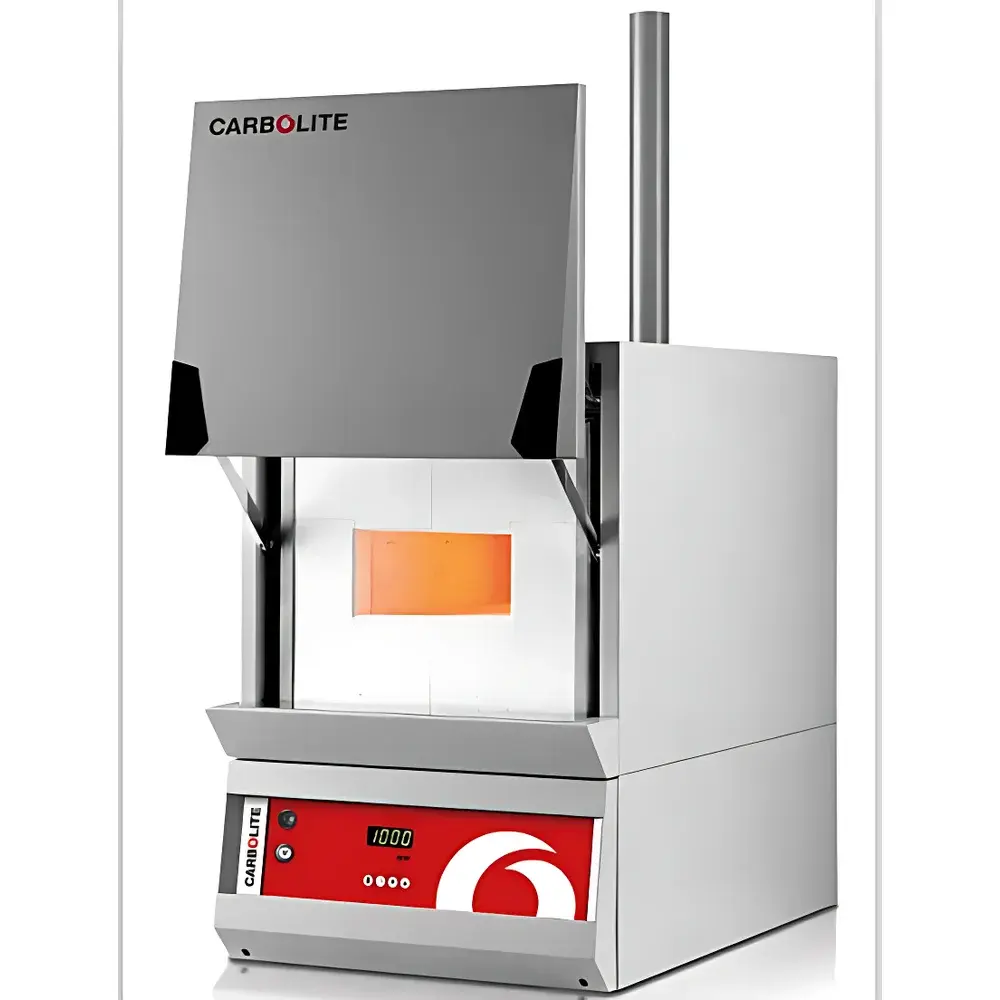
Carbolite Gero AAF 11/7/301 Ashing Furnace
| Brand | Carbolite Gero |
|---|---|
| Origin | United Kingdom |
| Instrument Type | Box-type Muffle Furnace |
| Maximum Temperature | 1200 °C |
| Temperature Uniformity | ±5 °C (at setpoint) |
| Rated Power | 7080 W |
| Heating Rate to Max Temp | ~70 min |
| Heating Method | Resistance Wire (NiCr Alloy) |
| Internal Chamber Dimensions | 235 × 196 × 400 mm (W × H × D) |
| Air Exchange Rate | 4–5 air changes per minute |
| Chamber Lining | Rigid Alumina Refractory Brick |
| Heating Element Protection | Silicon Carbide (SiC) Refractory Bricks |
| Compliance Standards | BS 1016-104.4:1998, ISO 1171:1997, ASTM D2361-02, ASTM D3174-04 |
Overview
The Carbolite Gero AAF 11/7/301 Ashing Furnace is a purpose-engineered laboratory muffle furnace designed for precise, reproducible high-temperature ashing of organic and carbonaceous materials. Operating on the principle of controlled oxidative combustion in a fully insulated, gas-flushed chamber, it delivers consistent thermal decomposition under defined airflow and temperature conditions. Unlike general-purpose box furnaces, the AAF series integrates a dedicated vertical chimney and calibrated inlet system to maintain a continuous, laminar air exchange—critical for complete oxidation of volatile residues and minimization of reductive charring. Its rigid alumina refractory lining and silicon carbide-protected heating elements ensure long-term stability in aggressive ashing environments, particularly during repeated exposure to halogenated organics, sulfates, or alkaline ash matrices.
Key Features
- Optimized combustion architecture: High-efficiency chimney design enables 4–5 complete air exchanges per minute, promoting stoichiometric oxygen supply and minimizing localized reducing zones.
- Precise thermal management: Pre-heated intake air enters the chamber at near-setpoint temperature, significantly improving axial and radial temperature uniformity (±5 °C across working volume).
- Chemically inert chamber: Dense, sintered alumina brick lining (Al2O3 ≥ 95%) resists acid/base attack and mechanical abrasion from crucible handling and ash residue buildup.
- Robust heating system: Nickel-chromium resistance wire elements embedded in silicon carbide refractory bricks provide corrosion resistance against sulfuric, phosphoric, and chloride vapors generated during coal, polymer, or food ashing.
- Low-profile cavity geometry: Reduced chamber height (196 mm) positions sample plane closer to active airflow, enhancing convective heat transfer and accelerating volatilization kinetics.
- High-capacity floor: Generous internal footprint (235 × 400 mm) accommodates multiple standard porcelain or platinum crucibles (e.g., 30–50 g samples per run), supporting throughput requirements in QC and regulatory testing labs.
Sample Compatibility & Compliance
The AAF 11/7/301 is validated for standardized ash content determination across diverse sample classes including coal and coke (ASTM D3174-04, ISO 1171:1997), plastics and polymers (ISO 3451-1), foodstuffs and feedstuffs (AOAC 942.05), and pharmaceutical excipients (USP ). Its stable 1200 °C operating envelope meets upper-temperature requirements for silica-rich or phosphate-based ash matrices. The furnace’s documented airflow rate, temperature uniformity profile, and thermal recovery time are traceable to UKAS-accredited calibration protocols. It supports GLP-compliant operation when paired with external data loggers meeting IEC 61000-4-30 Class A specifications and is routinely deployed in laboratories undergoing FDA 21 CFR Part 11 or ISO/IEC 17025 audits.
Software & Data Management
While the AAF 11/7/301 operates via an integrated PID controller with manual setpoint programming, its analog output (0–10 V or 4–20 mA) enables seamless integration into centralized lab monitoring systems (e.g., Siemens Desigo, Honeywell Experion PKS). Optional RS485 Modbus RTU interface allows connection to SCADA platforms for remote parameter logging, alarm triggering, and electronic batch record generation. When used with compliant third-party software (e.g., LabVIEW-based validation modules), the furnace supports full audit trail functionality—including operator ID, timestamped setpoint changes, dwell duration, and thermal ramp profiles—required for GMP documentation and regulatory submissions.
Applications
- Determination of total ash content in solid fuels per ASTM D3174 and ISO 1171
- Residue-on-ignition analysis for inorganic catalysts and ceramic precursors
- Preparation of ash for subsequent elemental analysis (ICP-OES, XRF)
- Thermal conditioning of quartz and porcelain crucibles prior to gravimetric analysis
- Controlled pyrolysis of biomass and waste-derived fuels under oxidizing atmosphere
- Validation of ash fusion temperatures in coal quality control workflows
FAQ
What standards does the AAF 11/7/301 comply with for ash content testing?
It is factory-validated to meet BS 1016-104.4:1998, ISO 1171:1997, ASTM D2361-02, and ASTM D3174-04 for method-specific thermal performance and airflow consistency.
Can the furnace be used for sulfur-resistant ashing of coal samples?
Yes—the silicon carbide refractory protection and alumina lining mitigate sulfate-induced degradation of heating elements and chamber integrity over extended cycles.
Is temperature uniformity verified across the entire working volume?
Yes; Carbolite Gero provides a certified temperature mapping report (9-point grid) demonstrating ≤ ±5 °C deviation at 1200 °C, measured per ASTM E220-19 Annex A3.
Does the unit support programmable multi-step heating profiles?
No—the base model features single-setpoint PID control; however, external programmable controllers (e.g., Eurotherm 2408) can be interfaced via analog input for complex ramp-soak-cool sequences.
What maintenance intervals are recommended for optimal airflow performance?
Chimney and inlet ducts should be inspected quarterly; refractory brick integrity and element resistance should be verified annually using a calibrated multimeter and visual inspection protocol per Carbolite Gero Service Manual Rev. 4.2.



