
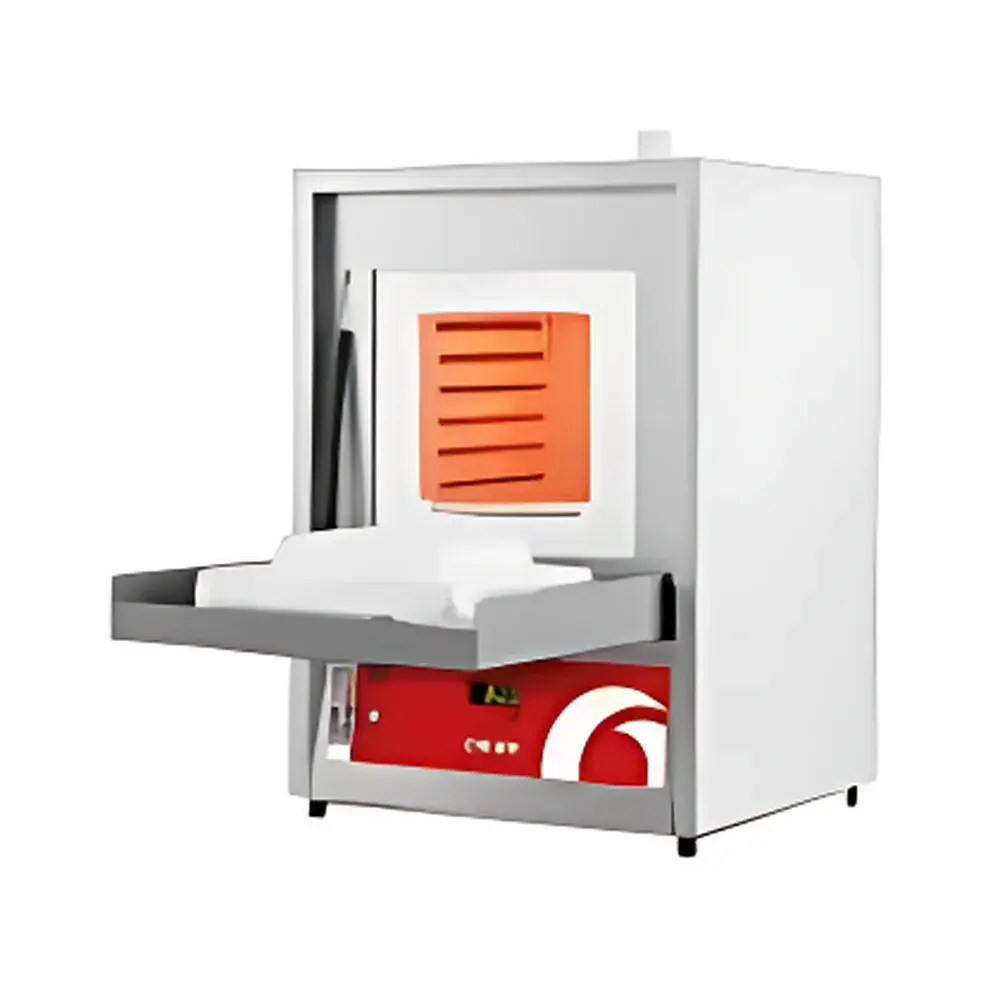
Carbolite Gero ELF Series Laboratory Box Furnace
| Brand | Carbolite Gero |
|---|---|
| Origin | Germany |
| Model | ELF |
| Type | Box Furnace |
| Maximum Operating Temperature | 1100 °C |
| Chamber Volumes | 6 L, 14 L, 23 L |
| Door Design | Top-hinged downward-opening (drop-down) door |
| Heating Architecture | Forced-air convection with optimized internal airflow |
| Insulation | Vacuum-formed low-thermal-mass ceramic fiber insulation |
| Hearth | Rigid high-purity alumina ceramic plate |
| Exhaust | Integrated top-mounted ceramic flue |
| Controller | PID301 single-segment programmable temperature controller with delay start and timer functions |
| Compliance | Designed to meet IEC 61000-6-3 (EMC) and IEC 61000-6-2 (immunity) |
Overview
The Carbolite Gero ELF Series is a precision-engineered laboratory box furnace designed for reproducible, stable thermal treatment in research, quality control, and routine analytical workflows. Based on Carbolite Gero’s decades of German engineering heritage in high-temperature instrumentation, the ELF platform employs a robust forced-air convection heating system that ensures uniform temperature distribution across the entire chamber volume — critical for applications such as ashing, calcination, sintering, heat treatment of small components, and pre-conditioning of reference materials. Its maximum operating temperature of 1100 °C is achieved via high-efficiency Kanthal A1 heating elements embedded within a multi-layer vacuum-formed ceramic fiber insulation system, minimizing thermal inertia and enabling rapid ramp rates without compromising stability or safety. The downward-opening (drop-down) door mechanism enhances ergonomics and improves access during sample loading/unloading while maintaining structural integrity at elevated temperatures.
Key Features
- Three standardized chamber volumes (6 L, 14 L, and 23 L) to accommodate diverse throughput requirements — from micro-samples to larger crucibles or multiple test specimens.
- Forced-air convection design with strategically positioned fan and baffle configuration ensures ±1.5 °C temperature uniformity (at 1000 °C, measured per DIN 17052-1), significantly exceeding passive muffle furnace performance.
- Low-thermal-mass vacuum-formed ceramic fiber insulation reduces external casing surface temperature to <50 °C at maximum operating temperature — enhancing operator safety and reducing ambient heat load in shared lab spaces.
- Rigid high-purity alumina ceramic hearth provides mechanical stability, chemical inertness, and resistance to thermal shock — suitable for repeated exposure to aggressive ashing agents (e.g., sodium carbonate fluxes) or oxidizing atmospheres.
- PID301 digital temperature controller offers intuitive single-segment programming, adjustable ramp/soak profiles, delay-start functionality, and elapsed-time logging — supporting ISO/IEC 17025-compliant documentation of thermal cycles.
- Top-mounted ceramic flue enables passive exhaust of combustion by-products or volatile decomposition gases, facilitating integration with central lab ventilation systems or optional fume hoods.
Sample Compatibility & Compliance
The ELF furnace supports a broad range of sample forms including crucibles (alumina, quartz, platinum), ceramic boats, metal trays, and standard ASTM/ISO-compliant ashing dishes. Its air-circulating architecture ensures consistent thermal exposure regardless of sample geometry or stacking arrangement — essential for regulatory methods such as ASTM D3174 (ash content in coal), ISO 1171 (determination of ash), or USP <231> (heavy metals testing). All ELF units are CE-marked and constructed in accordance with EN 61000-6-2 (electromagnetic immunity) and EN 61000-6-3 (emission standards). While not intrinsically rated for inert or reducing atmospheres, optional purge fittings (available upon request) allow controlled nitrogen or argon blanketing for oxygen-sensitive processes.
Software & Data Management
The PID301 controller includes built-in event logging (start time, setpoint, actual temperature at 1-minute intervals) with non-volatile memory retention. Data export is supported via RS485 interface (Modbus RTU protocol), enabling seamless integration with laboratory information management systems (LIMS) or SCADA platforms. For enhanced traceability in regulated environments (e.g., pharmaceutical QC labs), optional firmware upgrades provide audit-trail capability compliant with FDA 21 CFR Part 11 requirements — including user authentication, electronic signatures, and immutable cycle records. All calibration data and maintenance logs can be archived externally to support GLP and GMP audit readiness.
Applications
- Gravimetric analysis: Quantitative ash residue determination in foodstuffs, polymers, pharmaceutical excipients, and environmental samples.
- Thermal pre-treatment: Conditioning of catalysts, battery electrode materials, and ceramic green bodies prior to sintering.
- Residue-on-ignition (ROI): Standardized LOI testing in geological and cementitious materials per ASTM C114 and EN 196-2.
- Calibration reference: Stabilization of thermocouple calibration standards and fixed-point cells in metrology labs.
- Materials research: Oxidation studies, phase transformation kinetics, and thermal degradation profiling under controlled air atmosphere.
FAQ
Is the ELF furnace suitable for use under inert gas conditions?
The standard ELF model operates in ambient air only. Optional gas inlet/outlet ports can be factory-installed to enable nitrogen or argon purging; however, full inert-atmosphere certification (e.g., Class II explosion-proof rating) requires custom configuration.
What is the typical temperature uniformity specification across the working zone?
At 1000 °C, the ELF achieves ≤±1.5 °C uniformity over the central 70% of chamber volume, verified per DIN 17052-1 using nine-point mapping with calibrated Class A Pt100 sensors.
Can the PID301 controller be upgraded to multi-segment programming?
No — the PID301 is a fixed-function single-segment controller. For multi-step thermal profiles, Carbolite Gero recommends the optional L600 series controller upgrade, which supports up to 16 segments and real-time graphing via USB.
Does the furnace include a certificate of conformance or calibration report?
Each unit ships with a Factory Conformance Certificate (FCC) detailing serial number, electrical safety test results, and temperature verification at 1100 °C. NIST-traceable calibration certificates are available as an add-on service.
What maintenance is required to ensure long-term performance?
Annual inspection of heating element continuity, door gasket integrity, and fan operation is recommended. Ceramic fiber insulation requires no scheduled replacement but should be visually inspected for compression or cracking after prolonged use above 900 °C.



