
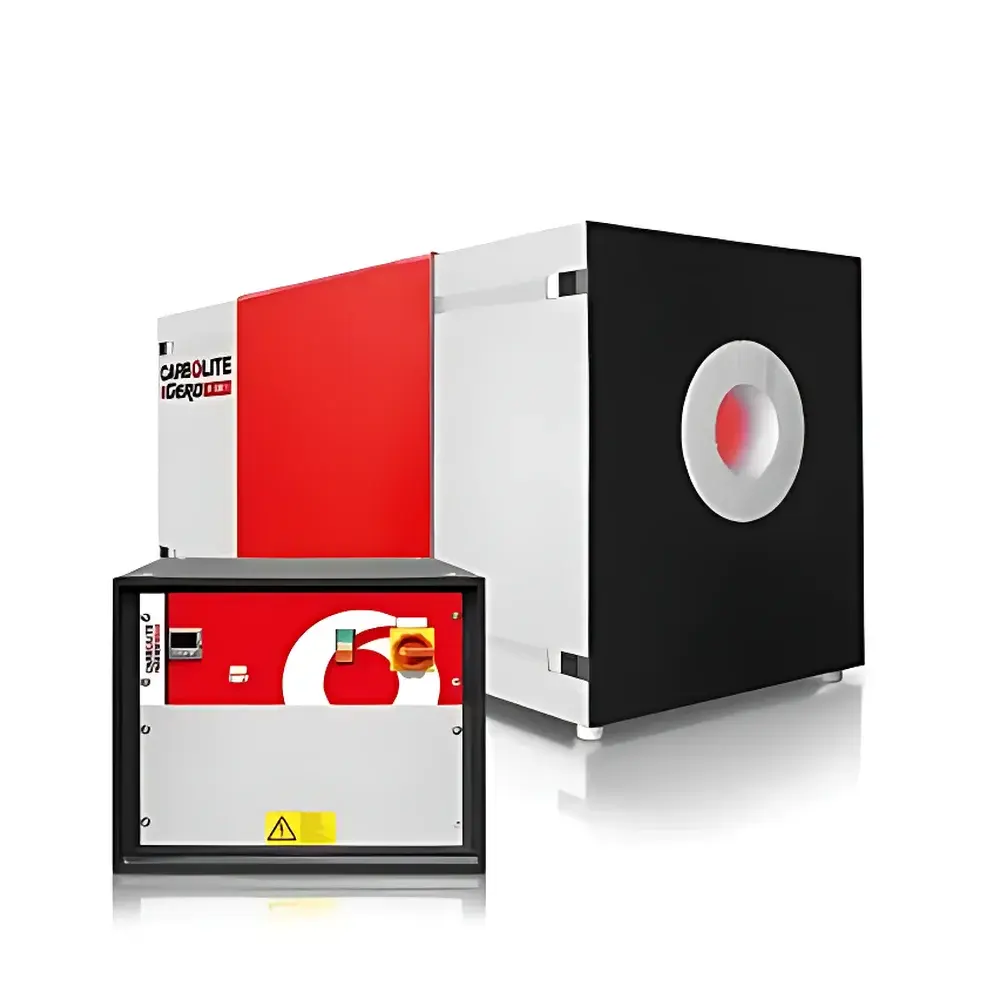
Carbolite Gero FHA/FHC Series 1350°C Horizontal/Vertical Tube Furnaces
| Brand | Carbolite Gero |
|---|---|
| Origin | Germany |
| Model | FHA (Single-Zone) / FHC (Triple-Zone) |
| Max Operating Temperature | 1350°C |
| Heating Element | 5 mm APM alloy wire embedded in low-heat-capacity ceramic fiber insulation |
| Temperature Uniformity | ±5°C over specified hot zone length |
| Thermocouple Type | High-stability Type S (Platinum/Rhodium) |
| Controller Options | EPC3016P1 (FHA), CC-T1 (FHC) |
| Over-Temperature Protection | Independent safety limiter |
| Atmosphere Compatibility | Air, inert gas (N₂, Ar), reducing (H₂), vacuum (optional mechanical or turbo-molecular pumping) |
| Power Supply Options | 3-phase 200–415 V or 480 V AC |
| Communication Interface | Ethernet (optional, specified at order) |
| Hot Zone Lengths | 200–1250 mm |
| Tube OD Options | 32–110 mm |
| External Dimensions (L×W×H) | up to 1450 × 520 × 590 mm |
| Control Cabinet Dimensions | up to 1200 × 700 × 1100 mm |
| Weight Range | 25–130 kg (furnace), 50–90 kg (cabinet) |
Overview
The Carbolite Gero FHA and FHC series are precision-engineered horizontal/vertical tube furnaces designed for high-temperature thermal processing in research laboratories, materials science facilities, and industrial R&D environments. Built on Carbolite Gero’s legacy of German engineering excellence, these furnaces operate up to 1350°C and employ a robust thermal architecture centered on 5 mm diameter APM (Alloy 800HT derivative) heating wire — a high-temperature-resistant nickel-chromium-iron alloy known for exceptional oxidation resistance and long-term stability under cyclic thermal stress. The heating elements are fully embedded within low-heat-capacity ceramic fiber insulation, minimizing thermal inertia and enabling rapid, energy-efficient heating profiles. Each furnace is configured with either single-zone (FHA) or triple-zone (FHC) independent temperature control, allowing precise axial thermal gradient management — critical for processes such as crystal growth, sintering, annealing, and controlled-atmosphere synthesis. The modular design supports both horizontal and vertical orientation, accommodating diverse experimental geometries and integration into larger process lines.
Key Features
- Maximum operating temperature of 1350°C in air, inert, or reducing atmospheres (H₂-compatible above 750°C with optional lab gas safety system)
- Low-thermal-mass ceramic fiber insulation ensures fast ramp rates and minimal standby heat loss
- Type S (Pt10Rh–Pt) thermocouples provide traceable, high-accuracy temperature measurement with long-term drift <0.1°C/year under standard use conditions
- 24-segment programmable controllers (EPC3016P1 for FHA; CC-T1 for FHC) support complex thermal cycles including hold, ramp, and soak sequences
- Independent over-temperature protection circuit with redundant safety limiter meets EN 60519-1 requirements for electrical equipment for electroheating
- Modular hot zone lengths (200–1250 mm) and tube outer diameters (32–110 mm) enable application-specific configuration
- Dedicated control cabinet (up to 6 m cable separation) houses power electronics, controller, and safety systems — enhancing operator safety and EMC compliance
- Ethernet communication interface (optional, factory-configured) enables remote monitoring, data logging, and integration into LabVantage or LIMS platforms under ISO/IEC 17025 workflows
Sample Compatibility & Compliance
The FHA/FHC series accommodates a broad range of work tubes — including fused quartz (max 1100°C), high-purity alumina (1600°C), silicon carbide, and metallic alloys (e.g., Inconel 600/625). When using ceramic tubes, maximum recommended heating rate is 5°C/min to prevent thermal shock. For vacuum applications (down to 10⁻³ mbar), optional turbomolecular or two-stage rotary vane pumping systems are available — compatible with tube IDs ≥60 mm. Optional oxygen probes permit real-time ppm-level O₂ monitoring in inert gas lines, supporting ASTM E2913 and ISO 8502-9 compliant atmosphere validation. All units comply with CE marking requirements (2014/35/EU Low Voltage Directive, 2014/30/EU EMC Directive) and conform to IEC 61000-6-2/6-4 immunity/emission standards. Optional 21 CFR Part 11-compliant audit trail and electronic signature modules are available for regulated pharmaceutical and biotech applications.
Software & Data Management
Carbolite Gero’s CC-T1 and EPC3016P1 controllers support full data logging (time-stamped temperature, setpoint, power %, alarm status) to internal memory or external USB drives. Logged data exports in CSV format for post-processing in MATLAB, Python (Pandas), or statistical analysis tools. Ethernet-enabled units integrate seamlessly with OPC UA or Modbus TCP protocols, enabling bidirectional communication with SCADA, MES, or custom Python-based automation frameworks. Firmware updates are performed via secure HTTPS upload, and controller configurations are backed up/restored using encrypted .cfg files. Audit trails record all parameter changes, user logins, and alarm events — supporting GLP/GMP documentation requirements where electronic records must demonstrate integrity, confidentiality, and availability per ALCOA+ principles.
Applications
These furnaces serve demanding thermal processes across academia and industry: solid-state synthesis of battery cathode materials (e.g., NMC, LFP); thermal gravimetric analysis (TGA) coupling; catalyst activation and regeneration; metal oxide reduction studies; CVD precursor decomposition; glass annealing and devitrification profiling; and pre-sintering of advanced ceramics. Their triple-zone capability (FHC) allows active thermal gradient control — essential for directional solidification experiments and zone refining. Vertical orientation supports gravity-independent crystal growth setups and fluid-phase reaction studies under controlled partial pressure. Integration with mass flow controllers and residual gas analyzers enables dynamic atmosphere modulation during thermal cycling — a requirement for developing next-generation solid electrolytes and hydrogen storage materials.
FAQ
What is the maximum recommended heating rate for ceramic work tubes?
For fused quartz or alumina tubes, do not exceed 5°C/min to avoid thermal fracture.
Can the furnace be operated vertically without modification?
Yes — all FHA/FHC models include reinforced L-brackets and adjustable leveling feet for stable vertical mounting.
Is vacuum compatibility standard or optional?
Vacuum operation requires optional pump integration (rotary vane or turbomolecular) and flanged end caps — specified at time of order.
How is temperature uniformity verified and documented?
Uniformity is measured per ASTM E220 at ≤1250°C using a 5-point traverse across the hot zone with calibrated reference thermocouples; certificate available upon request.
Are replacement heating elements field-serviceable?
Yes — modular heater cartridges are accessible without disassembling the insulation core, minimizing downtime and enabling preventive maintenance planning.



