
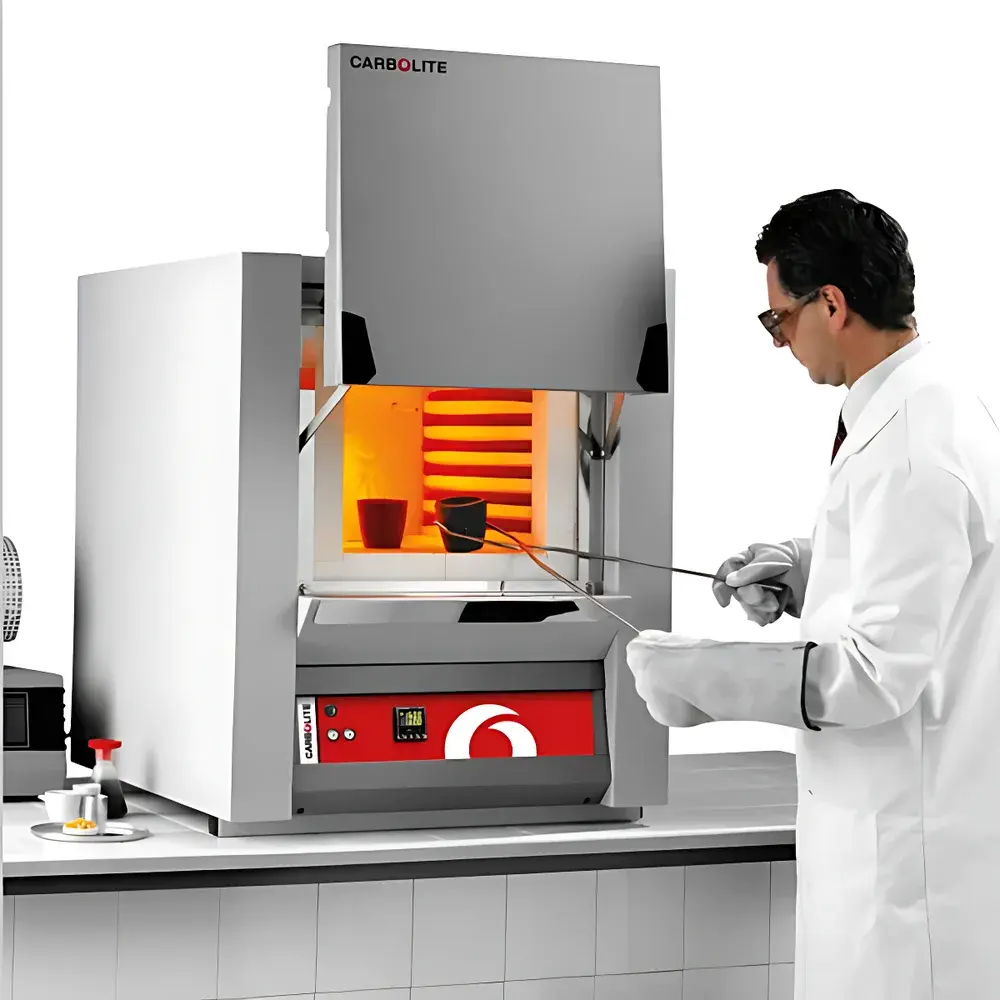
Carbolite Gero GPC Series High-Capacity Box-Type Muffle Furnace
| Brand | Carbolite Gero |
|---|---|
| Origin | United Kingdom |
| Instrument Type | Box Furnace |
| Model | GPC 12/36/3216P1 |
| Maximum Temperature | 1300 °C |
| Temperature Uniformity | ±3 °C |
| Rated Power | 9000 W |
| Heating Time to Max Temp | 37 min |
| Heating Method | Resistance Wire (Radiant) |
| Internal Chamber Dimensions | 250 × 320 × 450 mm (L×W×H) |
| Chamber Volume | 36 L |
| Insulation | Low-Density Alumina Fiber Board |
| Door Type | Vertically Lifting |
| Controller | PID301 Single-Stage Programmable Controller |
| Optional Upgrades | 8- or 20-Stage Program Controller, Over-Temperature Protection, RS232 Interface, NiCr Thermocouple & Flow Meter for Atmosphere Control (≤1100 °C) |
Overview
The Carbolite Gero GPC Series is a high-capacity, vertically opening box-type muffle furnace engineered for demanding thermal processing applications in industrial laboratories, materials research facilities, and quality control environments. Designed around a robust radiant heating architecture, the GPC employs high-purity resistance wire elements embedded within low-density alumina fiber insulation—ensuring rapid thermal response, exceptional energy efficiency, and long-term dimensional stability under repeated thermal cycling. Its maximum operating temperature of 1300 °C complies with ASTM E1142 and ISO 8573-1 thermal classification requirements for Class T1300 furnaces, making it suitable for ashing, calcination, sintering, heat treatment, and pre-conditioning of ceramic, metallurgical, and geological specimens. The vertically lifting door minimizes radiant exposure during loading/unloading and maintains ergonomic safety compliance per EN 61000-6-4 and IEC 61000-3-2 standards.
Key Features
- Vertically actuated refractory door with integrated hard-anodized alumina sealing gasket, reducing operator exposure to radiant heat and improving thermal retention
- High-efficiency low-density alumina fiber insulation system (density < 200 kg/m³), enabling 37-minute ramp to 1300 °C while maintaining surface temperatures below 65 °C at ambient conditions (per EN 60519-2)
- PID301 single-segment programmable controller with real-time setpoint tracking, auto-tuning capability, and ±3 °C temperature uniformity across the 36 L working chamber (verified per ASTM E220)
- Modular heating element layout—accessible from rear service panel—facilitating field replacement without disassembly of insulation or chamber lining
- Standard over-temperature cut-off circuit (independent of main controller) with redundant thermocouple input, certified to SIL 2 per IEC 61508 for unattended operation
- Optional RS232 serial interface compliant with Modbus RTU protocol for integration into LabVantage, STARLIMS, or custom SCADA systems
Sample Compatibility & Compliance
The GPC series accommodates standard crucibles (alumina, silicon carbide, platinum) and large-format sample trays up to 230 × 300 mm. Its inert muffle chamber—free of catalytic surfaces or metallic volatiles—ensures contamination-free processing for ASTM D3175 (coal ash analysis), ISO 562 (coke reactivity), and USP heavy metal testing. All models are CE-marked and conform to IEC 61000-6-2 (immunity) and IEC 61000-6-3 (emission) directives. Optional atmosphere control packages—including NiCr thermocouple ports and calibrated mass flow meters—support inert (N₂, Ar), reducing (H₂/N₂), or oxidizing (air) environments up to 1100 °C, meeting GLP audit requirements for traceability and parameter logging.
Software & Data Management
While the base PID301 controller operates standalone, optional 8- or 20-segment program modules support multi-step thermal profiles with dwell, ramp, and soak functions. All temperature logs—including setpoints, actual readings, alarm events, and power consumption—are timestamped and exportable via RS232 to CSV or Excel-compatible formats. When paired with Carbolite Gero’s optional DataLogger Pro software (v3.2+), the system generates 21 CFR Part 11–compliant audit trails with electronic signatures, user access levels, and immutable record retention—essential for pharmaceutical stability studies (ICH Q1A) and ISO/IEC 17025-accredited testing labs.
Applications
- Thermal gravimetric analysis (TGA) sample preparation and residue quantification
- Calcination of catalyst supports (e.g., γ-Al₂O₃, CeO₂-ZrO₂) under controlled airflow
- Ash content determination per AOAC 942.05, EPA Method 1311, and DIN 51718
- Sintering of technical ceramics (ZrO₂, Si₃N₄) and metal injection molded (MIM) components
- Pre-firing of refractory linings and investment casting shell molds
- Heat treatment qualification per AMS 2750E (Pyrometry) when used with external SAT and TUS validation kits
FAQ
What is the maximum recommended continuous operating temperature?
The GPC series is rated for continuous operation at 1300 °C; however, sustained use above 1250 °C may reduce heating element service life. For optimal longevity, Carbolite Gero recommends limiting exposure >1250 °C to ≤2 hours per cycle.
Can the furnace be validated for GMP environments?
Yes—when equipped with optional data logging, dual thermocouples (control + independent verification), and IQ/OQ documentation packages, the GPC meets FDA and EMA expectations for equipment qualification in pharmaceutical manufacturing.
Is atmosphere purging supported out of the box?
No—purge capability requires optional NiCr thermocouple ports, gas inlet/outlet fittings, and a calibrated flow meter. These accessories are configured during factory build and require separate ordering.
How often does the insulation require replacement?
Under normal usage (≤10 cycles/week, max 1300 °C), the alumina fiber insulation maintains structural integrity for ≥5 years. Visual inspection for cracking or shrinkage is advised annually per maintenance schedule GPC-MNT-04.
Does the PID301 controller support remote monitoring via Ethernet?
Not natively—the base controller uses RS232 only. Ethernet connectivity requires the optional COM-ETH gateway module (sold separately), which converts Modbus RTU to TCP/IP and supports SNMP polling for enterprise-level infrastructure integration.



