
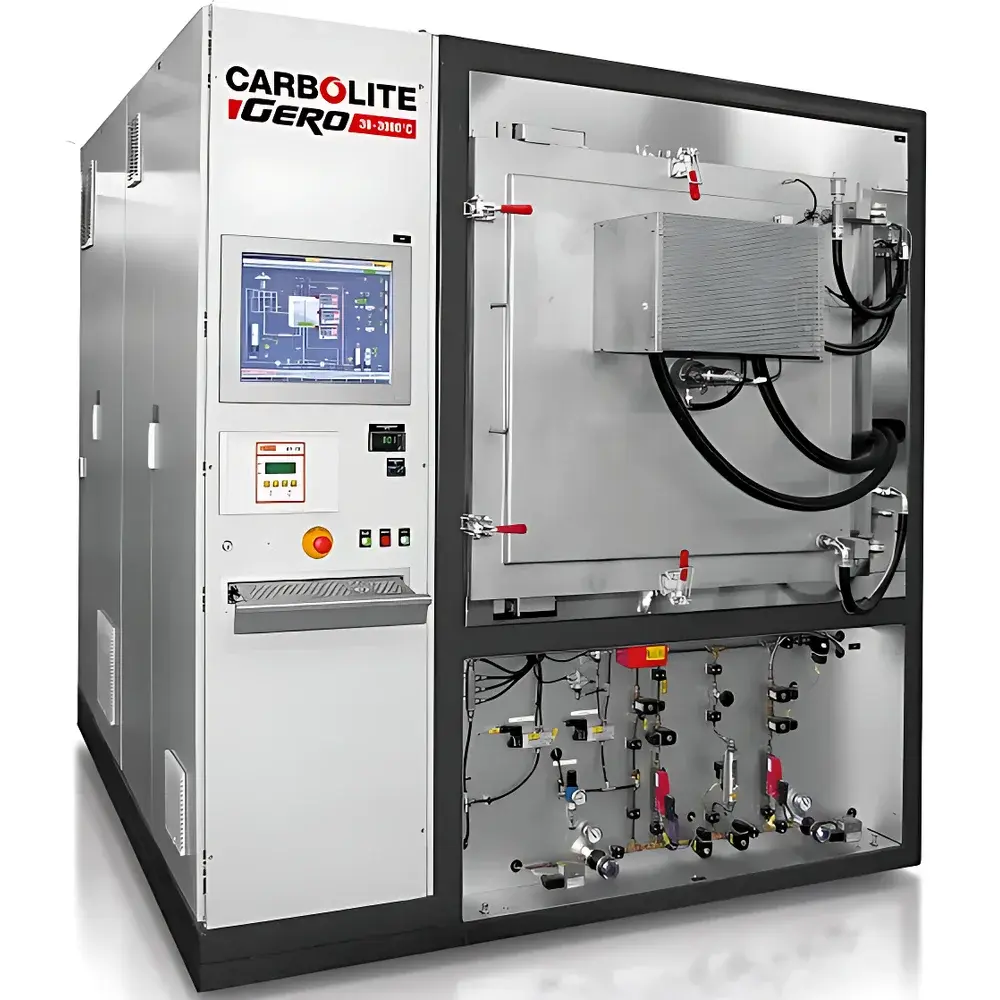
Carbolite Gero HTK High-Temperature Box Furnace
| Brand | Carbolite Gero |
|---|---|
| Origin | Germany |
| Instrument Type | Box Furnace |
| Heating Elements | Graphite / Molybdenum / Tungsten / Ceramic Fiber |
| Cooling System | Water-Cooled Double-Wall Vacuum Chamber |
| Safety Monitoring | Independent Temperature Controller & Thermocouple |
| Optional Accessories | Rapid Cooling Unit |
| Internal Volume Range | 8–600 L (Customizable) |
| Compliance | Designed for GLP/GMP environments |
Overview
The Carbolite Gero HTK High-Temperature Box Furnace is an engineered thermal processing system designed for demanding laboratory R&D and industrial-scale production applications requiring precise, repeatable, and contamination-controlled high-temperature environments. Built upon Carbolite Gero’s legacy of German engineering excellence, the HTK series leverages a modular architecture to support three core furnace configurations—graphite, molybdenum/tungsten metal, and ceramic fiber—each optimized for distinct atmospheric, vacuum, and chemical compatibility requirements. The furnace operates on fundamental principles of resistive heating within a thermally isolated chamber, where heat transfer dynamics are tightly regulated via dual-wall water-cooled vacuum jacketing, minimizing external thermal radiation and enabling stable thermal gradients across large workspaces. Its design supports continuous operation up to 2,400 °C (depending on configuration), with vacuum levels reaching ≤10⁻⁵ mbar in metal-chamber variants. This makes the HTK particularly suited for processes such as sintering, pyrolysis, graphitization, vacuum brazing, and controlled-atmosphere annealing where oxygen exclusion, carbon neutrality, or reactive gas integration is critical.
Key Features
- Water-cooled double-wall vacuum chamber architecture ensures thermal stability, structural integrity, and operator safety during extended high-temperature cycles
- Independent safety temperature monitoring system with dedicated controller and redundant thermocouple input—compliant with IEC 61508 SIL 2 functional safety guidelines
- Modular heating element selection: graphite (for vacuum/inert/reducing atmospheres), molybdenum or tungsten (for ultra-high-purity inert/vacuum environments, zero-carbon processing), and ceramic fiber (for oxidizing or high-oxygen partial pressure applications)
- Integrated water cooling system with real-time flow rate monitoring, adjustable flow control, and digital coolant temperature display
- Configurable internal volume from 8 L (benchtop R&D scale) to 600 L (production-grade), all built to dimensional repeatability tolerances ≤±1.5 mm
- Optional rapid cooling units reduce cycle time by up to 40% without compromising thermal uniformity or sample integrity
- Gas handling interface supports seamless integration of CO, H₂, He, N₂, and Ar supply systems with leak-tested stainless-steel manifolds and mass flow controllers
Sample Compatibility & Compliance
The HTK series accommodates diverse sample geometries and material classes—including ceramic green bodies, metal powders, semiconductor substrates, and composite preforms—within its standardized and custom-designed crucible trays and support fixtures. Graphite-furnace variants are validated for use with SiC, Si₃N₄, AlN, and boron carbide ceramics under vacuum or forming gas (5% H₂/95% N₂). Molybdenum and tungsten chambers meet ASTM F2697 specifications for low-outgassing metallic vacuum components and are routinely deployed in nuclear fuel pellet sintering, sapphire annealing (per MIL-C-20005), and high-vacuum brazing of radar tube assemblies. Ceramic fiber models conform to ISO 13320 particle sintering protocols and are widely used in piezoelectric PZT and BST oxide fabrication. All configurations support IQ/OQ/PQ documentation packages aligned with FDA 21 CFR Part 11 data integrity requirements and EU Annex 11 computerized system validation standards.
Software & Data Management
The HTK integrates with Carbolite Gero’s proprietary TCC (Thermal Control Center) software suite, enabling full-cycle programming, real-time parameter logging (temperature, pressure, gas flow, cooling rate), and automated report generation in PDF/CSV formats. Audit trails record all user actions, setpoint changes, and alarm events with timestamped, non-erasable entries—meeting ALCOA+ (Attributable, Legible, Contemporaneous, Original, Accurate, Complete, Consistent, Enduring, Available) data governance criteria. Optional Ethernet/IP and Modbus TCP interfaces allow integration into centralized MES or SCADA platforms for traceability across multi-furnace production lines.
Applications
- Sintering of advanced ceramics (e.g., SiC, AlN, ZrO₂) under vacuum or controlled N₂/Ar
- Graphitization of carbon-based composites and pyrolytic carbon coatings
- Metal injection molding (MIM) debinding and sintering under H₂/N₂ atmospheres
- High-purity annealing of sapphire wafers and optical crystals
- Vacuum brazing of aerospace-grade superalloys and metal-ceramic hybrids
- Oxidation-resistant firing of piezoelectric and ferroelectric oxides (e.g., BaTiO₃, PZT)
- Nuclear fuel kernel densification and TRISO particle fabrication
FAQ
What maximum temperature can the HTK furnace achieve?
Maximum operating temperature depends on the selected heating element and insulation system: graphite variants reach up to 2,400 °C, molybdenum/tungsten up to 2,200 °C, and ceramic fiber up to 1,600 °C.
Is the HTK furnace suitable for hydrogen atmosphere processing?
Yes—graphite and metal-chamber configurations are certified for H₂ service up to 100% concentration, with integrated combustible gas safety enclosures meeting EN 13463-1 explosion protection standards.
Can the furnace be validated for GMP manufacturing environments?
Yes—the HTK supports full qualification (IQ/OQ/PQ), electronic signature capability, and 21 CFR Part 11-compliant audit trail functionality when equipped with TCC software and optional validation kits.
How is thermal uniformity maintained across large workspaces?
Through symmetrical heating element layout, multi-zone power regulation, and active water-jacket temperature stabilization—achieving ±3 °C uniformity over 90% of the working volume at 1,800 °C (per DIN 17052-1 test protocol).
Are custom internal dimensions available beyond the standard 8–600 L range?
Yes—Carbolite Gero offers bespoke chamber geometry design, including non-standard aspect ratios and integrated instrumentation ports, subject to mechanical feasibility and thermal modeling review.
Related Products



