
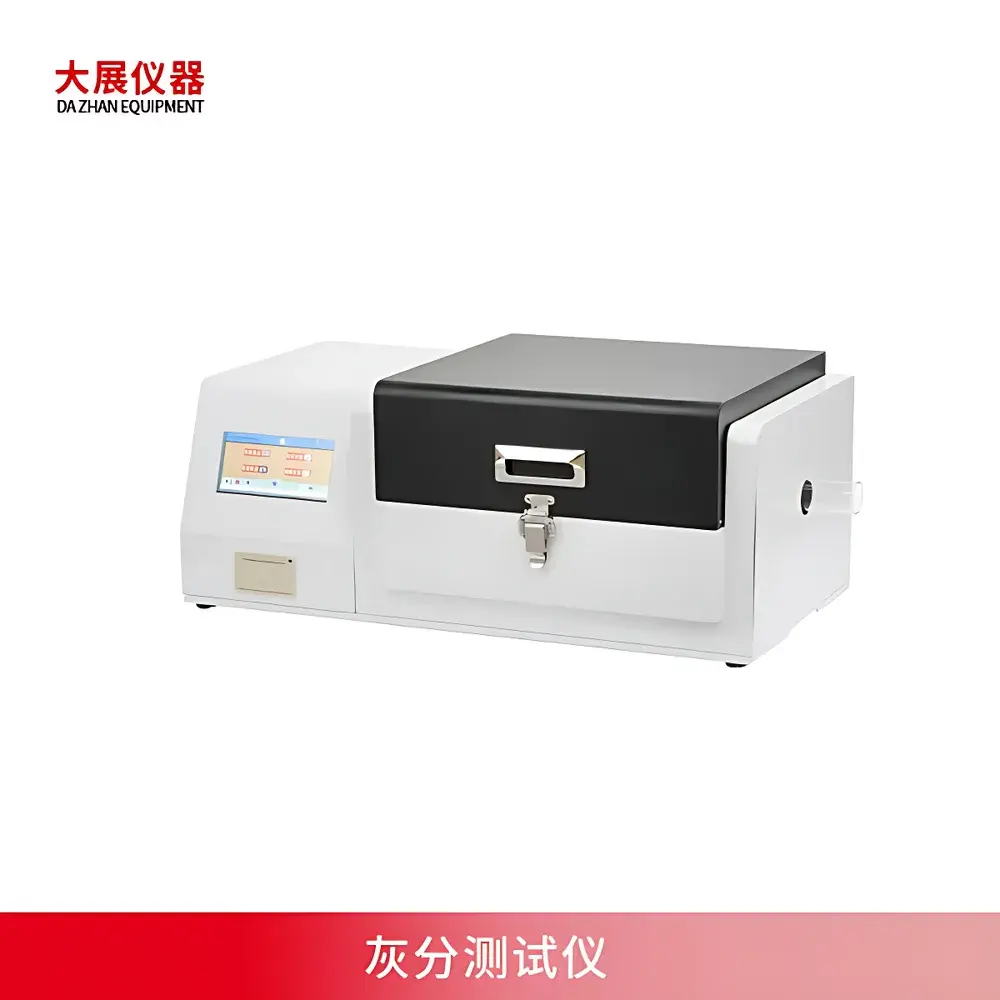
DZ3500S Carbon Black & Ash Content Analyzer by DAZHAN
| Brand | DAZHAN |
|---|---|
| Origin | Jiangsu, China |
| Model | DZ3500S |
| Display | 7-inch capacitive touchscreen |
| Quartz tube dimensions | φ44 × 600 ± 5 mm |
| Furnace chamber | Φ45 × 300 ± 5 mm |
| Heating element | high-temperature alloy wire |
| Heating zone length | 350 mm |
| Operating temperature range | ambient to 1200 °C |
| Temperature control | intelligent programmable multi-segment PID |
| Temperature resolution | 0.1 °C |
| Power supply | AC 220 V / 50 Hz or 60 Hz |
| Gas flow control | dual-channel, program-automated switching |
| Cooling method | forced-air + lid-open rapid cooling (≤20 min from 900 °C to ambient) |
| Sample capacity | 4 positions per run |
| Data processing | built-in calculation engine for carbon black % and ash % |
| Optional accessories | exhaust filtration unit, thermal printer |
Overview
The DZ3500S Carbon Black & Ash Content Analyzer is a dedicated thermal gravimetric instrument engineered for precise quantification of carbon black loading and inorganic residue (ash) in polymer and elastomeric materials. It operates on the principle of controlled pyrolysis under inert (N₂) or oxidative (air/O₂) atmospheres, followed by high-temperature combustion or calcination to isolate non-volatile inorganic components. Designed specifically for rubber, plastic, and cable compound laboratories, the DZ3500S complies with core methodology requirements outlined in ASTM D1606, ISO 6964, IEC 60811-4-1, and GB/T 3512—standards governing carbon black content determination in polyolefins (e.g., PE, PP, PB), insulating and sheathing compounds for power and optical fiber cables, and vulcanized rubber formulations. Its integrated furnace architecture enables reproducible thermal treatment across four parallel sample positions, minimizing inter-run variability and supporting throughput-critical QC workflows.
Key Features
- Four-position simultaneous sample processing — increases daily assay capacity by up to 4× compared to single-sample furnaces, reducing labor cost per test.
- Lid-open rapid cooling system — achieves ≤20-minute cooldown from 900 °C to ambient temperature, eliminating bottlenecks in sequential testing cycles.
- Intelligent programmable temperature control — supports multi-step thermal profiles including ramp rates (°C/min), hold durations (min), and atmosphere switching logic — essential for method alignment with ASTM D5630 or ISO 6964 Annex A.
- High-uniformity furnace cavity (Φ45 × 300 mm) with high-alloy heating elements — ensures axial and radial temperature consistency within ±5 °C across the working zone at 900 °C, critical for inter-laboratory comparability.
- 7-inch capacitive touchscreen interface — provides intuitive navigation, real-time curve visualization (mass vs. time/temperature), and password-protected method storage for audit-ready operation.
- Dual independent gas channels with automated solenoid switching — enables seamless transition between inert purge (N₂) during pyrolysis and oxidative air flow during ash residue oxidation, minimizing operator intervention.
Sample Compatibility & Compliance
The DZ3500S is validated for use with solid granular or pelletized specimens of polyethylene (PE), polypropylene (PP), polybutene (PB), ethylene-propylene-diene monomer (EPDM), silicone rubber, and halogen-free flame-retardant (HFFR) cable compounds. Sample mass range: 0.5–2.0 g, placed in pre-weighed ceramic or quartz crucibles (compatible with standard ASTM D5630 crucible geometry). The instrument’s thermal protocol satisfies regulatory expectations for material verification in cable manufacturing per IEC 60502-1 and UL 1581 §1060. Optional exhaust filtration (activated carbon + particulate trap) ensures safe handling of volatile decomposition products, supporting compliance with OSHA 29 CFR 1910.1200 (HCS) and local industrial hygiene requirements. All firmware and data logs retain timestamps, user IDs, and method versioning — enabling traceability aligned with GLP principles.
Software & Data Management
The embedded analysis engine performs automatic mass-loss calculations based on initial sample weight, post-pyrolysis char mass, and final ash residue mass. Results are reported as % carbon black (calculated as mass loss between inert pyrolysis and oxidative burnout) and % ash (residue after 750 °C oxidation for 30 min). Raw thermogravimetric data (time, temperature, mass) are exportable via USB to CSV format for external statistical analysis (e.g., JMP, Minitab). Optional thermal printer support enables direct generation of GMP-compliant hardcopy reports containing operator ID, sample ID, date/time stamp, method name, and pass/fail status against internal specification limits. Audit trail functionality records all parameter changes, calibration events, and result exports — consistent with FDA 21 CFR Part 11 electronic record integrity expectations when deployed in regulated environments.
Applications
- Quality control of carbon black masterbatches used in automotive tire treads and conveyor belts.
- Verification of filler loading consistency in halogen-free low-smoke (LSOH) cable jacketing compounds.
- Batch release testing for polyolefin-based medical tubing where ash content correlates with catalyst residue levels.
- R&D screening of novel conductive composites (e.g., CNT/PE blends) where differential thermal stability informs dispersion quality.
- Failure analysis of extruded profiles exhibiting surface blooming or inconsistent electrical resistivity.
FAQ
What standards does the DZ3500S support for carbon black testing?
ASTM D5630, ISO 6964, IEC 60811-4-1, GB/T 3512, and JIS K 6221.
Can the instrument distinguish between carbon black and other organic fillers?
No — it quantifies total volatile carbonaceous matter under inert conditions; differentiation requires complementary techniques such as FTIR or Raman spectroscopy.
Is calibration traceable to national standards?
Yes — temperature calibration uses NIST-traceable Pt100 reference sensors; mass calibration is performed using Class M1 certified weights per ISO/IEC 17025 guidelines.
What maintenance is required for long-term accuracy?
Quarterly verification of thermocouple drift, annual replacement of quartz tube seals, and biannual cleaning of gas line filters — documented in the included maintenance log template.
Does the system support remote monitoring or network integration?
Not natively — but USB-exported CSV files integrate with LIMS platforms via scripted ingestion; Ethernet or Wi-Fi modules are available as OEM add-ons upon request.



