
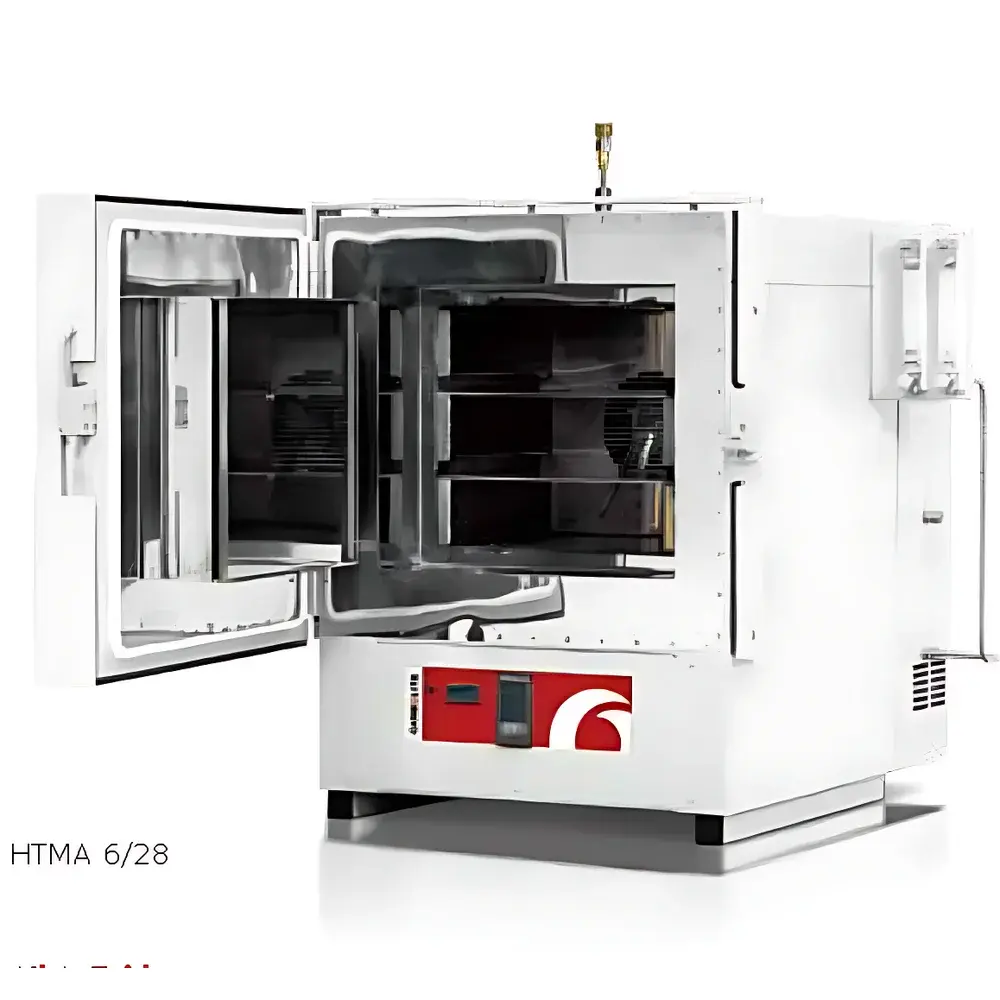
Carbolite Gero HTMA Series Horizontal Tube Atmosphere Furnace with Programmable Temperature Control
| Brand | Carbolite Gero |
|---|---|
| Origin | United Kingdom |
| Model | HTMA 6/28 |
| Temperature Range | 400 °C / 500 °C / 600 °C (configurable) |
| Temperature Uniformity | ±0.5 °C |
| Chamber Dimensions (W×D×H) | 305 mm × 305 mm × 305 mm |
| External Dimensions (W×D×H) | 880 mm × 675 mm × 885 mm |
| Chamber Volume | 28 L |
| Chamber Material | Corrosion-Resistant Stainless Steel (AISI 310S or equivalent) |
| Heating Method | Forced-Convection Horizontal Airflow via Rear-Mounted Fan and Side-Directed Gas Channels |
| Atmosphere Sealing | Dual-Seal Door (Metal Heat-Resistant Gasket + Elastomeric Airtight Seal) |
| Gas Flow Control | Manual Nickel-Copper Needle Valve & Flowmeter (50–500 mL/min), O₂ Residual ≤50 ppm after purge |
| Safety | Independent Over-Temperature Protection, PID301 Single-Stage Controller with Ramp/Soak Function |
Overview
The Carbolite Gero HTMA Series is a horizontally oriented, forced-convection atmosphere furnace engineered for precise thermal processing under controlled inert, reducing, or reactive gas environments. Unlike conventional drying ovens, the HTMA operates on a sealed-tube principle with horizontal laminar airflow—enabled by a rear-mounted high-temperature fan and side-directed gas channels—to ensure exceptional temperature uniformity (±0.5 °C) and reproducible gas exchange kinetics across the 28 L working chamber. Its design conforms to ISO 9001-compliant manufacturing standards and supports applications requiring strict oxygen exclusion (down to ≤50 ppm residual O₂ post-purge), such as catalyst activation, powder metallurgy sintering, electrode calcination, and pre-annealing of semiconductor substrates. The furnace is not a general-purpose drying oven; it is a process-grade thermal system built to meet GLP/GMP-aligned laboratory and pilot-scale manufacturing requirements.
Key Features
- Triple-tier temperature capability: factory-configured maximum operating temperatures of 400 °C, 500 °C, or 600 °C—each validated per IEC 60584 thermocouple calibration protocols
- Horizontally aligned chamber with full-seal dual-gasket door assembly: primary metal-to-metal seal (Inconel 600 gasket) and secondary elastomeric O-ring for leak rates <1 × 10⁻⁵ mbar·L/s (tested per ISO 10110-5)
- Forced-convection airflow architecture: rear-mounted ceramic-insulated fan delivers uniform horizontal gas circulation, minimizing thermal stratification and ensuring consistent heating of stacked crucibles or flat substrates
- Corrosion-resistant chamber construction: AISI 310S stainless steel interior with perforated crucible support tray—optimized for repeated exposure to H₂, N₂, Ar, NH₃, or forming gas (N₂/H₂)
- Manual atmosphere management: nickel-copper needle valve and calibrated flowmeter (range 50–500 mL/min) enable independent control of purge and protective gas streams—no cross-contamination between cleaning and holding phases
- Integrated safety architecture: independent over-temperature cut-off (setpoint +25 °C), earth leakage protection, and PID301 single-stage controller with ramp/soak programming and real-time deviation alarm
Sample Compatibility & Compliance
The HTMA 6/28 accommodates standard ceramic, quartz, or metallic crucibles up to Ø120 mm × 100 mm height. Its 305 mm cubic chamber allows vertical stacking of multiple samples while maintaining laminar gas flow integrity. All wetted components—including gas manifolds, valves, and internal tubing—are constructed from stainless steel (AISI 316L) or nickel-copper alloys to resist oxidation and halide-induced corrosion during prolonged operation at elevated temperatures. The system complies with EN 61000-6-3 (EMC emission limits), EN 61000-6-2 (immunity), and carries CE marking under the EU Machinery Directive 2006/42/EC. Optional RS485 or Ethernet interfaces support integration into FDA 21 CFR Part 11–compliant data acquisition systems when paired with certified third-party software and audit-trail-enabled controllers.
Software & Data Management
While the base HTMA 6/28 ships with the PID301 single-stage controller (no built-in data logging), optional upgrades include the Carbolite Gero 3508 multi-segment programmable controller with integrated 16-channel data logger. This module supports up to 99 programs, each with 20 segments, and records temperature, gas flow status, and alarm events with timestamped CSV export via USB or network interface. When configured with RS232/RS485 or Ethernet connectivity, the system enables remote monitoring and centralized supervision within LIMS or MES platforms. All logged data includes electronic signatures, change history, and immutable audit trails—fully compatible with GLP documentation workflows and ISO/IEC 17025 calibration record retention requirements.
Applications
- Catalyst pre-treatment: reduction of NiO, Co₃O₄, or CuO under controlled H₂/N₂ mixtures at 350–550 °C
- Electrode material synthesis: thermal decomposition of LiCoO₂ precursors or carbon-coating of Si anodes under argon
- Thermal gravimetric conditioning: moisture and organic binder removal from ceramic green bodies prior to sintering
- Metal powder annealing: stress relief and oxide layer reduction in stainless steel or titanium powders under vacuum-assisted forming gas
- Reference material stabilization: heat treatment of NIST-traceable calibration standards under inert atmosphere to prevent surface oxidation
FAQ
What gas purity levels can be achieved inside the chamber?
With proper initial purge using ≥99.998% purity nitrogen or argon, residual oxygen concentration can be stabilized at ≤50 ppm, verified using an inline electrochemical O₂ sensor (optional accessory).
Is the HTMA suitable for hydrogen atmospheres?
Yes—when equipped with H₂-rated solenoid valves, explosion-proof fan housing, and leak-tested gas manifolds (per ISO 20816-1), the HTMA meets ATEX Category 2G requirements for Group II B hydrogen service.
Can I upgrade from manual gas control to automated switching?
Yes—the 3508 controller package includes programmable gas sequencing logic, enabling timed transitions between purge, reaction, and cool-down gas phases without operator intervention.
Does the furnace support validation documentation?
Carbolite Gero provides IQ/OQ documentation templates, temperature mapping reports (per ASTM E2251), and calibration certificates traceable to UKAS-accredited standards upon request.
What maintenance intervals are recommended for continuous operation?
Fan bearing inspection every 2,000 hours; gasket replacement every 12 months or after 100 thermal cycles above 500 °C; thermocouple recalibration annually or per ISO/IEC 17025 internal quality schedule.



