
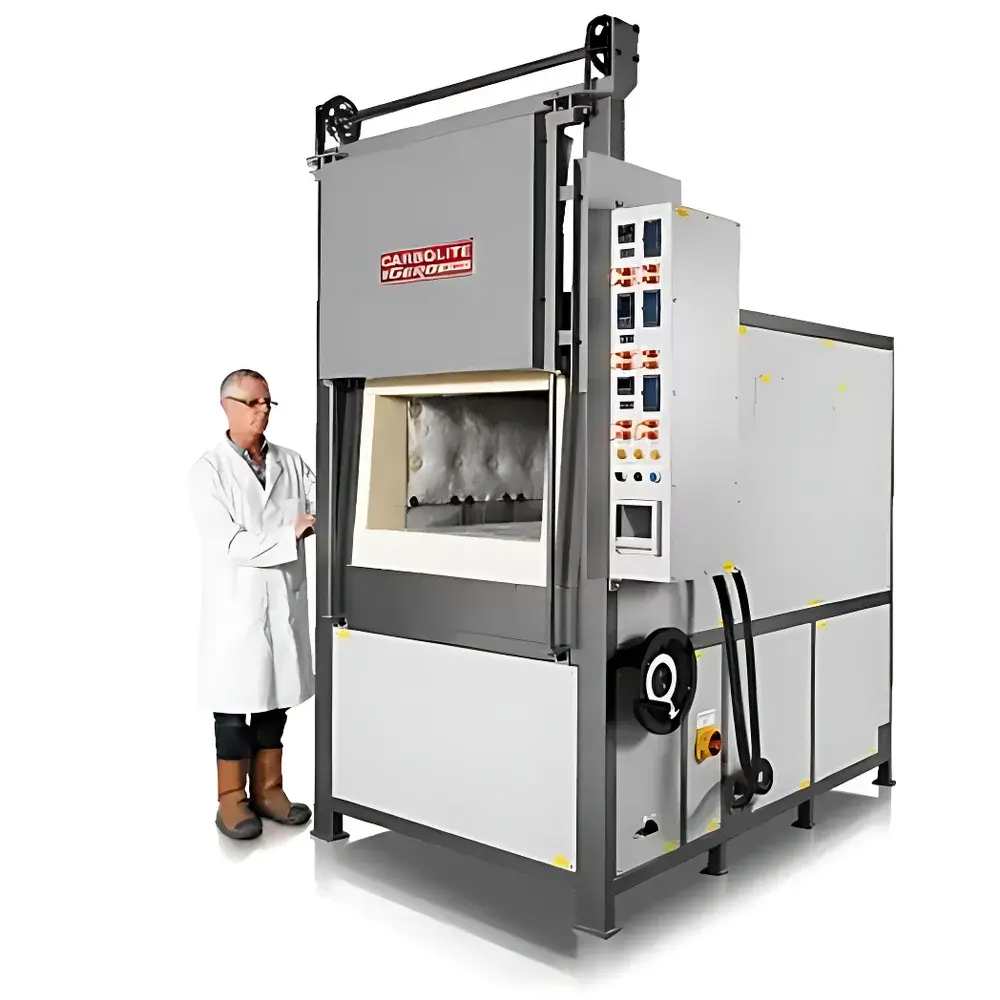
Carbolite Gero LCF Series Industrial Box Furnace
| Brand | Carbolite Gero |
|---|---|
| Origin | Germany |
| Model | LCF |
| Temperature Range | 1200°C and 1400°C |
| Heating Elements | Resistance Wire (up to 1200°C), Silicon Carbide Rods (up to 1400°C) |
| Construction | Hollow Structural Steel Frame with Galvanized Steel Outer Casing |
| Insulation | Dual-layer Refractory Insulation |
| Door Operation | Manual Vertical Lift with Safety Interlock |
| Standard Controller | EPC3016P1 Programmable Temperature Controller |
| Compliance Options | AMS 2750F (NADCAP) Qualified Configurations Available |
| Communication Interface | Ethernet (optional, specified at order) |
| Floor Plate | Wear-Resistant Silicon Carbide Hearth |
| Energy Efficiency | Optimized via Low-Density High-Performance Insulation |
Overview
The Carbolite Gero LCF Series Industrial Box Furnace is a heavy-duty, precision-engineered thermal processing system designed for demanding high-temperature applications in industrial R&D, quality assurance, and production environments. Built on Carbolite Gero’s legacy of German engineering excellence, the LCF series operates on resistive heating principles—utilizing either high-stability resistance wire (for 1200°C configurations) or silicon carbide (SiC) heating elements (for 1400°C operation)—to deliver uniform temperature distribution, exceptional thermal stability, and long-term repeatability across extended duty cycles. Its robust hollow structural steel frame, galvanized outer casing, and dual-layer refractory insulation architecture ensure mechanical integrity under repeated thermal cycling while maintaining external surface temperatures within occupational safety limits (per EN 60519-1). The furnace is engineered for integration into regulated manufacturing workflows, including aerospace heat treatment, metallurgical annealing, ceramic sintering, and advanced materials development where traceability, process validation, and thermal uniformity are mission-critical.
Key Features
- Two standard maximum operating temperatures: 1200°C (resistance wire heated) and 1400°C (silicon carbide rod heated), both validated per ASTM E220 and ISO/IEC 17025 calibration protocols
- Manually operated vertical-lift door with integrated safety interlock that de-energizes heating elements upon opening—compliant with IEC 61000-6-2 electromagnetic compatibility requirements
- Wear-resistant silicon carbide hearth plate rated for continuous use up to 1400°C, minimizing contamination and facilitating easy sample handling
- Dual-zone insulation system comprising low-conductivity ceramic fiber modules and high-density insulating firebrick—reducing standby heat loss by up to 35% compared to conventional single-layer designs
- EPC3016P1 programmable controller as standard, supporting multi-segment ramp-soak profiles, real-time deviation monitoring, and configurable alarm thresholds
- Optional Ethernet-enabled digital controllers (e.g., Eurotherm 3508, Watlow F4T) with full Modbus TCP or OPC UA support for SCADA integration and automated data capture
- Configurable auxiliary systems: pneumatic/electric door actuators, inert atmosphere purge enclosures (rated to 1000°C), remote-mounted control cabinets, and custom cavity dimensions for oversized loads
Sample Compatibility & Compliance
The LCF series accommodates a broad range of sample geometries and material classes—including ferrous and non-ferrous alloys, refractory ceramics, composite preforms, and powder metallurgy compacts—within its standardized chamber volumes (ranging from 30 L to 200+ L depending on configuration). All standard and custom variants can be supplied with documentation packages aligned with Nadcap AC7101/Rev. E and AMS 2750F Rev. F requirements, including temperature uniformity surveys (TUS), system accuracy tests (SAT), and sensor calibration certificates traceable to NIST or UKAS. Optional features such as redundant thermocouple inputs, audit-trail-enabled controllers (21 CFR Part 11 compliant firmware), and GLP/GMP-ready data logging modules support regulatory submissions in aerospace, medical device, and nuclear-grade manufacturing sectors.
Software & Data Management
Carbolite Gero provides native firmware and optional third-party software suites enabling full lifecycle thermal process management. The EPC3016P1 controller logs timestamped temperature data internally (1-second resolution, 10,000-point memory buffer), exportable via USB or RS485. For enterprise-scale deployment, Ethernet-capable controllers integrate seamlessly with LabArchives ELN, Siemens Desigo CC, or custom MES platforms through open protocol support. All data streams include metadata tags for furnace ID, operator login, program ID, and environmental conditions—ensuring full ALCOA+ (Attributable, Legible, Contemporaneous, Original, Accurate, Complete, Consistent, Enduring, Available) compliance. Remote diagnostics, over-the-air firmware updates, and predictive maintenance alerts (based on heater resistance drift trends) are available via Carbolite Gero’s cloud-connected service portal.
Applications
- Aerospace component stress relieving, solution heat treatment, and aging per AMS 2770 and AMS 2771 specifications
- Sintering of technical ceramics (Al₂O₃, SiC, ZrO₂) and metal injection molded (MIM) parts under controlled atmospheres
- Heat treatment of tool steels, stainless alloys, and nickel-based superalloys requiring ±1°C uniformity across working zones
- Research-scale pyrolysis, ashing, and calcination studies in materials science laboratories accredited to ISO/IEC 17025
- Calibration reference furnaces for secondary thermocouple verification and blackbody source characterization
FAQ
Is the LCF furnace suitable for inert or reducing atmosphere processing?
Yes—optional atmosphere protection enclosures with gas-tight seals, inlet/outlet ports, and pressure monitoring are available; maximum safe operating temperature in protected mode is 1000°C.
Can the furnace be validated to AMS 2750F Class 2 or Class 3 requirements?
Absolutely—custom configurations include TUS-certified chambers, dual independent thermocouple loops, and documentation packages fully aligned with AMS 2750F Rev. F Table 6 and Table 7 criteria.
What is the typical lead time for a customized LCF model?
Standard configurations ship within 8–10 weeks; complex customizations (e.g., >200 L volume, integrated robotics interface, or full 21 CFR Part 11 validation package) require 14–20 weeks from PO confirmation.
Does Carbolite Gero provide installation and commissioning support internationally?
Yes—factory-trained engineers offer on-site IQ/OQ/PQ execution, SAT/TUS performance verification, and operator training per ISO 9001:2015 guidelines across EMEA, APAC, and North America regions.



