
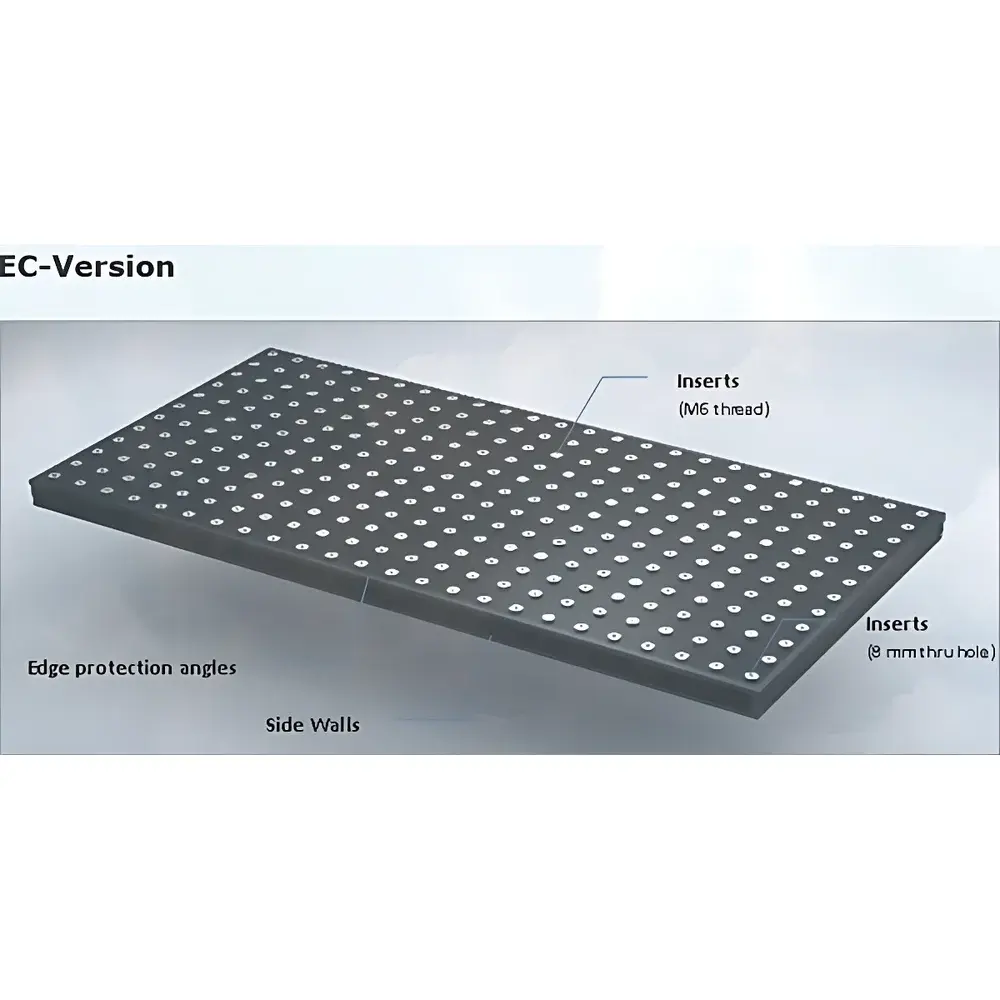
Carbon Vision EC-Vision Economical Carbon Fiber Optical Breadboard
| Brand | Carbon Vision |
|---|---|
| Origin | Germany |
| Model | EC-Vision Economical Series |
| Core Construction | Aluminum or Nomex® honeycomb core with CFRP face sheets |
| Mounting Grid | M6 threaded inserts on 25 mm grid (standard), customizable |
| Thickness Options | 50 mm, 80 mm, 130 mm (standard) |
| Standard Sizes | 600 × 900 mm, 900 × 1200 mm, 1200 × 1800 mm |
| Thermal Expansion Coefficient | ~0.2–0.5 × 10⁻⁶ /K (axial, depending on layup) |
| Density | ~1.5–1.7 g/cm³ |
| Stiffness-to-Weight Ratio | >5× higher than steel, >3× higher than aluminum breadboards |
| Magnetic Permeability | μᵣ ≈ 1.0 (non-magnetic) |
| Environmental Tolerance | Humidity-independent operation |
Overview
The Carbon Vision EC-Vision Economical Carbon Fiber Optical Breadboard is an engineered structural platform designed for high-stability optical and precision metrology applications where thermal drift, mechanical resonance, and mass constraints are critical. Built upon a lightweight honeycomb core—typically aluminum or Nomex®—sandwiched between unidirectional or quasi-isotropic carbon fiber reinforced polymer (CFRP) face sheets, the EC-Vision series delivers exceptional dimensional stability without compromising rigidity. Its operational principle relies on the intrinsic orthotropic mechanical properties of CFRP composites: ultra-low coefficient of thermal expansion (CTE) in the fiber direction, high specific modulus (>120 GPa/g·cm⁻³), and near-zero magnetic susceptibility. Unlike traditional steel or aluminum breadboards, the EC-Vision platform exhibits minimal deflection under static load (e.g., <1.2 µm center sag under 22.7 kg at mid-span on a 600 × 900 mm, 130 mm-thick unit), while maintaining compatibility with ultra-high-vacuum (UHV) chambers, MRI environments, and cryogenic staging systems. The EC-series architecture allows stiffness tuning via optional CFRP reinforcement plates bonded to top/bottom surfaces—enabling application-specific optimization without redesigning the base structure.
Key Features
- Ultra-Low Thermal Drift: Axial CTE of 0.2–0.5 × 10⁻⁶ /K—approximately 1/10 that of stainless steel and 1/4 that of 6061-T6 aluminum—ensuring sub-micron positional stability across laboratory temperature fluctuations (±2°C).
- Mass Efficiency: Typical density of 1.5–1.7 g/cm³ yields up to 75% weight reduction versus equivalent steel platforms, easing integration into motion-controlled stages and airborne or satellite-mounted instrumentation.
- Vibration Damping Enhancement: Composite damping ratio (tan δ) exceeds 0.015—60% higher than conventional metal breadboards—suppressing resonant amplification in the 50–500 Hz range common in building-borne and pump-induced vibrations.
- Non-Magnetic & Vacuum-Compatible: Fully non-ferromagnetic construction meets ASTM E595 total mass loss (TML) < 1.0% and collected volatile condensable materials (CVCM) < 0.10%, qualifying for Class 10⁻⁷ mbar UHV use and MRI-adjacent optical setups.
- Corrosion-Immune Surface Integrity: CFRP face sheets resist oxidation, galvanic degradation, and humidity-induced creep—eliminating maintenance requirements associated with anodized aluminum or passivated steel platforms.
- Configurable Mechanical Performance: Stiffness can be incrementally increased by bonding additional CFRP laminates to either side—a design flexibility unavailable in monolithic metal alternatives.
Sample Compatibility & Compliance
The EC-Vision breadboard is compatible with standard optical components (lenses, mirrors, kinematic mounts, translation stages) using M6 × 0.75 threaded inserts arranged on a 25 mm pitch grid (customizable to 12.5 mm or metric ISO threads). It supports static loads up to 120 kg distributed over ≥3 support points (per 600 × 900 mm unit, 130 mm thickness). All CFRP layups comply with RoHS Directive 2011/65/EU and REACH Annex XVII restrictions. Manufacturing adheres to ISO 9001:2015 quality management protocols. While not certified to ISO 14644 cleanroom standards, surface roughness (Ra < 0.8 µm) and low particle shedding make it suitable for Class 1000 (ISO 6) environments when handled with cleanroom protocols. No special grounding is required; however, optional conductive CFRP variants (surface resistivity < 10⁴ Ω/sq) are available for ESD-sensitive applications.
Software & Data Management
The EC-Vision platform is a passive mechanical component and does not incorporate embedded electronics, firmware, or software interfaces. However, its geometric and material specifications—including CAD models (STEP, IGES), finite element mesh files (.inp), and thermal-mechanical performance datasets—are provided in machine-readable formats for integration into optical design workflows (Zemax OpticStudio, CODE V, FRED) and structural simulation suites (ANSYS Mechanical, COMSOL Multiphysics). Carbon Vision supplies traceable calibration reports for flatness (≤ ±5 µm over 600 × 900 mm, per ISO 10360-2), parallelism (≤ 3 arcsec), and surface finish. All documentation conforms to GLP-compliant archiving standards, supporting audit readiness for regulated R&D environments (e.g., photonics development under FDA 21 CFR Part 11–aligned QA systems).
Applications
- Interferometric measurement systems requiring sub-wavelength path-length stability over multi-hour acquisitions
- Vacuum-compatible quantum optics benches for trapped-ion or cold-atom experiments
- Aerospace-grade inertial sensor test platforms subject to thermal cycling (−40°C to +70°C)
- High-power laser system bases where thermal lensing in metal substrates induces beam pointing instability
- Nanoscale imaging rigs (e.g., AFM, STED, PALM) demanding mechanical Q-factors >10⁴ to suppress acoustic coupling
- MRI-embedded optical coherence tomography (OCT) probes requiring zero magnetic interference
FAQ
Is the EC-Vision breadboard compatible with existing aluminum optical rails and post holders?
Yes—standard M6 mounting holes align with industry-standard optical hardware from Thorlabs, Newport, and Standa. Adapters for M4 or 1/4″-20 accessories are available.
Can custom cutouts or cable routing channels be machined post-purchase?
No—CFRP machining requires diamond tooling and controlled dust extraction. All cutouts, ports, and recesses must be specified at order stage.
What is the maximum operating temperature for long-term use?
Continuous exposure up to 80°C is supported; short-term excursions to 120°C are permissible with reduced mechanical life expectancy.
Does the honeycomb core affect electromagnetic shielding performance?
The standard EC-Vision offers no inherent RF shielding. Conductive epoxy-coated or copper-clad CFRP variants are offered separately for EMI-sensitive applications.
Are ISO/ASME GD&T tolerances documented for each unit?
Yes—flatness, parallelism, and hole position tolerances are measured via coordinate measuring machine (CMM) and reported in the Certificate of Conformance shipped with each platform.




