
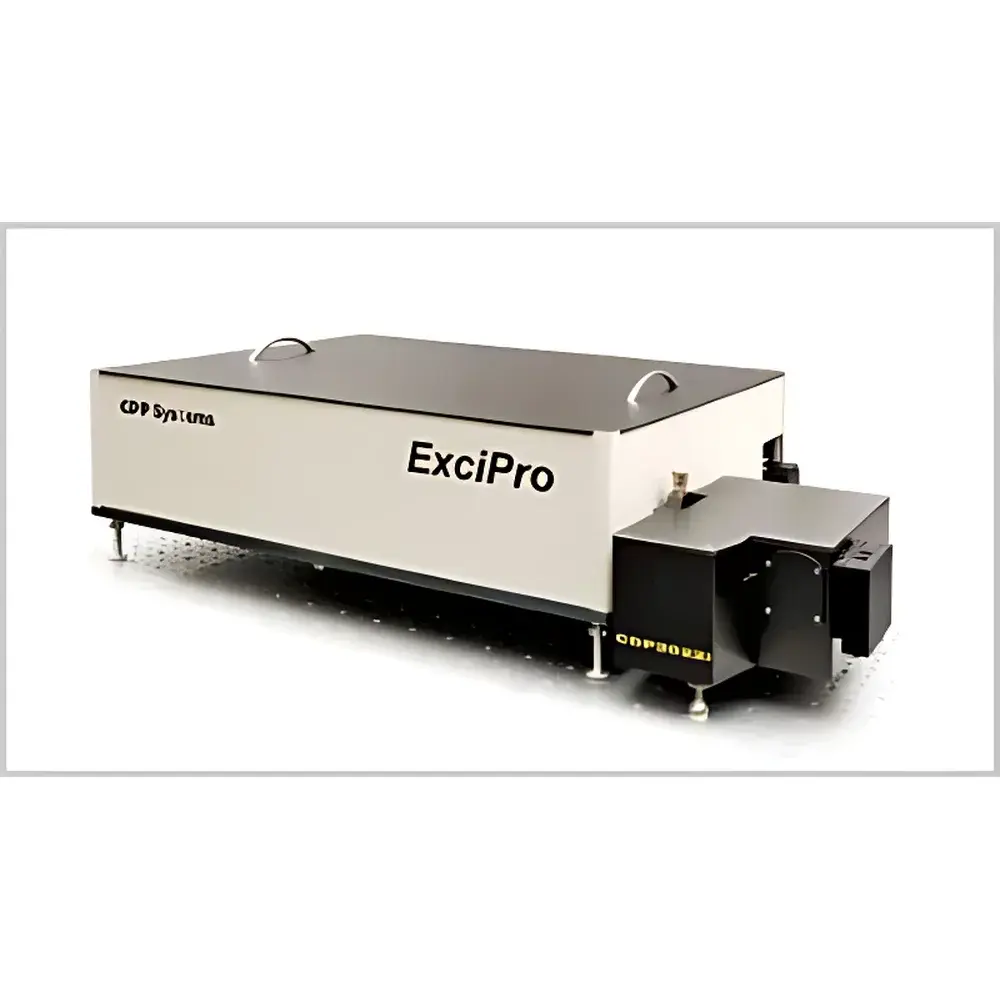
CDP ExciPro Femtosecond Pump-Probe Transient Absorption Spectrometer
| Brand | CDP |
|---|---|
| Origin | Imported (Non-Chinese) |
| Manufacturer Type | Authorized Distributor |
| Model | ExciPro |
| Multichannel Visible Probe Range | 350–1000 nm |
| Multichannel IR Probe Range | 900–1600 nm |
| Single-Channel Probe Range | 250–2500 nm |
| Max Pump–Probe Delay | 2.0 ns (4.0 ns optional double-pass) |
| Optical Delay Step Resolution | 1.56 fs |
| Max Repetition Rate (Multichannel) | 1 kHz |
| Temporal Resolution | < 100 fs |
| Detection Modes | Multichannel & Single-Channel ΔOD |
| Excitation Source | Integrated SHG + All-Reflective White-Light Continuum Generator |
| Software | ExciPro 2.5 (acquisition, transient spectral analysis, chirp correction) |
| Compliance | Designed for GLP-compliant ultrafast spectroscopy workflows |
Overview
The CDP ExciPro Femtosecond Pump-Probe Transient Absorption Spectrometer is a turnkey ultrafast optical instrument engineered for quantitative, time-resolved measurement of photoinduced electronic and vibrational dynamics in molecular, nanoscale, and condensed-phase systems. It operates on the fundamental principle of collinear or non-collinear pump-probe spectroscopy: an ultrashort (<100 fs) excitation pulse ("pump") initiates a non-equilibrium state in the sample, while a time-delayed, broadband probe pulse interrogates the resulting changes in absorption—quantified as optical density difference (ΔOD)—across wavelength and delay time. By scanning the optical path length of the probe relative to the pump via a high-stability, computer-controlled reflective delay line with 1.56 fs step resolution, the system reconstructs transient spectra with sub-100 fs temporal fidelity. The ExciPro integrates all critical subsystems—including a synchronized femtosecond oscillator/amplifier interface, internal second-harmonic generation (SHG), an all-reflective white-light continuum (WLC) generator, and dual-path detection architecture—into a vibration-isolated, air-stable optical platform optimized for long-term operational reproducibility in academic and industrial R&D laboratories.
Key Features
- Fully integrated pump-probe architecture with <100 fs temporal resolution, validated via autocorrelation and cross-correlation diagnostics
- Simultaneous multichannel detection across visible (350–1000 nm) and near-infrared (900–1600 nm) spectral bands using NMOS linear image sensors with >70 dB dynamic range and low read-noise performance
- Single-channel extended-range probing (250–2500 nm) enabled by optional CDP 2017 optical parametric amplifier (OPA) integration
- Computer-controlled four-grating imaging spectrometer turret for rapid, software-selectable dispersion and spectral calibration
- Dual-beam reference channel for real-time normalization of laser intensity fluctuations and environmental drift
- Internal all-reflective WLC source eliminates chromatic aberration and ensures flat spectral output without transmissive optics degradation
- Embedded delay-line control firmware with sub-femtosecond interpolation and backlash-free stepping for high-precision time-domain sampling
Sample Compatibility & Compliance
The ExciPro supports transient absorption measurements on diverse sample formats including liquid solutions (cuvettes, flow cells), spin-coated thin films (e.g., perovskites, organic semiconductors), single crystals, and solid-state nanostructures. Its modular beam delivery accommodates standard 1-inch optical mounts and optional cryostat or gas-cell interfaces. The system adheres to ISO/IEC 17025-relevant practices for metrological traceability of delay timing and spectral calibration. Data acquisition and processing workflows are compatible with GLP and GMP environments: ExciPro 2.5 software maintains full audit trails, user-access logs, and version-controlled parameter sets per experiment, satisfying documentation requirements under FDA 21 CFR Part 11 for regulated research applications.
Software & Data Management
ExciPro 2.5 is a native Windows-based application developed specifically for ultrafast spectroscopy data handling. It provides synchronized hardware control (delay stage, spectrometer grating position, detector gain, OPA tuning), real-time ΔOD calculation, and post-acquisition global fitting routines (singular value decomposition, target analysis, kinetic modeling). Built-in chirp compensation algorithms correct for group-delay dispersion in probe pulses using reference interferograms. All raw and processed datasets are stored in HDF5 format with embedded metadata (wavelength grid, delay array, instrument configuration, timestamp), ensuring FAIR (Findable, Accessible, Interoperable, Reusable) data principles. Export modules support ASCII, MATLAB (.mat), and Python-compatible NumPy arrays for integration into custom analysis pipelines.
Applications
- Charge carrier relaxation and recombination kinetics in photovoltaic materials (e.g., halide perovskites, OPVs, quantum dots)
- Vibrational energy redistribution and solvation dynamics in solution-phase photochemistry
- Exciton formation, dissociation, and transport in 2D materials (MoS₂, WS₂) and heterostructures
- Photoinduced electron transfer in catalytic complexes and biomimetic systems
- Ultrafast intersystem crossing and triplet-state population dynamics in organic emitters
- Nonlinear optical response characterization of novel transparent conductors and plasmonic metasurfaces
FAQ
What laser systems are compatible with the ExciPro?
The ExciPro is designed for synchronization with Ti:sapphire oscillators (70–100 MHz) and regenerative amplifiers (1–10 kHz). It accepts standard 800 nm fundamental input; optional harmonic modules enable 400 nm and 266 nm excitation.
Can the system be upgraded for mid-IR probe detection beyond 1600 nm?
Yes—integration of a CDP 2017 OPA with idler output enables tunable probe wavelengths up to 16 µm, supporting ultrafast vibrational spectroscopy in the fingerprint region.
Is remote operation supported for shared facility use?
ExciPro 2.5 includes TCP/IP-based API access and VNC-compatible remote desktop protocols, enabling secure off-site monitoring and scheduled experiments without physical presence.
How is spectral calibration performed and maintained?
Calibration uses NIST-traceable Hg/Ar emission lines and is stored per grating position; automated recalibration routines execute at user-defined intervals or after environmental perturbation detection.
Does the system meet electromagnetic compatibility (EMC) standards for laboratory deployment?
The ExciPro complies with EN 61326-1:2013 for laboratory equipment EMC and meets CE marking requirements for Class A emissions and immunity in scientific environments.
Related Products




