
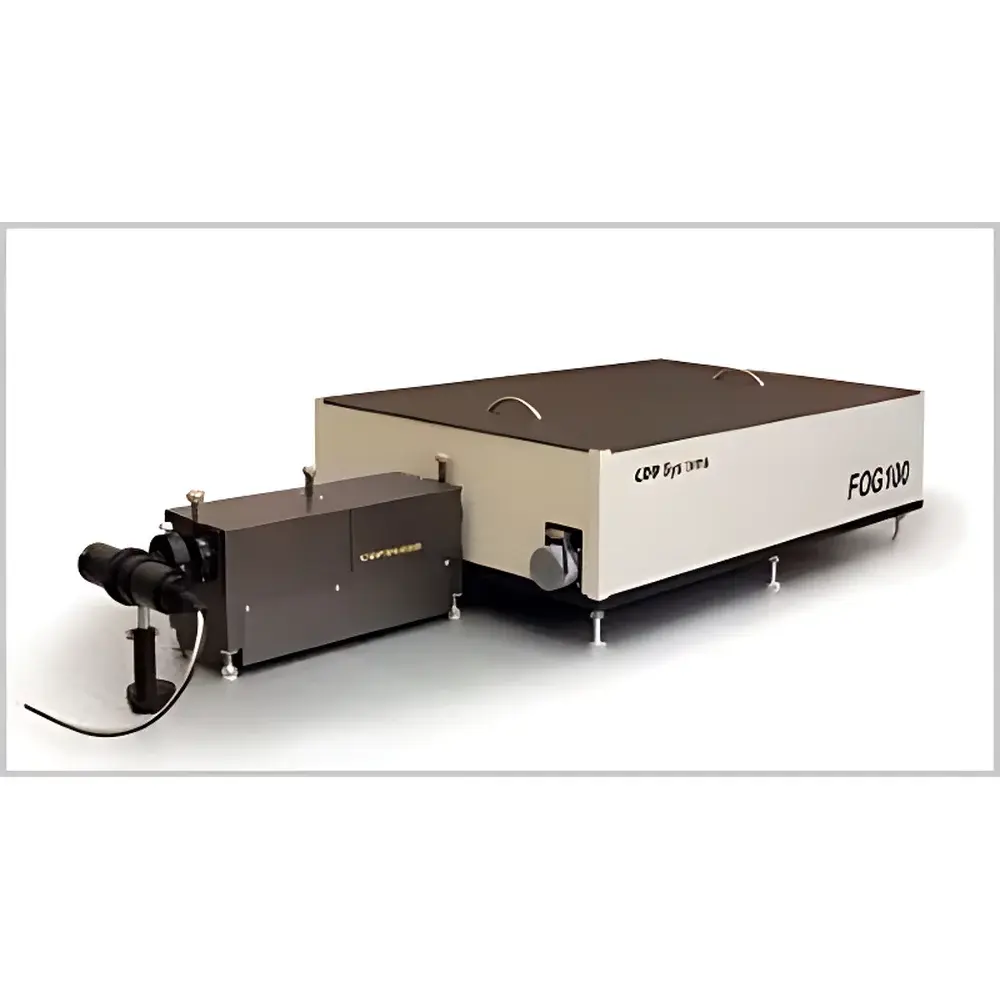
CDP FOG100 Fluorescence Upconversion Spectrometer
| Brand | CDP |
|---|---|
| Origin | Russia |
| Model | FOG100 |
| Spectral Range | 320–1600 nm (excitation-dependent) |
| Repetition Rate | 1 kHz–10 kHz (DA), 100 kHz–100 MHz (DX) |
| Max Gate-Excitation Delay | 2.0 ns (optional up to 6.0 ns) |
| Minimum Delay Step | 1.56 fs |
| Temporal Resolution | < 100 fs |
| Dynamic Range | > 10⁵ |
| Monochromator | Computer-Controlled Dual Grating |
| Capabilities | Fluorescence Anisotropy, Time-Resolved Kinetics (solutions, solids, thin films) |
| Compliance | Designed for GLP/GMP-aligned laboratories |
Overview
The CDP FOG100 Fluorescence Upconversion Spectrometer is a turnkey, ultrafast time-resolved spectroscopic system engineered for quantitative measurement of fluorescence decay dynamics in the femtosecond-to-nanosecond regime. Unlike conventional time-correlated single-photon counting (TCSPC) or streak camera-based approaches, the FOG100 implements fluorescence optical gating—a nonlinear cross-correlation technique wherein signal generation occurs only when both the excitation pulse and a time-delayed gate pulse spatially and temporally overlap within the sample volume. This principle decouples temporal resolution from detector bandwidth limitations; instead, resolution is governed solely by the duration and synchronization fidelity of the two ultrashort laser pulses—typically sub-100 fs Ti:sapphire oscillator outputs. As a result, the FOG100 delivers intrinsic time resolution independent of photodetector rise time, enabling direct, background-free acquisition of transient emission profiles without iterative deconvolution. Since its commercial introduction in 1997, the platform has undergone continuous hardware refinement—including optimized noncollinear phase-matching geometry, thermally stabilized optical delay lines, and low-noise PMT detection—making it a benchmark instrument for laboratories requiring robust, high-fidelity ultrafast photophysical characterization.
Key Features
- Sub-100 fs intrinsic temporal resolution, verified via autocorrelation and known reference dyes (e.g., Coumarin 153 in methanol)
- Computer-controlled dual-grating monochromator with motorized slits and wavelength calibration traceable to NIST-certified emission standards
- Programmable optical delay line with 1.56 fs minimum step size and < ±5 fs long-term stability over 8-hour acquisitions
- Dual operational modes: DA variant (1–10 kHz repetition rate, optimized for high-signal SNR in dilute solutions); DX variant (100 kHz–100 MHz, compatible with amplified laser systems for low-duty-cycle solid-state samples)
- Integrated fluorescence anisotropy module enabling polarization-resolved upconversion detection with < 0.5° extinction ratio control
- Rugged optomechanical architecture with kinematic mirror mounts, vibration-damped baseplate, and sealed optical path to minimize air-current-induced dispersion drift
Sample Compatibility & Compliance
The FOG100 accommodates diverse sample formats without modification: cuvette-based liquid solutions (1–4 mm path length), spin-coated thin films (≥10 nm thickness), single crystals, and powder pellets mounted on quartz substrates. All optical interfaces are designed to maintain alignment integrity under thermal cycling (15–30 °C ambient range). The system meets essential requirements for regulated environments: raw data files include embedded metadata (timestamp, delay position, grating angle, PMT voltage, laser energy monitor reading); file structure and naming conventions align with ISO/IEC 17025 documentation practices. When operated with validated third-party acquisition software (e.g., LabVIEW-based modules compliant with 21 CFR Part 11), the platform supports electronic signatures, audit trails, and user-access-level controls required for GLP and GMP workflows.
Software & Data Management
Instrument control and data acquisition are managed via a Windows-based native application supporting real-time spectral reconstruction, global fitting of multi-exponential decay models (e.g., τ₁, τ₂, amplitudes, χ² minimization), and batch processing of anisotropy datasets. Export formats include ASCII (.txt), HDF5 (.h5), and vendor-neutral .SPE for interoperability with Igor Pro, MATLAB, and OriginLab. All acquired transients are stored with full provenance: excitation wavelength, gate polarization state, monochromator slit width, and environmental sensor logs (temperature, humidity). Optional Python API enables integration into automated screening pipelines—for instance, coupling with robotic sample changers for high-throughput photochemical stability assays.
Applications
- Ultrafast solvation dynamics in polar solvents (e.g., time-dependent Stokes shift analysis)
- Charge-transfer state formation and recombination kinetics in organic photovoltaic blends
- Energy transfer efficiency quantification in lanthanide-doped nanoparticles and perovskite quantum dots
- Triplet-triplet annihilation upconversion (TTA-UC) mechanism validation in donor-acceptor systems
- Anisotropy decay profiling to determine rotational diffusion coefficients and molecular rigidity in polymer matrices
- Photostability assessment of fluorescent probes under pulsed irradiation (e.g., STED-compatible dyes)
FAQ
What laser sources are compatible with the FOG100?
The system is designed for use with mode-locked Ti:sapphire oscillators (700–1000 nm, <100 fs pulse width) and their frequency-doubled or OPA-tuned derivatives. Synchronization electronics support external trigger inputs from regenerative amplifiers (e.g., Spitfire Pro) with jitter < 100 ps.
Can the FOG100 measure phosphorescence lifetimes?
No—the optical gating mechanism requires prompt fluorescence emission coincident with the gate pulse; microsecond-to-second phosphorescent decays fall outside the maximum 6 ns delay window and lack sufficient instantaneous photon flux for nonlinear signal generation.
Is vacuum or purged operation required for UV measurements below 350 nm?
Yes. For spectral acquisition below 350 nm, the monochromator housing and sample compartment must be continuously purged with dry nitrogen (dew point < −40 °C) to minimize ozone absorption and Rayleigh scattering artifacts.
How is calibration performed for temporal axis accuracy?
Delay stage calibration uses a HeNe interferometer referenced to a stabilized Fabry–Pérot cavity; wavelength calibration employs Hg/Ar spectral lamp lines with RMS residual < 0.15 nm across the full 320–1600 nm range.
Does the system support time-resolved emission spectra (TRES) acquisition?
Yes. The dual-monochromator architecture enables simultaneous scanning of both excitation and emission axes, allowing construction of TRES maps at user-defined delay points with 0.5 nm spectral resolution and 5 fs temporal sampling intervals.





