
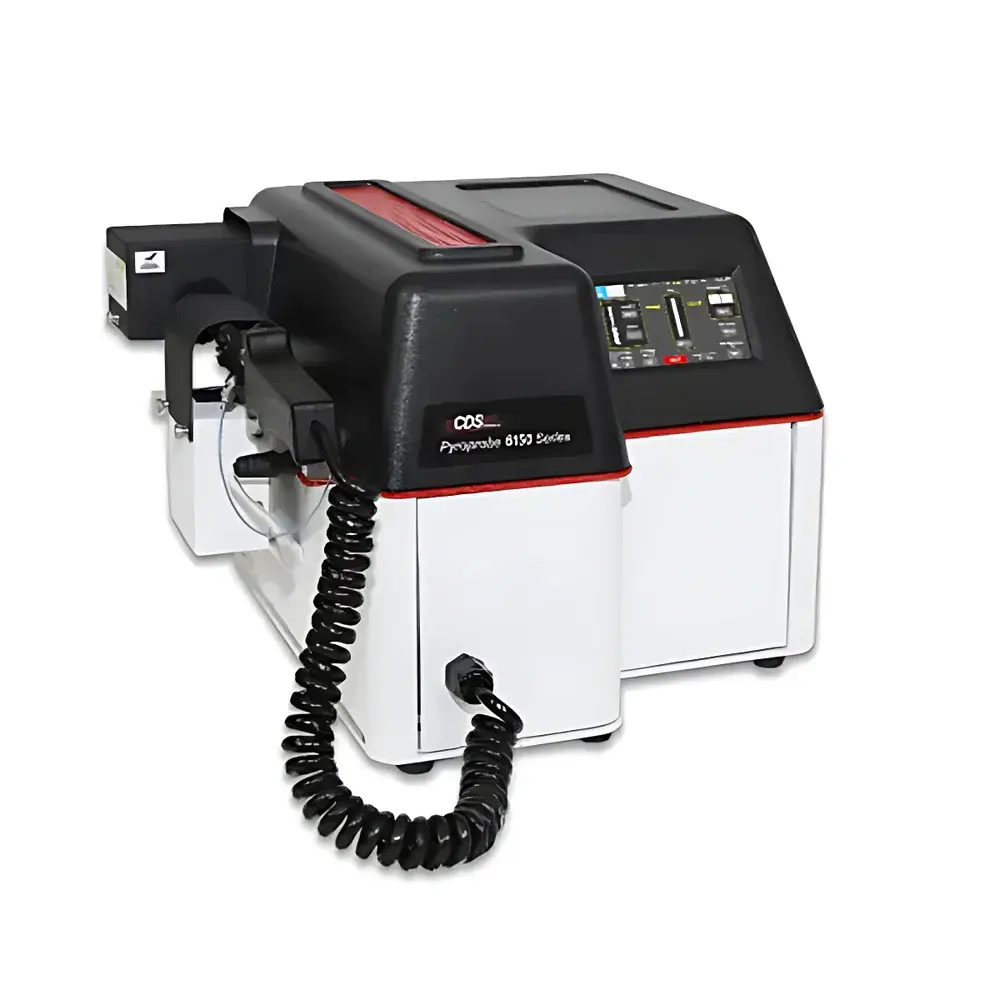
CDS 6150 Automated Pyrolyzer
| Brand | CDS Analytical |
|---|---|
| Origin | USA |
| Model | 6150 |
| Pyrolyzer Type | Filament-Heated Pyrolyzer |
| Temperature Range | Ambient to 1300 °C (1 °C increment) |
| Temperature Accuracy | ±0.1 °C |
| Cooling Time | <18 s (from 650 °C to <50 °C, gas-free) |
| Reproducibility | RSD ≤1.5% (polystyrene standard) |
| Transfer Line Max Temp | 350 °C |
| Programmable Steps per Method | Up to 10 |
| GC Trigger Support | Per-step synchronized GC start signal |
| Sample Tube | Reusable fused-silica quartz tube |
| Optional Autosampler | 48-position |
Overview
The CDS 6150 Automated Pyrolyzer is a high-precision, filament-heated thermal pyrolysis system engineered for seamless integration with any make or model of gas chromatograph (GC) or gas chromatography–mass spectrometer (GC/MS). It operates on the principle of controlled, rapid thermal degradation—subjecting solid or viscous samples to precisely defined temperature profiles under inert atmosphere to generate volatile fragments representative of original macromolecular structure. Unlike furnace-based systems, the CDS 6150 employs a platinum-resistance heated filament assembly that enables direct, real-time temperature measurement and feedback control at the sample zone, minimizing thermal lag and maximizing method fidelity. Its design supports both single-shot flash pyrolysis and multi-step programmed pyrolysis, making it suitable for structural elucidation of polymers, identification of additives in complex matrices, and characterization of thermally labile organic materials across regulated and research-driven environments.
Key Features
- Ultra-fast thermal cycling: Achieves cooling from 650 °C to below 50 °C in under 18 seconds without external cooling gas—reducing cycle time and enhancing throughput.
- High-fidelity temperature control: Platinum resistance heating and sensing integrated into the filament stage deliver ±0.1 °C accuracy and stability across the full 25–1300 °C operating range, with 1 °C programmable resolution.
- Intuitive human-machine interface: Integrated 7-inch capacitive touchscreen provides full method editing, real-time status monitoring, one-touch run initiation, and diagnostic logging—all accessible without external PC dependency.
- Programmable multi-step pyrolysis: Supports up to 10 independent temperature ramps or holds per method; each step can emit a TTL-trigger signal to initiate GC acquisition, enabling discrete chromatograms per thermal event.
- High-temperature transfer line: Heated capillary interface rated to 350 °C ensures quantitative transfer of thermally sensitive pyrolysates while remaining compatible with concurrent use of other GC inlet configurations (e.g., split/splitless, PTV).
- Reusable quartz sample tubes: Chemically inert fused-silica tubes allow repeated use after simple solvent rinsing or low-temperature ashing; optical transparency enables visual verification of sample placement and morphological changes during heating.
Sample Compatibility & Compliance
The CDS 6150 accommodates diverse sample forms—including powders, films, fibers, adhesives, cured resins, biological tissues, and microgram-scale forensic traces—without derivatization or extensive pretreatment. Its robust thermal architecture meets ASTM E2912 (Standard Guide for Pyrolysis–Gas Chromatography) and ISO 17202 (Plastics — Determination of additives by pyrolysis–GC) requirements. When operated in conjunction with validated GC/MS workflows, the system supports GLP-compliant data generation, including audit-trail-enabled method storage, user-access logs, and electronic signature-ready operation when paired with 21 CFR Part 11–compliant chromatography data systems (CDS). All hardware components are CE-marked and RoHS-compliant.
Software & Data Management
While the instrument operates autonomously via its embedded controller, optional CDS Pyrolysis Method Manager software (Windows-based) provides advanced method development, remote monitoring, batch scheduling, and report templating. Raw pyrolysis parameters—including actual vs. setpoint temperature profiles, trigger timestamps, and cooling kinetics—are logged in ASCII format for traceability. Exportable metadata aligns with ASTM E1947 and ASTM E2524 standards for chromatographic data exchange, facilitating integration into LIMS environments and automated QA/QC pipelines. Instrument diagnostics—including filament resistance drift, heater duty cycle, and thermal sensor health—are continuously monitored and archived.
Applications
The CDS 6150 serves as a critical front-end tool in multiple analytical domains: polymer identification and degradation pathway analysis in rubber, plastics, and composites; additive profiling (e.g., plasticizers, flame retardants, antioxidants) in electronics and packaging; lignin/cellulose ratio quantification in biomass feedstock assessment; forensic differentiation of synthetic fibers and paint binders; characterization of aged varnishes and binding media in cultural heritage conservation; and compositional screening of tobacco-specific nitrosamines and pyrolytic alkaloids. Its reproducibility (RSD ≤1.5% for polystyrene) ensures suitability for inter-laboratory comparison studies and regulatory submissions.
FAQ
Can the CDS 6150 be used with third-party GC/MS systems?
Yes—the pyrolyzer communicates via industry-standard TTL trigger signals and analog temperature outputs, ensuring compatibility with Agilent, Thermo Fisher, Shimadzu, PerkinElmer, and other major GC/MS platforms.
Is helium required for cooling or carrier gas?
No external cooling gas is needed for rapid cooldown; however, helium or nitrogen is required as the GC carrier gas and purge gas for the pyrolysis chamber, per standard pyrolysis-GC practice.
What maintenance is required for the filament heating system?
The platinum-resistance filament requires no routine replacement under normal use; periodic calibration verification using NIST-traceable reference materials (e.g., polystyrene, polyethylene) is recommended every 6 months or 200 runs.
Does the 48-position autosampler support unattended overnight operation?
Yes—the optional autosampler includes collision detection, tube presence sensing, and error-recovery logic, enabling fully automated sequences across heterogeneous sample sets with minimal operator intervention.
How is data integrity ensured during long-term deployment?
All method parameters, temperature logs, and trigger events are timestamped and stored locally on non-volatile memory; optional network connectivity allows secure FTP/SFTP export to centralized data repositories with SHA-256 checksum validation.






