
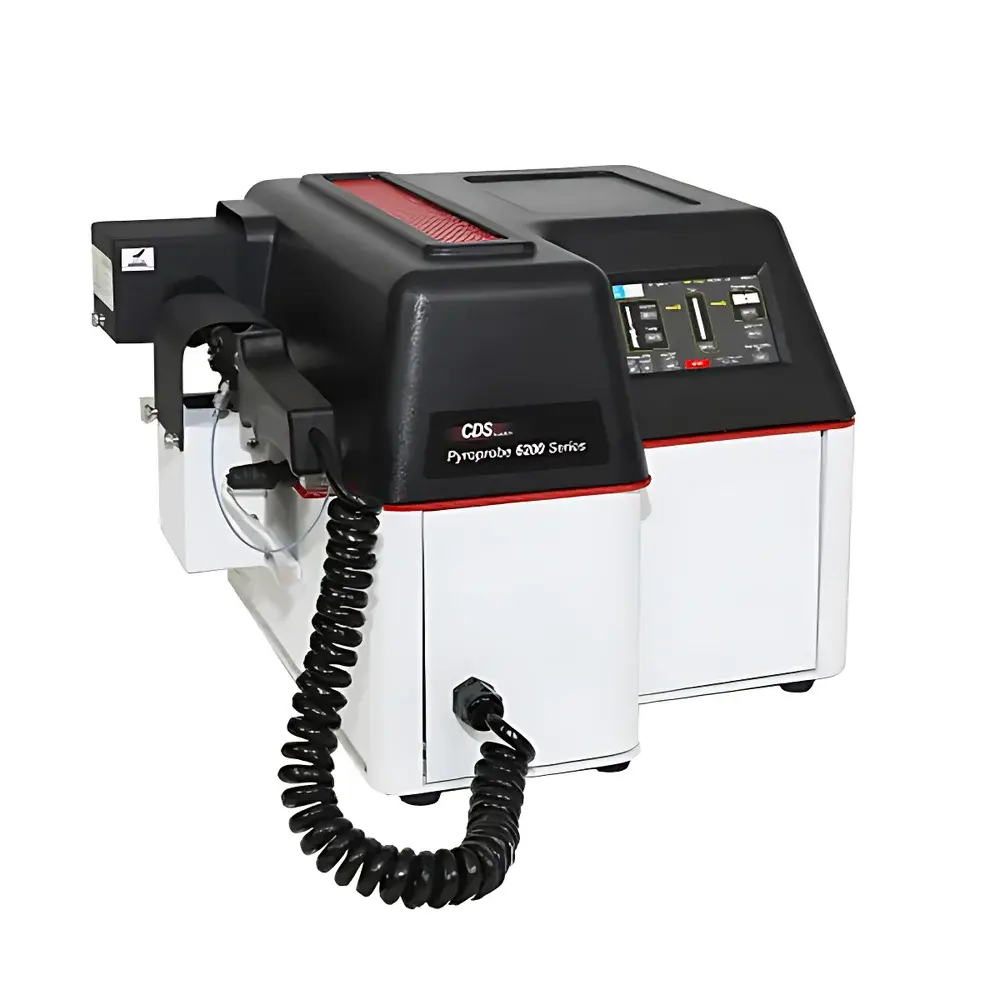
CDS 6200 Automated Pyrolyzer
| Brand | CDS Analytical |
|---|---|
| Origin | USA |
| Model | 6200 |
| Pyrolyzer Type | Filament (Wire) Pyrolyzer |
| Temperature Range | Ambient to 1300 °C (1 °C increment) |
| Temperature Accuracy | ±0.1 °C |
| Cooling Rate | From 650 °C to <50 °C in ≤18 s (no cryogenic gas required) |
| Reproducibility | RSD ≤1.5% (polystyrene standard) |
| Transfer Line Max Temp | 350 °C |
| Programmable Steps per Method | Up to 10 |
| Sample Capacity | 48-position auto-sampler (optional) |
| Operating Interface | Integrated touchscreen with one-touch start |
| Heating System | Platinum RTD-integrated resistive filament |
| Atmosphere Control | Switchable carrier/reactive gases (e.g., He, air) |
| Modes | Direct-to-GC and Cold Trap (cryo-trap optional) |
| Software-Controlled Mode Switching | Yes |
| Optional Functions | Thermal Desorption, Dynamic Headspace, Electronic Flow Control, Spectral Library Integration |
Overview
The CDS 6200 Automated Pyrolyzer is a high-precision, filament-based thermal pyrolysis system engineered for seamless integration with any GC or GC/MS platform. It operates on the principle of controlled, rapid thermal decomposition under inert or reactive atmospheres—enabling structural elucidation of thermally labile, non-volatile, or macromolecular analytes that cannot be directly introduced into chromatographic systems. Designed for laboratories requiring rigorous method reproducibility and regulatory compliance, the CDS 6200 delivers precise temperature control across a wide operational range (ambient to 1300 °C), sub-second thermal response, and real-time platinum RTD feedback for closed-loop heating stability. Its architecture supports both qualitative fingerprinting and quantitative analysis of polymers, additives, natural organic matter, synthetic resins, and complex matrices encountered in forensic, environmental, petrochemical, and cultural heritage applications.
Key Features
- Resistive filament heating with integrated platinum resistance thermometer (RTD) ensures accurate, drift-free temperature measurement and active feedback control.
- Ultra-fast cooling (<18 s from 650 °C to <50 °C) achieved without liquid nitrogen or compressed air—minimizing cycle time and eliminating external utility dependencies.
- Intuitive 7-inch capacitive touchscreen interface with one-touch method launch, real-time status monitoring, and on-device method storage.
- High-temperature transfer line (up to 350 °C) enables direct coupling to GC inlet; independently heated to prevent condensation and ensure quantitative transfer of volatile裂解 fragments.
- Programmable multi-step pyrolysis protocols (up to 10 steps per method) support evolving thermal degradation studies—including ramp-hold-cool sequences for mechanistic insight.
- Atmosphere switching capability allows in situ transition between inert (He, N₂) and oxidative (air, O₂) environments—critical for simulating combustion behavior or distinguishing thermal vs. oxidative degradation pathways.
- Software-selectable operation modes: direct injection (bypassing trap) and cold-trap collection (with optional cryo-cooling)—each mode validated for retention time stability and peak shape fidelity.
Sample Compatibility & Compliance
The CDS 6200 accommodates standard 3.5 mm OD quartz pyrolysis tubes—reusable, solvent-cleanable, and optically transparent for visual sample placement verification. Its design conforms to ASTM E2912 (Standard Guide for Pyrolysis–Gas Chromatography), ISO 17201-3 (Fire testing — Ignitability of materials), and USP requirements for thermal desorption and pyrolytic sample introduction. When configured with electronic flow control and audit-trail-enabled software, the system meets FDA 21 CFR Part 11 data integrity criteria for regulated QC/QA environments. All firmware and method parameters are timestamped and user-attributed, supporting GLP/GMP documentation workflows.
Software & Data Management
Control and method development are managed via CDS Pyrolysis Workstation software—a Windows-based application supporting method import/export, batch queueing, remote monitoring, and automated report generation (PDF/CSV). The software logs all instrument events—including temperature profiles, gas switching timestamps, trap activation cycles, and auto-sampler positioning—with SHA-256 hash verification for raw data immutability. Integrated spectral library matching (NIST-compatible) enables rapid identification of pyrolyzate fragments. Optional modules include dynamic headspace quantification algorithms and thermal desorption calibration curves compliant with EPA TO-17 and ISO 16000-6.
Applications
- Forensic science: Identification of synthetic fibers, paint binders, and ignitable liquid residues via characteristic pyrolyzate patterns.
- Polymer characterization: Differentiation of copolymer composition, detection of plasticizers, flame retardants, and stabilizers in rubber, PVC, and engineering thermoplastics.
- Biomass and biofuel research: Quantitative assessment of lignin/cellulose ratios, thermal stability of algal biomass, and pyrolytic oil composition profiling.
- Electronics failure analysis: Detection of encapsulant degradation products, solder flux residues, and halogenated flame retardants in PCB assemblies.
- Cultural heritage: Non-destructive micro-sampling of historical adhesives, varnishes, and parchment binders—preserving artifact integrity while enabling molecular attribution.
- Petrochemical QA: Screening of catalyst coke composition, heavy feedstock heteroatom distribution, and asphaltene thermal behavior.
FAQ
Does the CDS 6200 require external cooling gas for rapid cooldown?
No—its proprietary passive cooling design achieves sub-20-second cooldown from 650 °C to <50 °C without liquid nitrogen, dry ice, or compressed air.
Can the same quartz tube be reused across multiple analyses?
Yes—standard quartz pyrolysis tubes are chemically inert, withstand repeated thermal cycling up to 1300 °C, and can be cleaned with acetone or methanol between runs.
Is the system compatible with third-party GC/MS instruments?
Yes—the CDS 6200 interfaces universally via standard 1/16″ stainless steel transfer lines and supports all major GC vendor trigger protocols (Agilent, Thermo, Shimadzu, PerkinElmer).
How is method traceability ensured in regulated labs?
All methods, run logs, temperature profiles, and gas switching events are digitally signed and archived with user ID, timestamp, and checksum validation—fully aligned with 21 CFR Part 11 Annex 11 requirements.
What optional accessories extend its analytical scope?
Available upgrades include a 48-position robotic autosampler, cryogenic cold trap module (-30 °C), dynamic headspace concentrator, thermal desorption oven, and electronic mass flow controllers for carrier/reactive gas precision.
Related Products




