
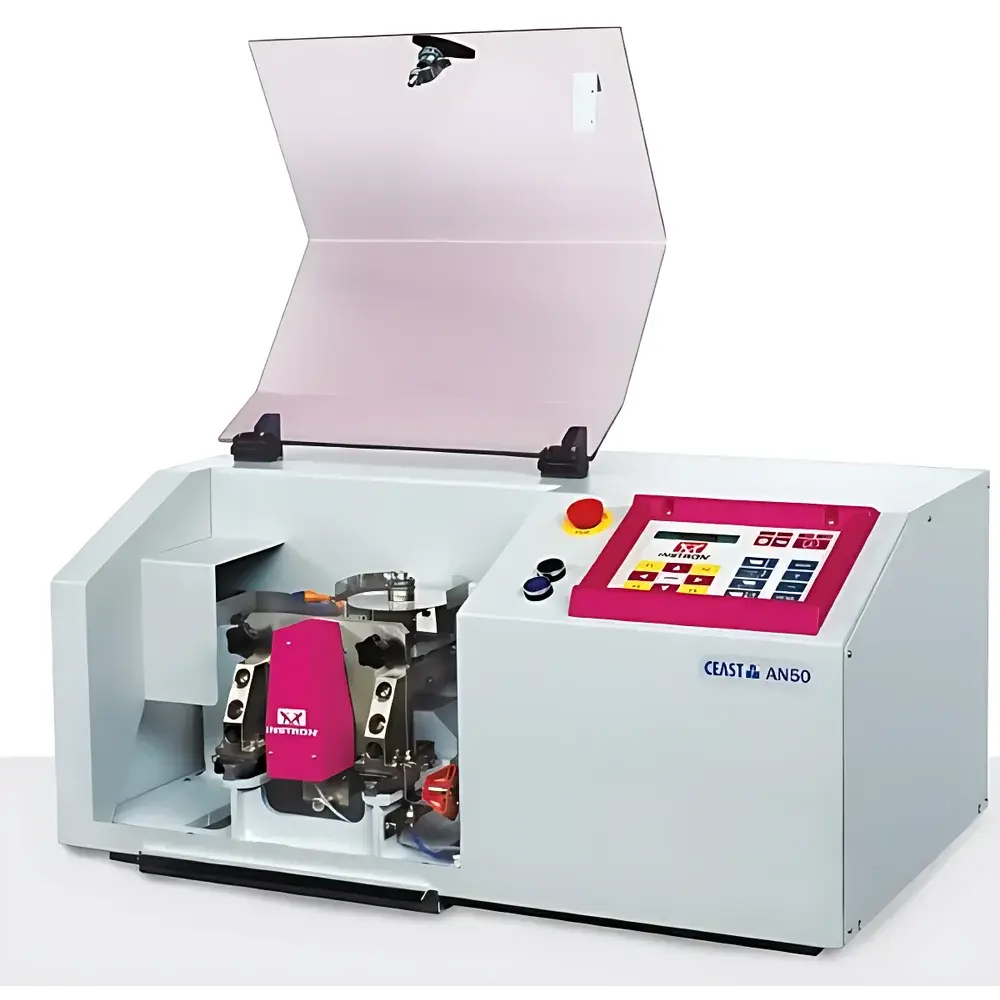
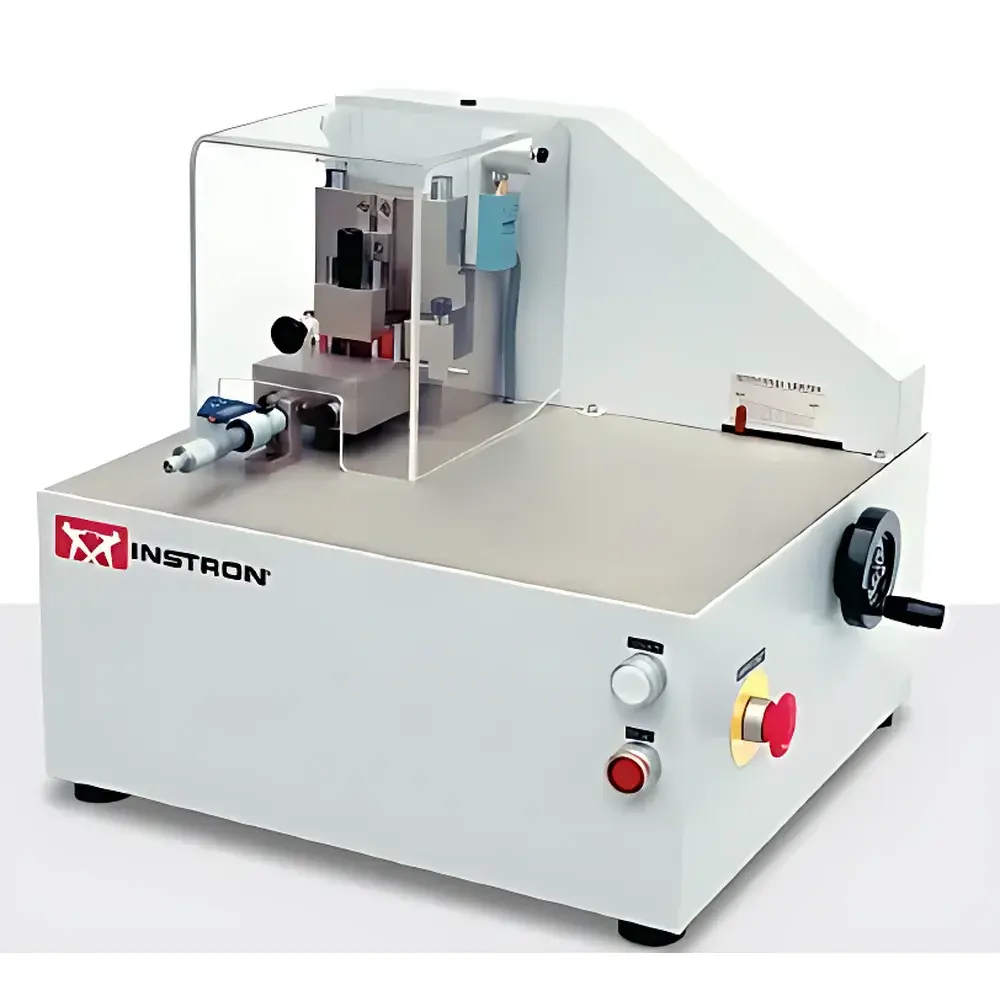
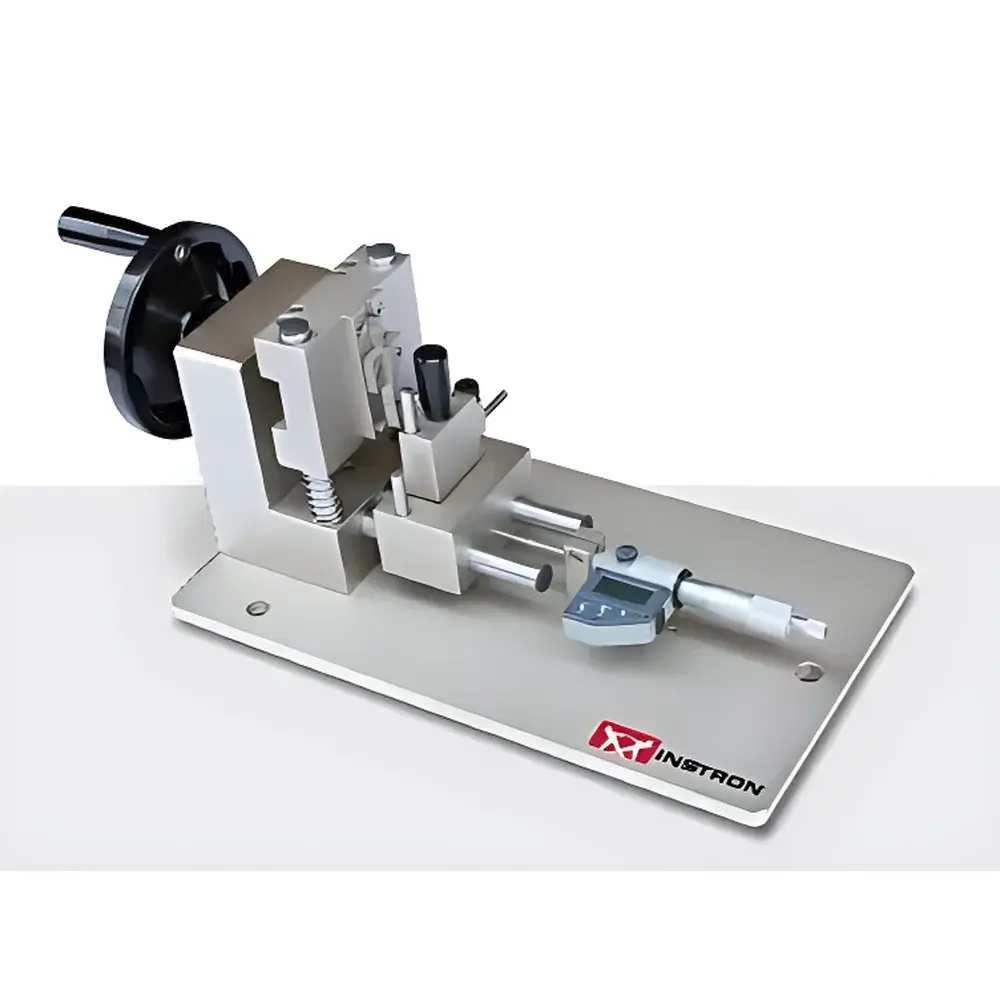
CEAST AN50 Fully Automatic Notched Specimen Preparation Machine
| Brand | INSTRON |
|---|---|
| Origin | Italy |
| Manufacturer | CEAST (INSTRON Group) |
| Type | Fully Automatic |
| Cutting Speed | 1–21 m/min |
| Stroke Travel | 0–210 mm |
| Notch Types | ISO Type A, B, C |
| Sample Capacity per Cycle | Up to 50 specimens |
| Feed Rate | 7–50 specimens per batch |
| Notch Depth Control Resolution | 0.01–0.25 mm |
| Optional Accessories | Blade Cooling Unit, Dual-Notch Fixture (for Charpy/Izod & Tensile Impact), Edge-Trimming Module, Digital Depth Gauge |
Overview
The CEAST AN50 Fully Automatic Notched Specimen Preparation Machine is an engineered solution for high-throughput, metrologically traceable notch fabrication in polymer mechanical testing laboratories. Designed and manufactured by CEAST — a brand of Instron headquartered in Turin, Italy — the AN50 implements precision linear blade motion governed by closed-loop servo control to produce standardized notches compliant with international test standards including ISO 179 (Charpy impact), ISO 180 (Izod impact), ASTM D256, ASTM D6110, ISO 8256 (tensile impact), DIN 53435, DIN 53453, and BS 2782-359. The machine operates on the principle of controlled orthogonal blade penetration into thermoplastic and reinforced thermoplastic specimens, where notch geometry — specifically root radius, depth, and flank angle — directly governs stress intensity factor (KIc) initiation behavior during subsequent impact or fracture toughness testing. Accurate notch reproducibility is not optional: deviations as small as ±0.02 mm in notch depth or ±0.05 mm in root radius can introduce >8% variance in measured impact energy, rendering comparative material qualification non-compliant with GLP or ISO/IEC 17025 requirements.
Key Features
- Fully automated cycle sequencing with programmable cutting speed (1–21 m/min) and depth (0.01–0.25 mm increments), eliminating operator-induced variability
- Simultaneous processing of up to 50 specimens per cycle using a precision-machined, interchangeable specimen holder compatible with standard 80 × 10 × 4 mm bars and ASTM D638 Type I dogbones
- Modular tooling architecture supporting ISO Type A (0.25 mm root radius), Type B (1.0 mm), and Type C (0.5 mm) notches via certified tungsten-carbide blades calibrated per ISO 9001 traceable procedures
- Optional blade cooling unit (compressed air or recirculating coolant) to suppress thermal deformation during extended runs on heat-sensitive polymers (e.g., PEEK, PEI)
- Dual-notch fixture enabling simultaneous creation of two standardized notches — one for Charpy/Izod and one for tensile impact — on a single specimen without repositioning
- Edge-trimming module for direct conversion of ASTM D638 dumbbell specimens into rectangular cross-sections meeting ISO 179/180 dimensional tolerances (±0.1 mm width, ±0.05 mm thickness)
Sample Compatibility & Compliance
The AN50 accommodates rigid and semi-crystalline thermoplastics (e.g., ABS, PC, PA6, POM, PP), fiber-reinforced composites (up to 30% glass or carbon), and engineering thermosets (e.g., epoxy laminates). Specimen thickness range: 3–12 mm; width tolerance: ±0.15 mm; surface flatness requirement: <0.05 mm deviation over 50 mm length. All notch geometries are validated against reference artifacts certified to ISO/IEC 17025-accredited calibration protocols. The system supports audit-ready documentation per FDA 21 CFR Part 11 when integrated with Instron Bluehill Universal software, including electronic signatures, change logs, and full parameter history per specimen batch.
Software & Data Management
Controlled via CEAST’s dedicated AN50 Operator Interface — a Windows-based application with intuitive workflow navigation and password-protected user roles (Operator, Technician, Administrator). Each test method stores complete parameter sets: blade type, feed rate, dwell time, depth profile, and environmental metadata (ambient temperature/humidity). Export formats include CSV, XML, and PDF reports compliant with ISO 17025 clause 7.8.2. When linked to Instron’s Bluehill Universal platform, raw notch data syncs bi-directionally with impact test results, enabling statistical process control (SPC) of KQ and GIC values across material lots.
Applications
- Quality control labs performing routine Charpy/Izod impact qualification per automotive OEM specifications (e.g., GMW14124, Ford WSS-M99P1111-A)
- Research institutions conducting fracture mechanics studies on polymer blends and nanocomposites
- Contract testing facilities accredited to ISO/IEC 17025 requiring documented, repeatable specimen preparation for inter-laboratory round robins
- R&D departments developing flame-retardant or bio-based polymers where notch sensitivity dictates regulatory compliance (UL 94, EN 13501-1)
- Failure analysis units reconstructing brittle fracture origins in field-failed components
FAQ
What standards does the AN50 support for notch geometry verification?
ISO 179-1, ISO 180-1, ASTM D256, ASTM D6110, ISO 8256, DIN 53435, and BS 2782-359 — with physical traceability to NIST SRM 2822 reference notched specimens.
Can the AN50 prepare notches in filled or abrasive composites?
Yes — tungsten-carbide blades with micro-ground edges maintain dimensional stability for ≥500 cuts on 30% glass-filled PA6; blade life is monitored via integrated force feedback and logged in maintenance records.
Is post-cut inspection of notch geometry required?
Per ISO 179-2, optical measurement using calibrated stereo microscopy (≥100× magnification) or coordinate measuring machines (CMM) is mandatory; CEAST provides certified reference gauges for daily verification.
How does the AN50 ensure repeatability across shifts or operators?
All parameters are locked in method files with digital signatures; no manual depth adjustment is possible during operation — eliminating human-set error sources inherent in manual or semi-automatic systems.
Does the system comply with regulatory data integrity requirements?
Yes — when deployed with Bluehill Universal, it satisfies ALCOA+ principles (Attributable, Legible, Contemporaneous, Original, Accurate) and supports 21 CFR Part 11 audit trails, electronic signatures, and role-based access control.



