
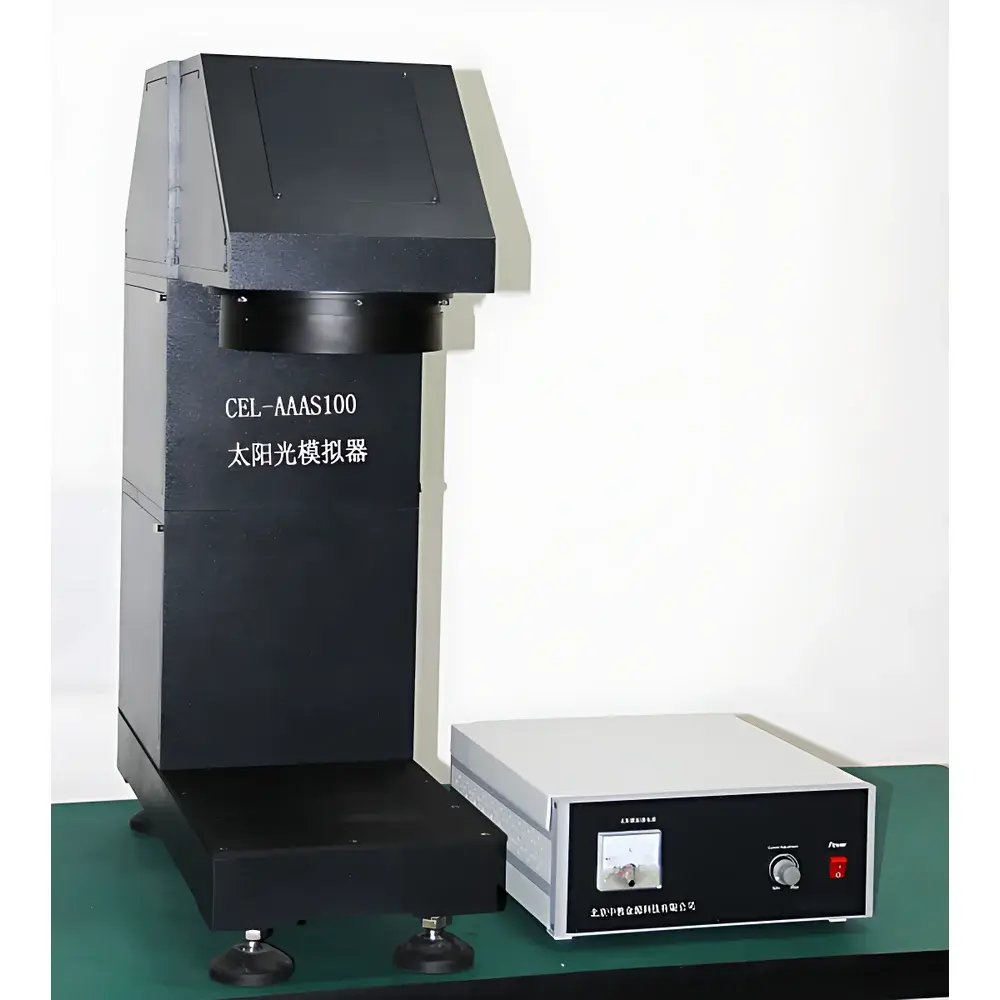
CEL-AAAS50 & CEL-AAAS100 AAA-Class Solar Simulator (Steady-State) by CEAULIGHT
| Brand | CEAULIGHT |
|---|---|
| Origin | Beijing, China |
| Manufacturer Type | OEM/ODM Producer |
| Origin Category | Domestic (China) |
| Models | CEL-AAAS50, CEL-AAAS100 |
| Price | ¥155,800 |
| Trigger Mode | Steady-State |
Overview
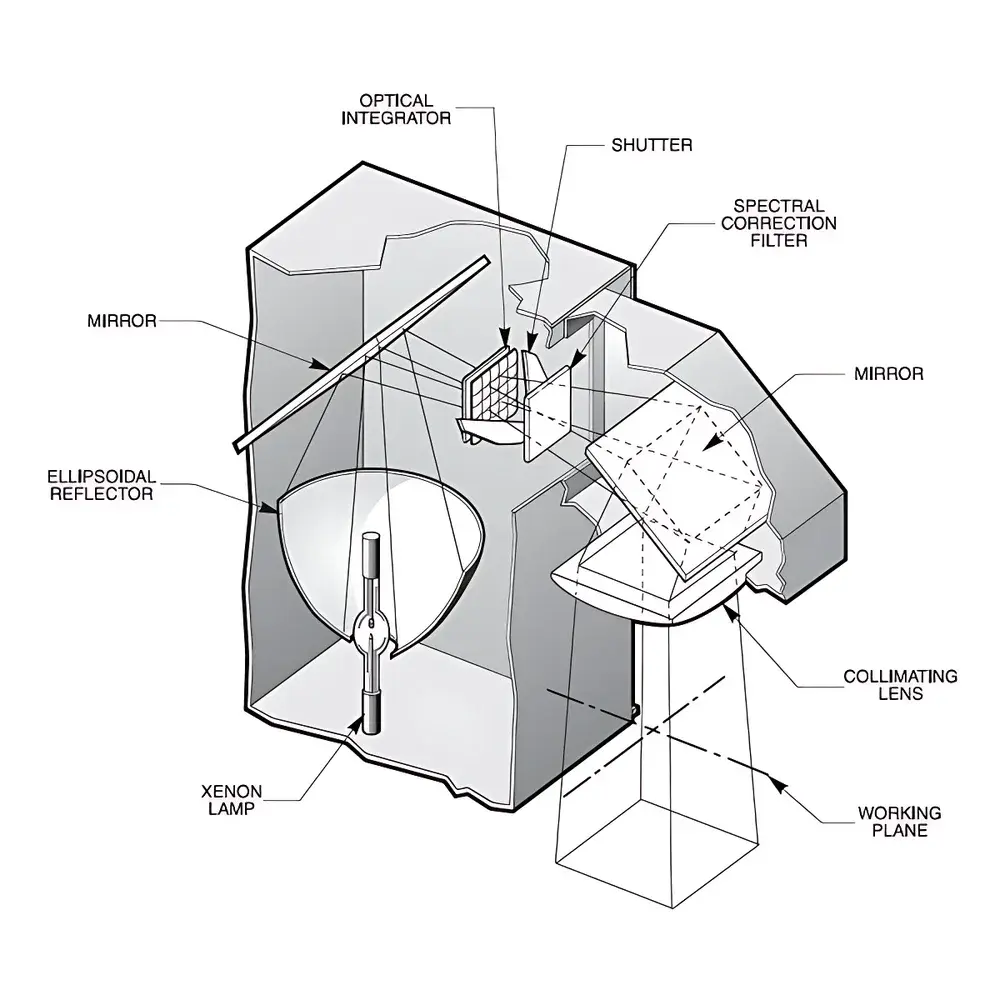
The CEL-AAAS50 and CEL-AAAS100 are laboratory-grade, steady-state solar simulators engineered for high-fidelity photovoltaic (PV) device characterization and photoresponsive material evaluation. Based on the principle of broadband xenon arc lamp illumination coupled with precision optical filtering and homogenization, these systems replicate the spectral irradiance distribution, spatial uniformity, and temporal stability of natural sunlight under AM1.5G conditions (1000 W/m², 25°C, 1.5 air mass). Designed in strict compliance with international photovoltaic testing standards—including ASTM E927-19 (Standard Specification for Solar Simulation for Photovoltaic Testing), IEC 60904-9:2020 Ed.3 (Photovoltaic devices — Part 9: Solar simulator performance requirements), and JIS C 8912:2013—the CEL-AAAS series delivers AAA-class classification across all three critical metrics: spectral match (Class A), spatial non-uniformity (Class A), and temporal instability (Class A).
Key Features
- AAA-class certification per ASTM E927-19, IEC 60904-9:2020, and JIS C 8912—verified across spectral match (0.75–1.25), spatial uniformity (<±2%), and temporal stability (<±2% over 1 hour)
- Optimized AM1.5G spectral filtering using high-transmission, low-thermal-drift interference filters to ensure accurate replication of terrestrial solar irradiance from 300 nm to 1100 nm
- High-efficiency optical integration system incorporating compound parabolic concentrators (CPCs) and diffuser arrays to achieve uniform irradiance profiles at target planes
- Dual-lamp compatibility with premium-grade Ushio and OSRAM short-arc xenon lamps—rated for >1,000 hours of stable output with minimal spectral drift or intensity decay
- Rigid cast-aluminum mechanical architecture providing long-term optical alignment retention, vibration resistance, and thermal dimensional stability
- Adjustable output orientation: horizontal, vertical, or arbitrary angular configuration to accommodate custom test fixtures, glovebox integration, or inverted cell measurement setups
- Hybrid cooling architecture combining forced-air convection and passive aluminum heat-sink modules to maintain lamp envelope temperature within ±2°C during continuous operation
Sample Compatibility & Compliance
The CEL-AAAS series supports a broad range of optoelectronic and photochemical samples, including but not limited to crystalline silicon (c-Si), multicrystalline silicon (mc-Si), thin-film technologies (a-Si, CIGS, CdTe), perovskite solar cells, organic photovoltaics (OPV), dye-sensitized solar cells (DSSC), III–V tandem devices, photocatalytic films, and photosensitive polymers. Its calibrated 100 mW/cm² output (±20% tolerance at 1 Sun) is traceable to NIM (National Institute of Metrology, China) reference cells and validated using calibrated silicon and GaAs reference detectors. The system meets essential requirements for ISO/IEC 17025-accredited PV testing laboratories and supports GLP-compliant documentation workflows when integrated with external data acquisition systems.
Software & Data Management
While the CEL-AAAS operates as a hardware-integrated steady-state source without embedded control software, it is fully compatible with third-party IV curve tracers (e.g., Keithley 2400/2450, Keysight B2900 series), digital multimeters, and programmable electronic loads. Its analog monitoring outputs (0–5 V DC) provide real-time feedback on lamp voltage, current, and thermal status for synchronization with external DAQ systems. When deployed in regulated environments, users may implement audit-trail-enabled data capture platforms compliant with FDA 21 CFR Part 11—ensuring electronic records integrity, user authentication, and change history logging for QC/QA reporting.
Applications
- Current–voltage (I–V) characterization of solar cells and modules under standard test conditions (STC)
- Quantum efficiency (QE) and external quantum efficiency (EQE) mapping with monochromator-coupled configurations
- Photoelectrochemical (PEC) cell performance assessment under simulated solar irradiation
- Photocatalytic degradation kinetics studies (e.g., methylene blue decomposition, CO₂ reduction)
- Light-induced degradation (LID) and UV preconditioning protocols per IEC 61215
- Surface photovoltage spectroscopy (SPS) and transient absorption measurements
- UV–vis stability testing of coatings, cosmetic formulations, and polymer-based encapsulants
- Photobiological safety screening per ISO 15004-2 and IEC 62471
FAQ
What standards does the CEL-AAAS comply with for solar simulation classification?
It meets AAA-class requirements per ASTM E927-19, IEC 60904-9:2020 Ed.3, and JIS C 8912:2013 across spectral match, spatial uniformity, and temporal stability.
Can the CEL-AAAS be used inside a nitrogen-filled glovebox?
Yes—its modular lamp housing and external power/control interface allow safe integration into inert-atmosphere enclosures with appropriate viewport and feedthrough specifications.
Is spectral recalibration required after lamp replacement?
Yes—each new xenon lamp exhibits unique aging characteristics; users must perform spectral validation using a calibrated spectroradiometer and adjust filter alignment if necessary.
Does the system support pulsed or flash-mode operation?
No—the CEL-AAAS is designed exclusively for steady-state illumination; flash-type simulators require separate hardware architecture and triggering electronics.
What maintenance intervals are recommended for optimal performance?
Lamp replacement every 1,000–1,200 hours; quarterly inspection of optical surfaces and cooling ducts; annual verification of irradiance uniformity and spectral profile using NIST-traceable instrumentation.





