
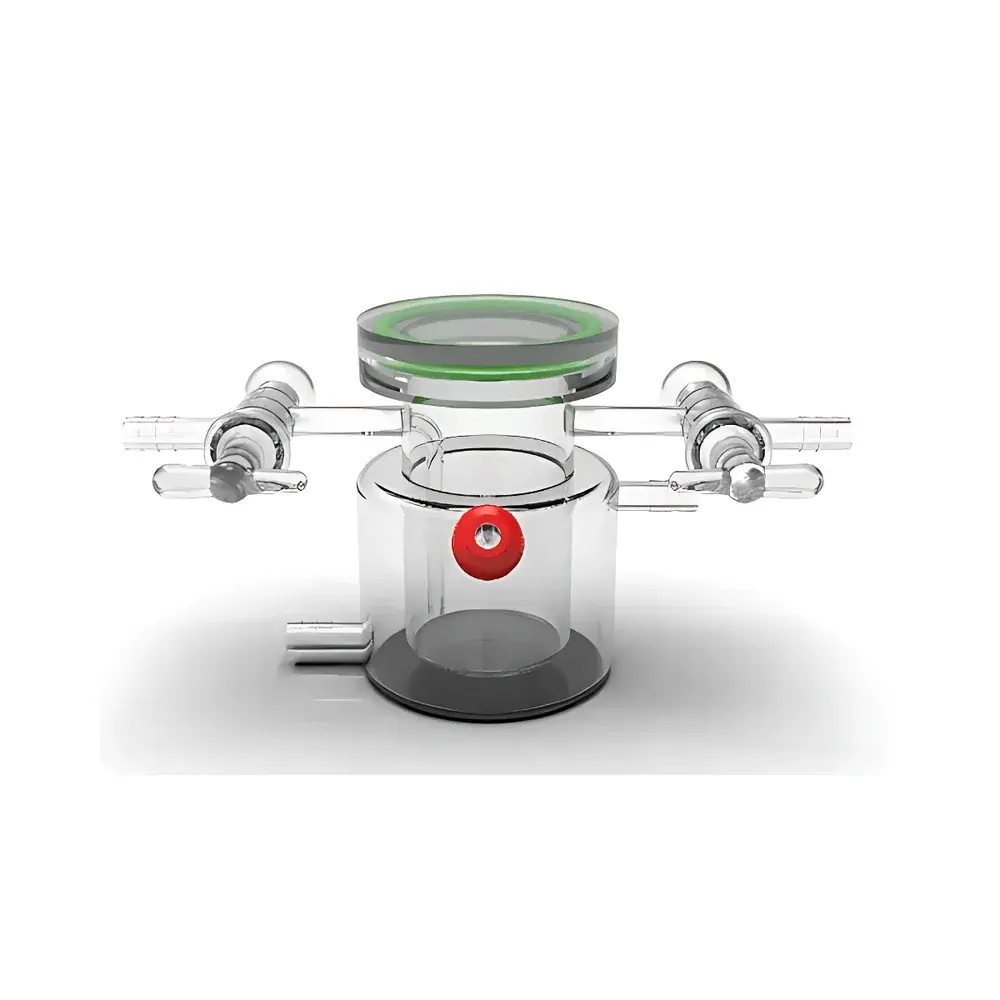
CEL-APR100H Integrated Photochemical Reactor with Temperature Control
| Brand | CEA (China Education Goldsource) |
|---|---|
| Origin | Beijing, China |
| Manufacturer Type | Direct Manufacturer |
| Origin Category | Domestic (China) |
| Model | CEL-APR100H |
| Light Source Type | Broadband UV–Vis Lamp (Xenon or Mercury Arc Compatible) |
| Irradiation Mode | External Irradiation |
| Reactor Volume | 100 mL |
| Construction Material | Borosilicate Glass (一体成型 / Monolithic) |
| Cooling/Heating Jacket | Integrated Double-Wall Water Circulation Sleeve |
| Gas Inlet | Bottom-Submerged Tubing with Inline Glass Stopcock |
| Sampling Port | Standardized Septum-Piercing Inlet (1/4″ NPT or SS Swagelok-compatible) |
| Optical Window | UV-Grade Fused Silica (≥185 nm transmission) |
| Sealing | Dual O-ring + C-Clamp Flange Assembly |
| Pressure Rating | Ambient (1 atm) |
| Compliance | Designed for ISO/IEC 17025-aligned photochemical testing workflows |
Overview
The CEL-APR100H Integrated Photochemical Reactor with Temperature Control is a purpose-engineered laboratory-scale photoreactor system designed for reproducible, controlled studies of heterogeneous and homogeneous photocatalytic processes under ambient pressure. Built on a monolithic borosilicate glass architecture, the reactor integrates a precision-machined double-wall thermal jacket enabling active temperature regulation via external circulator (±0.5 °C stability typical). Its optical design centers on a high-transmittance fused silica window (cut-on <185 nm), optimized for broadband excitation across deep UV, near-UV, and visible spectral ranges—compatible with both high-pressure xenon arc lamps (e.g., 300–1000 W) and mercury vapor lamps (e.g., 125–400 W) when used with appropriate collimation and filtering optics. The bottom-submerged gas inlet ensures uniform sparging and efficient mass transfer in gas–liquid reactions, while the integrated glass stopcock allows real-time gas flow modulation without disassembly. This configuration supports kinetic investigations requiring strict control over photon flux, temperature, gas composition, and sampling frequency—critical for benchmarking photocatalysts in H₂ evolution, CO₂ photoreduction, organic pollutant degradation, and O₂ generation.
Key Features
- Monolithic borosilicate glass construction with seamless double-wall thermal jacket for rapid, uniform heat exchange
- UV-grade fused silica optical window (≥90% transmittance at 254 nm; ≥85% at 185 nm) enabling high-fidelity irradiation down to vacuum UV edge
- Bottom-inlet gas dispersion tube with calibrated glass stopcock for precise stoichiometric control and bubble size management
- Dual-seal flange assembly using chemically resistant fluorocarbon O-rings and stainless-steel C-clamps ensuring leak-tight operation under extended irradiation
- Dedicated septum-piercing sampling port (compatible with standard GC/HPLC syringes) permitting non-invasive, time-resolved liquid/gas phase analysis
- Modular interface design supporting integration with external temperature controllers (e.g., Huber Chiller), gas mass flow controllers (MFCs), and online analyzers (e.g., GC-TCD, FTIR)
Sample Compatibility & Compliance
The CEL-APR100H accommodates aqueous suspensions, organic solvent systems, colloidal dispersions, and gas-saturated liquids—provided compatibility with borosilicate glass and fused silica is verified. It supports catalyst loadings from 10 mg to 500 mg in 100 mL working volume, with recommended stirring rates of 300–800 rpm for homogeneous suspension. The reactor meets mechanical and material requirements for ASTM E2627-18 (Standard Practice for Photocatalytic Activity Testing) and aligns with ISO 22197-1 (Photocatalytic Air Purification Materials) for light exposure geometry and dosimetry consistency. While not certified to IEC 61000-4 electromagnetic immunity standards, its passive glass construction minimizes field interference during concurrent optical and electrochemical measurements. All wetted parts comply with USP Class VI biocompatibility guidelines for non-invasive lab use.
Software & Data Management
The CEL-APR100H operates as a hardware platform requiring external instrumentation for data acquisition. When paired with third-party systems—such as LabVIEW-based photonic monitoring suites or MATLAB-driven MFC/temperature logging—it enables full experimental traceability. Users may configure automated timestamped sampling triggers synchronized with irradiance sensors (e.g., calibrated Si photodiodes or NIST-traceable radiometers) to satisfy GLP audit requirements. Raw irradiance, bath temperature, gas flow rate, and sampling events can be logged into CSV or HDF5 formats compliant with FAIR data principles. No proprietary firmware or closed-source software is embedded; all control logic remains user-definable per ISO/IEC 17025 clause 7.7 on method validation.
Applications
- Quantitative evaluation of photocatalyst quantum yield (Φ) for H₂ production in triethanolamine–water systems
- Kinetic modeling of CO₂-to-CH₄ reduction pathways using Ru/TiO₂ under simulated solar irradiation
- Structure–activity correlation studies for MOF-based photocatalysts in aerobic oxidation of benzyl alcohol
- Benchmarking of plasmonic Au–TiO₂ composites in tetracycline degradation under UVA (365 nm) LED arrays
- Photoelectrochemical co-catalyst screening in tandem cell configurations with potentiostat synchronization
- Accelerated aging tests of UV-stabilized polymer coatings under controlled radiant exposure
FAQ
What lamp types are compatible with the CEL-APR100H?
The reactor accepts externally mounted xenon arc lamps (300–1000 W), mercury vapor lamps (125–400 W), and narrowband UV-LED arrays (255–405 nm), provided beam collimation and thermal shielding are implemented.
Can the reactor be operated under inert atmosphere?
Yes—gas-tight integrity is maintained via dual O-rings and C-clamp flange; users routinely purge with N₂ or Ar prior to illumination to exclude O₂ during reductive photocatalysis.
Is the quartz window replaceable?
Yes—the UV-grade fused silica plate is secured with removable clamps and gasketed sealing; replacement parts are available with certified transmittance reports.
What temperature range is achievable with the water jacket?
When connected to a standard recirculating chiller/heater (e.g., Julabo F25), the system achieves stable operation from 5 °C to 80 °C; ramp rates ≤2 °C/min are recommended for thermal stress mitigation.
Does the reactor support in situ spectroscopic coupling?
The optical window permits fiber-optic coupling for in situ UV-Vis absorption, Raman, or fluorescence monitoring; custom collimator mounts are available upon request.




