
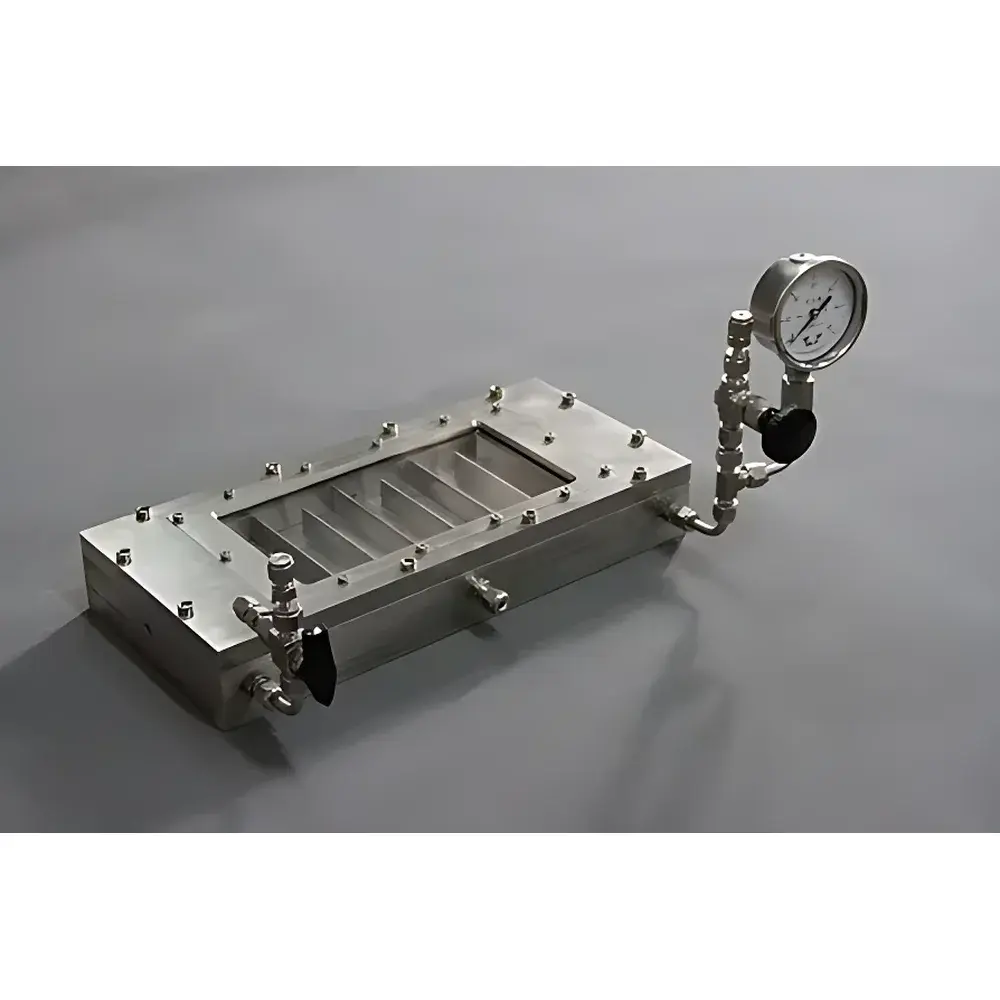
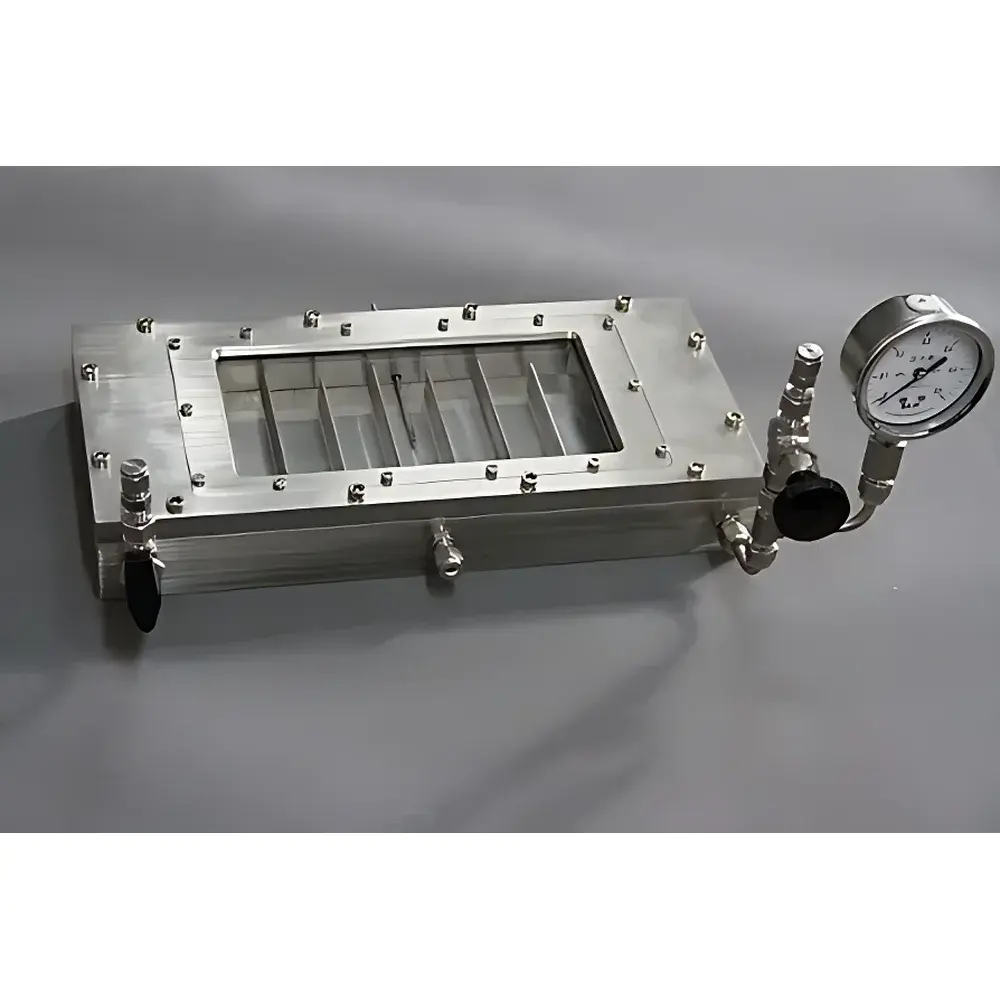
CEL-GPCR100 GB/T 23761-2009 Compliant Photocatalytic Reactor
| Brand | CEL (Zhongjiao Jinyuan) |
|---|---|
| Origin | Beijing, China |
| Manufacturer | Yes |
| Country of Origin | China |
| Model | CEL-GPCR100 |
| Price | USD 1,650 (approx.) |
| Reaction Volume | 100 mL (micro-scale) |
| Construction Material | ASTM A240 316L stainless steel |
| Operating Pressure | ≤ 1 bar (gauge), low-pressure service |
| Vacuum Capability | Ambient pressure operation only (no active vacuum system) |
| Optical Window | UV-grade fused silica (quartz), 200 mm × 100 mm, 5.0 mm sample-to-window gap |
| Temperature Control | Jacketed via external water bath |
| Flow Control | Anlok precision needle valve (US-made) |
| Valving | Anlok 3-way ball valve, quick-connect fittings, 3 mm Swagelok-type stainless steel compression fittings throughout |
| Compliance | Designed per GB/T 23761–2009 “Test Method for Photocatalytic Air Purification Materials” |
Overview
The CEL-GPCR100 is a purpose-engineered, standards-compliant photocatalytic reactor designed explicitly for performance evaluation of air-purifying photocatalytic materials in accordance with the Chinese national standard GB/T 23761–2009. It implements a controlled, sealed gas-phase reaction environment where target pollutants (e.g., formaldehyde, toluene, NOx) are introduced under defined flow conditions and exposed to UV or visible light irradiation through a high-transmittance quartz window. The reactor operates on the principle of heterogeneous photocatalysis—where gaseous analytes interact with immobilized catalysts (e.g., TiO2-coated substrates) under photon activation—enabling quantitative assessment of degradation kinetics, mineralization efficiency, and catalyst stability. Its monolithic 316L stainless steel construction ensures corrosion resistance against reactive oxygen species and organic intermediates, while the integrated thermal jacket supports isothermal operation across 15–80 °C when coupled with an external circulator.
Key Features
- Monobloc 316L stainless steel body machined from solid stock—no welds in critical pressure zones—ensuring structural integrity and long-term chemical compatibility.
- UV-transparent fused silica optical window (200 × 100 mm, ≥90% transmittance at 254 nm), precisely spaced 5.0 mm from catalyst surface to optimize photon flux density and mass transfer.
- Integrated double-wall thermal jacket with 6 mm NPT inlet/outlet ports for connection to external temperature-controlled water baths.
- Modular flow path architecture featuring Anlok-certified US-manufactured needle valves and 3-way ball valves for precise gas flow regulation, pressure balancing, and sampling line isolation.
- Standardized 3 mm stainless steel Swagelok-style compression fittings throughout—eliminating thread-sealant dependency and enabling rapid, leak-tight assembly without tools.
- Configurable baffle plate system (included) that extends residence time by inducing laminar flow redirection over the catalyst bed, enhancing gas–solid contact efficiency.
- Dual-purpose top cover design: facilitates rapid catalyst loading/unloading while maintaining alignment of quartz window and pressure boundary.
Sample Compatibility & Compliance
The CEL-GPCR100 accommodates planar catalyst samples up to 200 × 100 mm (e.g., coated glass slides, ceramic tiles, metal foams, or membrane-supported nanocomposites). Its geometry and flow dynamics comply strictly with GB/T 23761–2009 Section 5.2 (reactor configuration), Section 6.3 (irradiation requirements), and Section 7.4 (gas flow rate control: 0.5–2.0 L/min). While not certified to ISO/IEC 17025 or ASTM E2911, its mechanical design enables traceable validation against reference materials (e.g., NIST SRM 2976 formaldehyde standards) and supports GLP-aligned experimental documentation. All metallic wetted parts meet ASTM A240 Grade 316L specifications; quartz windows conform to SEMI F72 for UV optical homogeneity.
Software & Data Management
The CEL-GPCR100 is a hardware-only platform requiring external instrumentation for data acquisition. It interfaces seamlessly with third-party systems: pressure transducers (0–1 bar range, 0.01 bar resolution), thermocouple inputs (K-type, via 1/8″ NPT thermowell port), and gas analyzers (e.g., FTIR, GC-PID, chemiluminescence NOx detectors) connected through standardized 3 mm tubing. Real-time monitoring and protocol scripting may be implemented using LabVIEW, Python (with PySerial/PyVISA), or MATLAB. For regulatory environments, users may configure audit trails, electronic signatures, and metadata tagging via compliant LIMS or ELN platforms—fully compatible with FDA 21 CFR Part 11 when paired with validated software layers.
Applications
- Quantitative kinetic studies of VOC degradation (formaldehyde, acetaldehyde, benzene) under simulated indoor lighting conditions.
- Benchmarking of novel photocatalysts (e.g., doped TiO2, g-C3N4, MOFs) per GB/T 23761–2009 protocols for commercial certification.
- Accelerated aging tests assessing catalyst deactivation due to carbon deposition or surface poisoning.
- Reaction engineering analysis—including residence time distribution (RTD) mapping using tracer gases—and optimization of baffle geometry.
- Interlaboratory round-robin testing in national quality supervision programs for building materials and HVAC filtration media.
FAQ
What is the maximum allowable operating pressure?
The reactor is rated for continuous operation at ≤ 1 bar(g); exceeding this limit voids compliance with GB/T 23761–2009 and risks seal failure.
Can the quartz window be replaced with other optical materials?
Yes—custom windows (e.g., MgF2 for deep-UV, borosilicate for cost-sensitive screening) may be installed, though UV-grade fused silica is required for full standard conformance.
Is temperature uniformity across the catalyst surface validated?
Uniformity depends on external bath stability; typical deviation is ±0.5 °C across the active area when using a ±0.1 °C-stable circulator and proper flow rate (≥1.5 L/min).
Are replacement gaskets and O-rings supplied?
Yes—perfluoroelastomer (FFKM) gaskets for high-temperature/chemical resistance and Viton® backup rings are included in the standard spare kit.
Does the reactor support in situ spectroscopic monitoring?
Not natively—but the large quartz window and unobstructed optical path permit integration with external DRIFTS, Raman, or UV-Vis fiber-optic probes using custom collimation mounts.



