
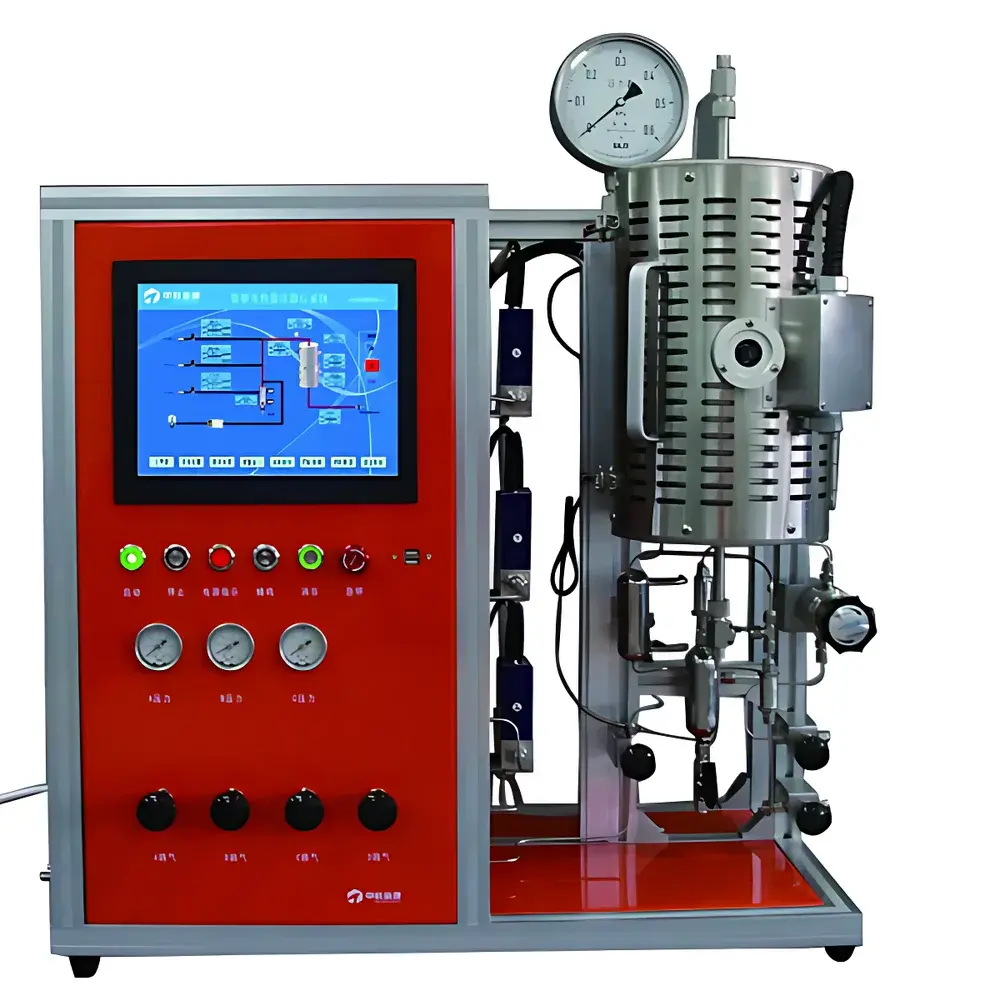
CEL-GPPCM Micro-Scale Photothermal Catalytic Reactor System by CEAULIGHT
| Brand | CEAULIGHT |
|---|---|
| Model | CEL-GPPCM |
| Origin | Beijing, China |
| Manufacturer Type | Direct Manufacturer |
| Region Classification | Domestic (China) |
| Reaction Pressure Range | ±0.01 MPa |
| Maximum Operating Temperature | ≤800 °C |
| Catalyst Loading Capacity | 0.1 mg–100 mg |
| Gas Inlet Channels | 3 (expandable to 4) |
| Liquid Injection Port | 1 dedicated interface |
| Flow Control Accuracy | ±1% FS |
| Pressure Display Resolution | ±0.01 MPa |
| Temperature Control Accuracy | ±1 °C |
| Temperature Display Resolution | ±0.1 °C |
| Reactor Material | Fused Quartz |
| Reactor Dimensions | Compatible with standard quartz tube configurations (ID/OD specified per configuration) |
| System Footprint | 400 mm (W) × 700 mm (H) × 700 mm (D) |
| Safety Features | Dual-stage temperature & pressure alarm with automatic interlock shutdown |
| Data Logging | Real-time acquisition, timestamped storage, CSV export capability |
| Compliance Framework | Designed for GLP-aligned operation |
Overview
The CEL-GPPCM Micro-Scale Photothermal Catalytic Reactor System is an integrated, benchtop platform engineered for quantitative evaluation of heterogeneous photocatalysts and photothermal catalysts under precisely controlled thermal, optical, and gaseous environments. It operates on the principle of simultaneous photon absorption and resistive heating—enabling true photothermal synergy studies where light-induced charge carrier generation and thermally activated surface reactions are decoupled or co-optimized. The system employs a high-transmittance fused quartz reaction tube mounted within an open-type programmable furnace, ensuring uniform radial heating up to 800 °C while maintaining full UV–Vis–NIR optical access. Its modular architecture supports both continuous-flow and batch-mode operation, with microgram-level catalyst loading (0.1–100 mg) minimizing material consumption without compromising kinetic relevance. Unlike conventional fixed-bed reactors, the CEL-GPPCM integrates real-time pressure regulation (±0.01 MPa resolution), multi-channel gas dosing, and optional liquid-phase injection—making it suitable for mechanistic investigations including transient kinetic analysis, isotopic labeling experiments, and in situ/operando spectroscopic coupling.
Key Features
- Fused quartz reactor tube with >90% transmittance across 190–2500 nm, enabling broadband irradiation from UV-C to NIR-II
- Open-heating furnace with PID-controlled ramp/soak programming (0–800 °C; ±1 °C stability)
- Triple independent mass flow controllers (MFCs) for reactive gas streams, plus one dedicated purge line and one liquid injection port (compatible with syringe pump integration)
- Dual-pressure monitoring: analog precision gauge + digital pressure transducer with real-time display and alarm-triggered interlock
- Integrated safety architecture featuring two-tier temperature and pressure thresholds—first stage triggers audible/visual alert; second stage initiates immediate heater cutoff or gas shutoff
- Touchscreen HMI running embedded control firmware: full parameter visualization, program editing, manual override, and automated data logging with time-stamped metadata
- Aluminum extrusion frame with standardized T-slot mounting—facilitates rapid reconfiguration for accessory integration (e.g., GC/MS interfaces, FTIR cells, or online MS sampling)
Sample Compatibility & Compliance
The CEL-GPPCM accommodates powdered, pelletized, or supported catalysts—including metal oxides (TiO₂, WO₃, BiVO₄), plasmonic nanoparticles (Au, Ag), MOFs, COFs, and doped semiconductors—within its quartz microreactor. Catalyst bed geometry is configurable via custom quartz frits or thermocouple-sheathed holders to ensure reproducible axial temperature profiles and minimal dead volume. All wetted parts comply with ASTM E2913-13 standards for inertness in catalytic testing. The system meets mechanical design requirements per ISO 10522:2019 (laboratory reactor safety) and supports documentation workflows aligned with ISO/IEC 17025:2017 for method validation. When operated with validated software settings and electronic signature protocols, data integrity satisfies foundational expectations of FDA 21 CFR Part 11 for regulated research environments.
Software & Data Management
Control logic resides in a deterministic real-time module synchronized with a Windows-based touchscreen PC. The HMI provides a dynamic P&ID-style process diagram showing all active control points (T, P, flow rates), editable setpoint tables, multi-step temperature ramp profiles, and configurable alarm thresholds. Historical trends—including reactor inlet pressure, bed temperature, individual gas flows, and derived parameters such as space velocity (GHSV) or conversion rate—are stored in encrypted binary format and exportable as CSV or Excel-compatible files. Raw data retains full timestamp resolution (100 ms), with user-defined annotation fields for experimental notes. Audit trails record operator login, parameter changes, alarm events, and system start/stop sequences—enabling retrospective verification per GLP principles.
Applications
- Photocatalytic water splitting (H₂/O₂ evolution) under simulated solar illumination
- CO₂ photoreduction to CH₄, CO, or C₂+ hydrocarbons using tunable wavelength sources
- Gas-phase degradation of VOCs (formaldehyde, toluene), NOₓ, SOₓ, and NH₃ under ambient or elevated temperatures
- Photothermal ammonia synthesis via plasmon-enhanced N₂ activation
- Kinetic isotope effect (KIE) studies using D₂O or ¹³CO₂ tracers
- Rapid screening of catalyst libraries under identical irradiance and thermal boundary conditions
- In situ DRIFTS or Raman coupling via side-arm quartz ports
FAQ
Can the system operate under positive pressure beyond atmospheric conditions?
Yes—the reactor is rated for design pressure up to 0.6 MPa (gauge), with active pressure regulation and safety interlocks enabled across the full range.
Is the quartz reactor compatible with corrosive gases such as HCl or Cl₂?
Fused quartz exhibits excellent resistance to most acids and halogens below 500 °C; however, prolonged exposure to hot, humid Cl₂ or HF requires pre-validation and optional quartz passivation.
How is light delivered to the reaction zone?
The system features a top-access optical path with standardized SMA905 or FC/PC couplings; users integrate external lamps (Xe, LED, laser diodes) or solar simulators with appropriate collimation and spectral filtering.
Does the controller support third-party instrument synchronization?
Yes—RS485 Modbus RTU and Ethernet TCP/IP interfaces enable bidirectional communication with GCs, MS detectors, or external DAQ systems for time-correlated multi-instrument experiments.
What maintenance is required for long-term reliability?
Routine inspection of MFC calibration (annually recommended), quartz tube integrity checks, and verification of O-ring seal performance at elevated temperatures constitute the primary preventive maintenance protocol.



