
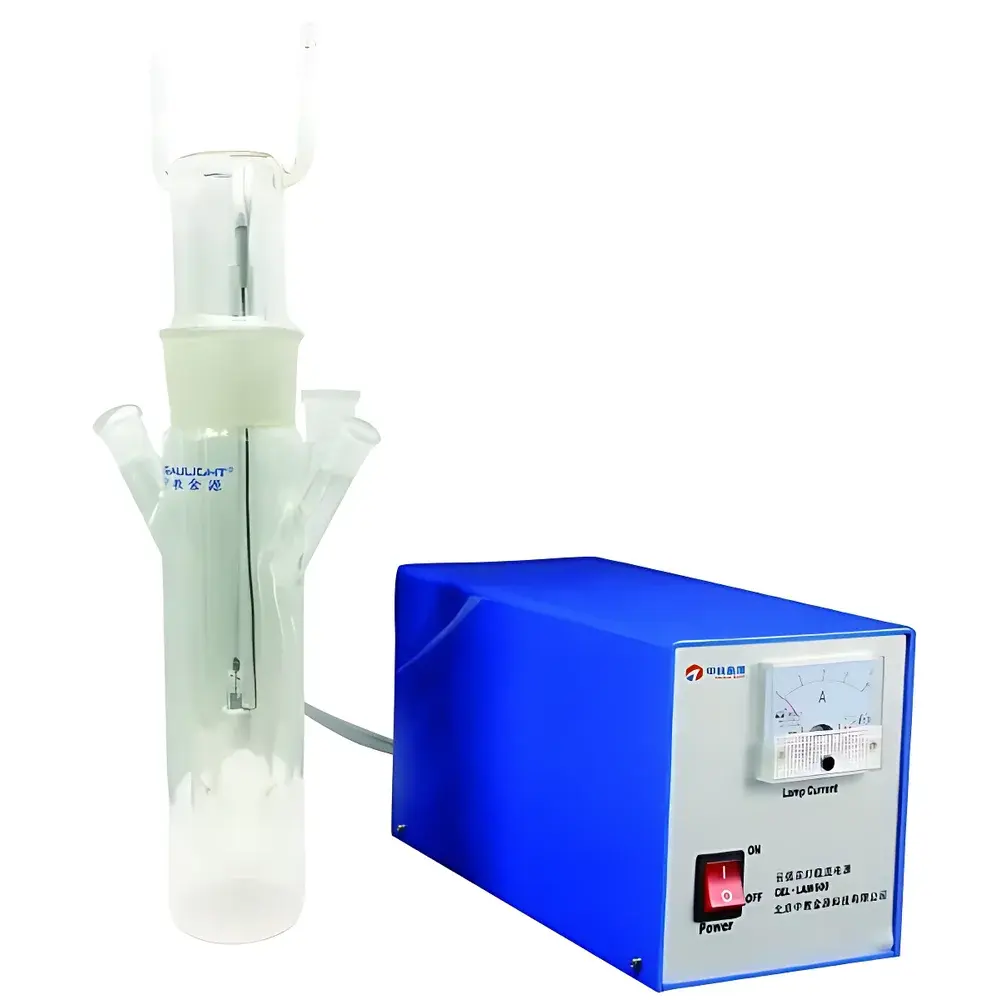
CEL-LAM500 Long-Arc Mercury Lamp Light Source
| Brand | CEL (China Education Goldsource) |
|---|---|
| Origin | Beijing, China |
| Manufacturer Type | Direct Manufacturer |
| Product Origin | Domestic (China) |
| Model | CEL-LAM500 |
| Light Source Type | Mercury Arc Lamp |
| Illumination Mode | External Irradiation |
| Input Power | 500 W |
| Lamp Total Length | 220 mm |
| Power Supply Input | 220 V AC |
| Spectral Peak | 365 nm |
| Cooling Compatibility | CEQW60 Quartz Cold Finger (60/40 ground joint, effective length 220 mm) |
| Compatible Reactors | CEPR250 (250 mL, borosilicate glass, multiple standard joints) and CEPR500 (500 mL, borosilicate glass, same joint options) |
Overview
The CEL-LAM500 is a high-stability, air-cooled long-arc mercury lamp light source engineered for reproducible ultraviolet (UV) irradiation in photochemical and photocatalytic research. Operating on the principle of mercury vapor discharge under controlled electrical excitation, it delivers intense, quasi-monochromatic output centered at 365 nm — a wavelength widely adopted for UV-initiated reactions including photocatalytic degradation, organic synthesis, polymer curing, and hydrogen evolution via water splitting. Unlike pulsed or LED-based systems, the continuous-wave (CW) emission profile of the long-arc configuration ensures uniform photon flux over extended durations, supporting kinetic studies requiring stable illumination for hours without spectral drift. Its external irradiation design enables flexible integration with custom optical setups, jacketed reactors, and multi-vessel parallel reaction platforms — making it suitable for both fundamental laboratory investigation and scalable process development.
Key Features
- 500 W nominal input power with optimized thermal management to sustain stable arc discharge and minimize intensity fluctuation (< ±3% over 4 h)
- 220 mm total lamp length enabling uniform irradiance distribution across large-diameter reactor windows (e.g., Ø60 mm cold finger interface)
- Standardized 220 V AC input compatibility with built-in current regulation and over-temperature protection circuitry
- Designed for direct coupling with CEQW60 quartz cold finger (60/40 ground joint), which filters >90% of IR radiation while maintaining UV transmission above 300 nm
- Modular mechanical interface supports rapid interchange with CEPR250 (250 mL) and CEPR500 (500 mL) borosilicate glass reactors featuring multiple standardized taper joints (14/23, 19/26, 24/29, and 60/40)
- Capable of simultaneous irradiation of up to four parallel reaction vessels when mounted on multi-position optical benches or rotary sample holders
Sample Compatibility & Compliance
The CEL-LAM500 is compatible with a broad range of photochemical sample formats, including liquid-phase suspensions (e.g., TiO₂ or g-C₃N₄ dispersions), gas-phase mixtures (NOₓ, VOCs), and thin-film catalyst coatings. Its 365 nm dominant emission aligns with ISO 105-B02 (textile colorfastness testing), ASTM D4329 (polymer UV exposure), and common photocatalytic activity benchmarks (e.g., methylene blue degradation per ISO 10678). All glass components — CEQW60 cold finger and CEPR-series reactors — are fabricated from high-purity fused quartz or Pyrex-grade borosilicate glass (≥93.5% SiO₂), ensuring minimal autofluorescence and UV absorption below 300 nm. The system meets IEC 61000-6-3 (EMC emissions) and IEC 61000-6-2 (immunity) standards for laboratory equipment.
Software & Data Management
While the CEL-LAM500 operates as a standalone analog light source, its electrical interface supports integration with external digital control systems via optional 0–10 V analog dimming input (add-on module). When paired with data-logging radiometers (e.g., calibrated silicon photodiodes with UV-enhanced filters) and LabVIEW- or Python-controlled DAQ hardware, users can record real-time irradiance (mW/cm² at 365 nm), cumulative fluence (J/cm²), and thermal drift profiles. Audit trails generated through such configurations comply with GLP documentation requirements and support 21 CFR Part 11–aligned electronic records when deployed in regulated R&D environments.
Applications
- Photocatalytic degradation of aqueous pollutants (e.g., phenol, rhodamine B, pharmaceutical residues) under simulated UV-A conditions
- Gas-phase photocatalysis for indoor air purification (formaldehyde, NO, toluene oxidation)
- Photoinduced hydrogen production using Pt/TiO₂ or NiS/CdS heterostructures in sealed quartz reactors
- UV-curable resin formulation screening and crosslinking kinetics analysis
- Photochemical synthesis of fine chemicals, including [2+2] cycloadditions and Norrish-type cleavages
- Accelerated material aging studies for UV-resistant coatings and packaging films
FAQ
What is the typical lifetime of the CEL-LAM500 mercury lamp under continuous operation?
Rated average life is 1,000 hours at rated power; actual longevity depends on thermal cycling frequency and cooling efficiency.
Can the CEL-LAM500 be used with optical filters to isolate specific UV bands?
Yes — standard 25 mm or 50 mm diameter interference filters (e.g., 365 ±5 nm, 313 ±3 nm) mount directly onto the lamp housing or cold finger collimator port.
Is the lamp compatible with vacuum or inert-gas purged reaction systems?
The lamp itself is not vacuum-rated, but the CEPR250/500 reactors and CEQW60 cold finger support N₂ or Ar purging via side-arm ports and septum-sealed inlet/outlet fittings.
Does the system include radiometric calibration data?
No factory calibration certificate is supplied; however, spectral irradiance data (300–400 nm) and spatial uniformity maps are available upon request for method validation.
How is heat management addressed during prolonged irradiation?
The CEQW60 cold finger provides passive IR rejection; for extended runs (>2 h), supplemental forced-air cooling around the lamp housing is recommended to maintain arc stability.





