
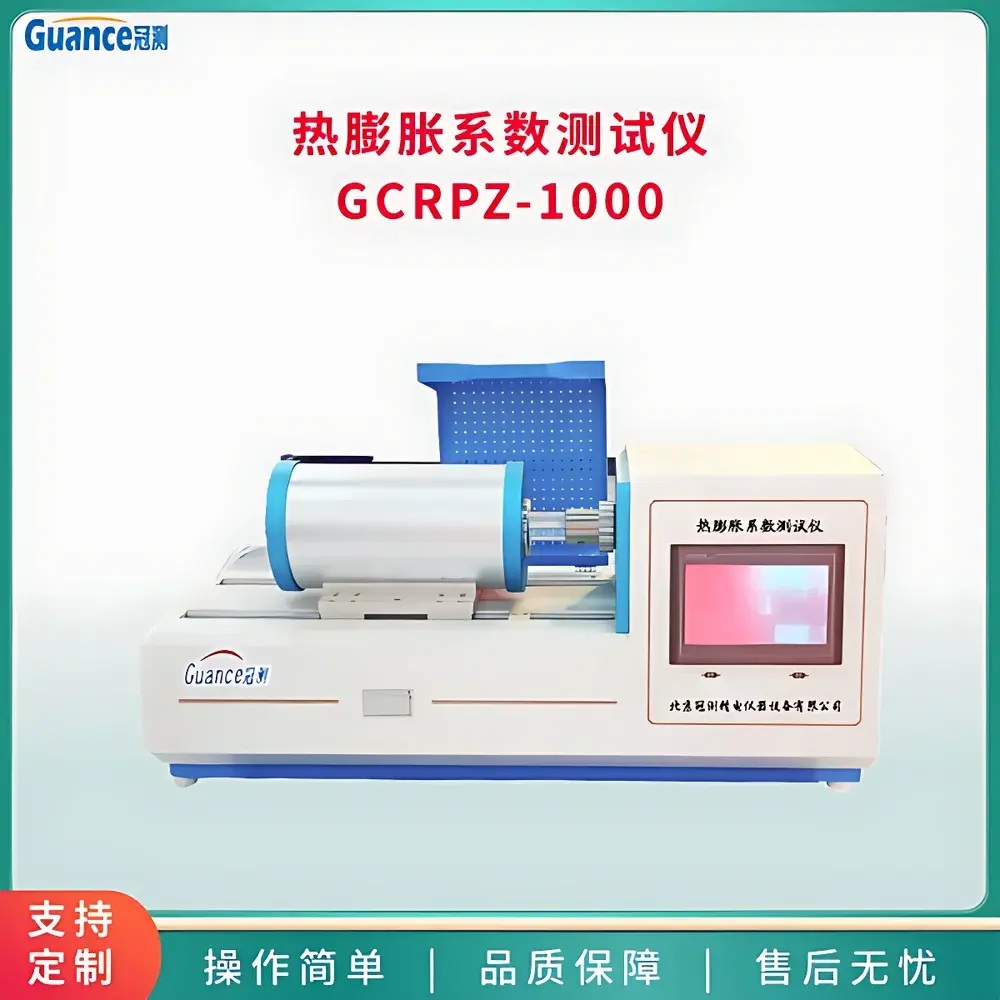
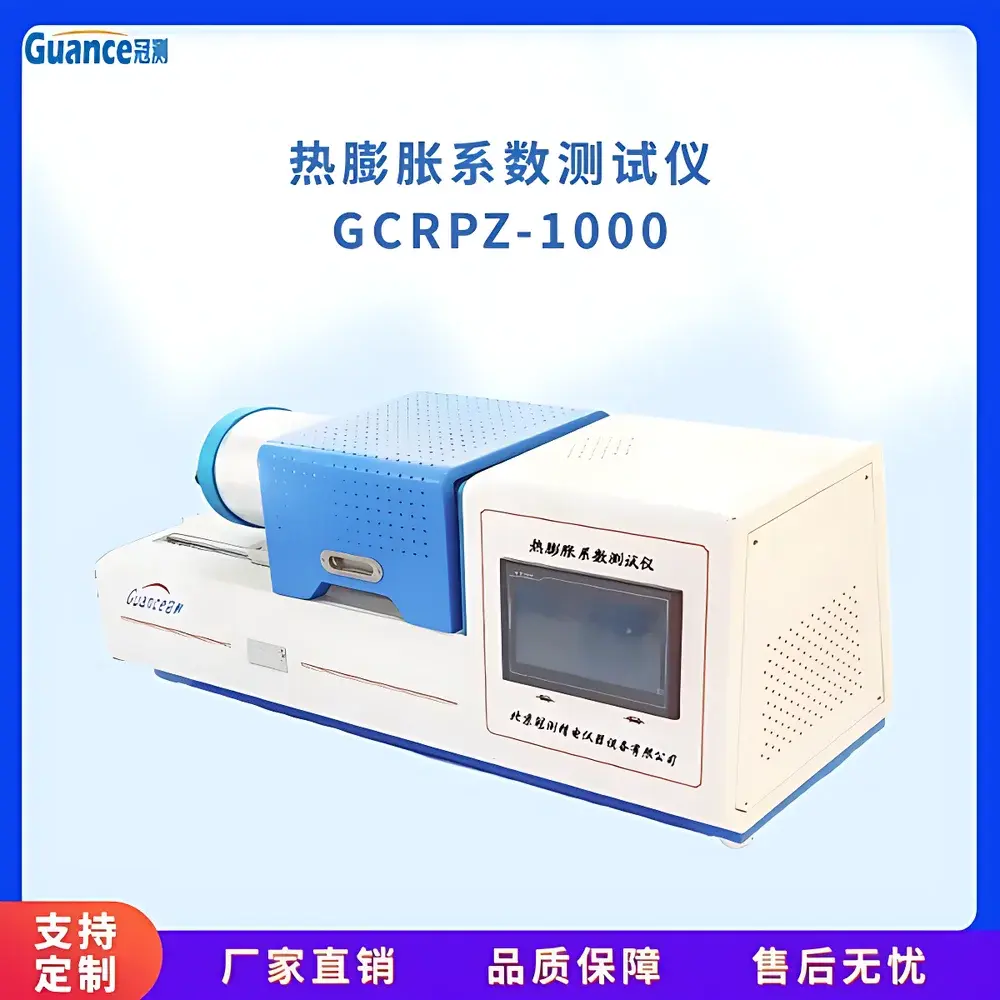
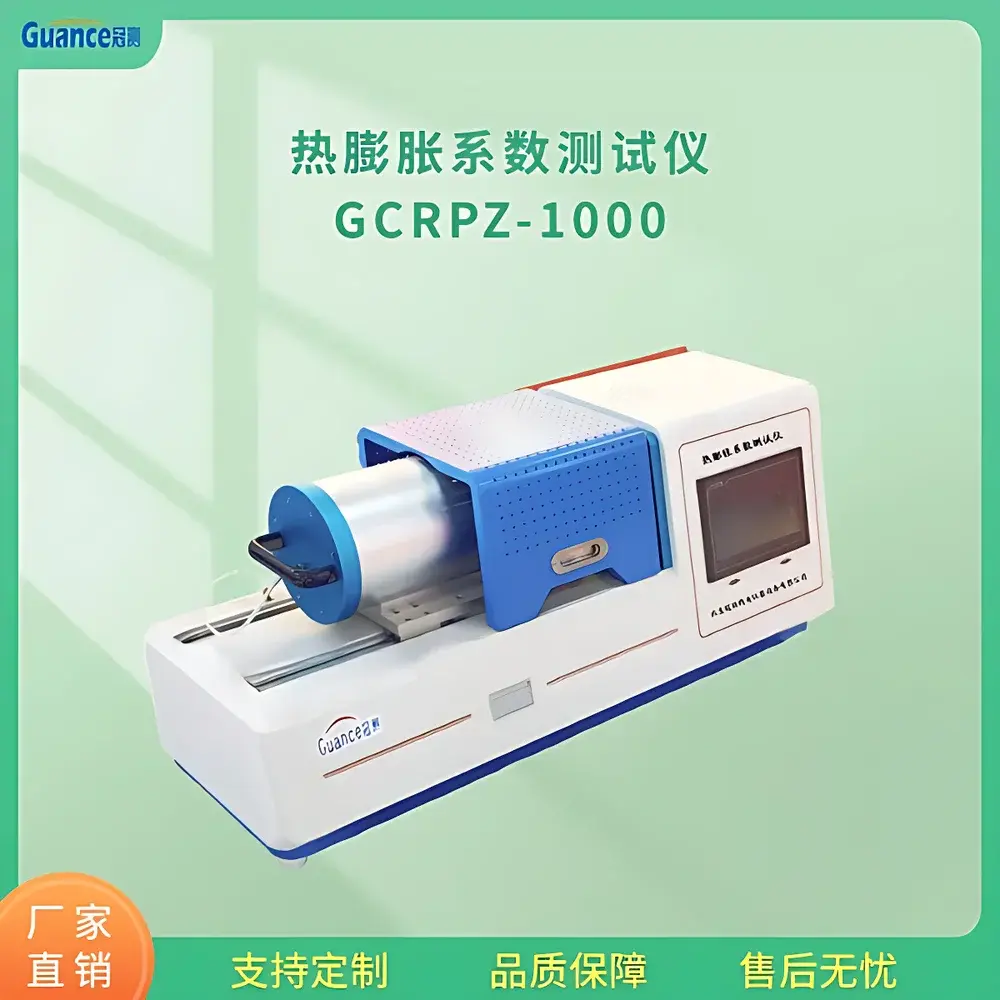
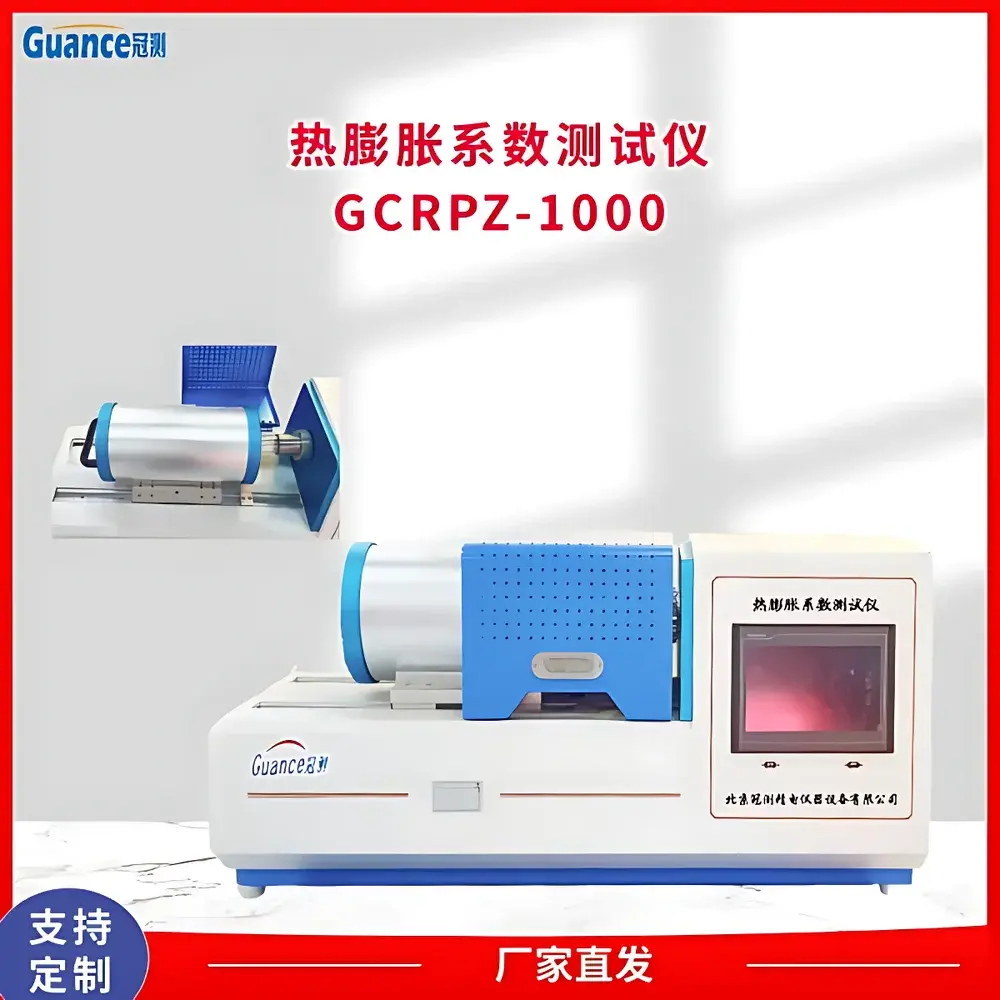
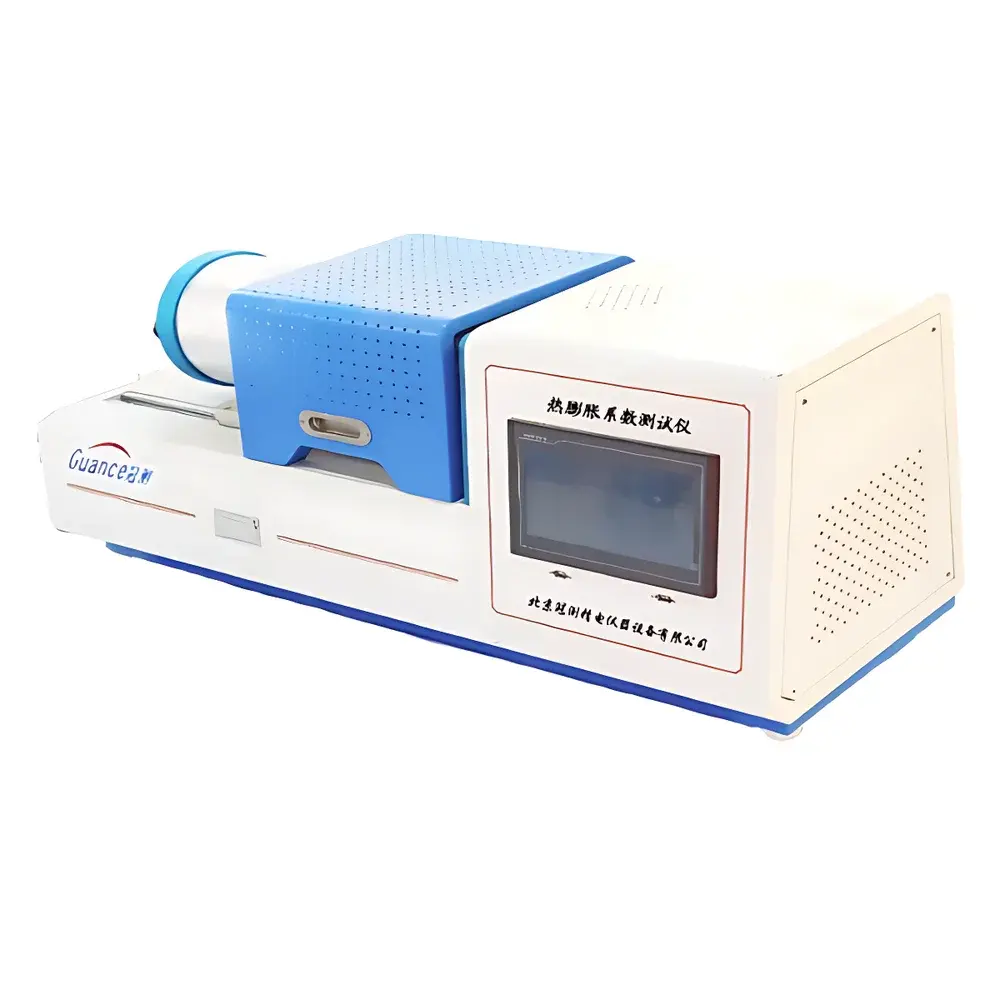
Guance Instruments GCRPZ-1000 High-Temperature Thermal Dilatometer
| Brand | Guance Instruments |
|---|---|
| Origin | Beijing, China |
| Manufacturer Type | Authorized Distributor |
| Product Origin | Domestic (China) |
| Model | GCRPZ-1000 |
| Temperature Range | Ambient to 1000 °C |
| Heating Rate | 0.1–10 K/min (adjustable) |
| Temperature Accuracy | ±1 °C |
| Sample Dimensions | Max. 50 mm length × 8 mm diameter |
| Measurement Range | ±5 mm |
| Resolution | 0.1 µm |
| Atmosphere Options | N₂, Ar, inert gases, vacuum (–0.1 MPa) |
| Sensor Type | Optical Grating Displacement Transducer |
| Sample Holder Material | Fused Quartz |
| Power Supply | 220 V ±10%, 50 Hz |
| Cooling Requirement | External recirculating chiller (max. 100 °C bath temp, ≤2 kW heating power) |
Overview
The Guance Instruments GCRPZ-1000 High-Temperature Thermal Dilatometer is a precision-engineered instrument designed for the quantitative measurement of linear dimensional changes in solid materials as a function of temperature. It operates on the principle of contact-based optical displacement sensing—utilizing a high-stability fused quartz sample holder and an optical grating transducer—to detect thermal expansion or contraction with sub-micron resolution. The system integrates a programmable high-temperature furnace (ambient to 1000 °C), PID-controlled heating/cooling profiles, and dual-mode operation (standalone embedded control or PC-synchronized acquisition). Its architecture complies with fundamental metrological requirements for thermal expansion characterization per ISO 11359-1 (Plastics — Thermomechanical Analysis), ASTM E228 (Linear Thermal Expansion of Solid Materials), and GB/T 4339–2008 (Metallic Materials — Determination of Thermal Expansion Coefficients). Designed for laboratory environments where reproducibility, traceability, and long-term stability are critical, the GCRPZ-1000 supports both routine quality control and advanced materials research.
Key Features
- Programmable temperature control from ambient to 1000 °C with adjustable heating rates from 0.1 to 10 K/min, optimized for controlled ramp-and-hold or step-heating protocols
- Optical grating displacement sensor delivering 0.1 µm resolution and ±5 mm full-scale range, ensuring high-fidelity detection of minute dimensional shifts
- Dual operational mode: embedded microcontroller enables autonomous test execution without PC; USB/RS-485 interface allows real-time data streaming and parameter synchronization with host software
- Fused quartz sample holder compatible with inert, reducing, and vacuum atmospheres (down to –0.1 MPa), minimizing thermal drift and chemical interaction during high-temperature testing
- Integrated PID algorithm with tunable parameters (P, I, D gains) accessible via front-panel interface or remote configuration through Windows-based application
- Thermal uniformity maintained across the sample zone via multi-zone furnace design and calibrated thermocouple feedback (Type S, Pt/Rh)
- Compliant with GLP documentation standards: timestamped raw data files, operator ID logging, and audit-trail-capable configuration history
Sample Compatibility & Compliance
The GCRPZ-1000 accommodates cylindrical solid specimens up to 50 mm in length and 8 mm in diameter—ideal for sintered ceramics, graphite electrodes, metallic alloys, glass batches, refractory bricks, carbon-fiber composites, and polymer-derived ceramics. Sample geometry must be geometrically stable under thermal load; end-face flatness ≤1 µm is recommended to minimize contact error. The instrument meets mechanical and electrical safety requirements per IEC 61010-1 and electromagnetic compatibility per EN 61326-1. Data integrity adheres to principles outlined in FDA 21 CFR Part 11 for electronic records and signatures when used in regulated environments (e.g., ceramic component qualification for aerospace or medical device manufacturing). Reference method alignment includes GB/T 3074.4–2016 (graphite electrode CTE determination) and ASTM C372 (linear thermal expansion of glass).
Software & Data Management
The included Windows-native application provides intuitive graphical setup for temperature ramps, dwell times, and trigger conditions. All acquired data—including displacement (µm), temperature (°C), time (s), and calculated instantaneous CTE (10⁻⁶/K)—are stored in structured binary format with embedded metadata (sample ID, operator, calibration date, atmosphere type). Export options include CSV, Excel (.xlsx), and PDF reports with customizable templates. Raw datasets retain full temporal resolution (≥10 Hz sampling) and support post-acquisition baseline correction, derivative analysis (dL/dT), and multi-curve overlay. Software logs all parameter modifications with timestamps and user credentials, satisfying GLP/GMP audit requirements. No cloud dependency: local storage only, with optional integration into LIMS via OPC UA or TCP/IP socket protocol.
Applications
- Determination of average and instantaneous coefficient of linear thermal expansion (CTE) over defined temperature intervals
- Identification of phase transition temperatures (e.g., α↔β quartz inversion, martensitic transformation in shape-memory alloys)
- Quantification of glass transition onset (Tg) and softening behavior in oxide and chalcogenide glasses
- Monitoring densification kinetics and shrinkage profiles during ceramic sintering (RCS—Rate-Controlled Sintering)
- Evaluation of thermal stability and irreversible expansion in nuclear-grade graphite moderators
- Correlation of thermal expansion anisotropy with crystallographic texture in polycrystalline metals and CMCs
- Validation of thermo-mechanical models used in finite element simulation of thermal stress in multilayer devices
FAQ
What is the maximum recommended heating rate for routine CTE measurements?
For optimal accuracy and furnace lifetime, a heating rate ≤5 K/min is recommended; higher rates (up to 10 K/min) are permissible for screening but may reduce thermal equilibrium fidelity.
Can the system operate under oxidizing atmospheres such as air or O₂?
No—the standard configuration uses fused quartz components rated for inert/vacuum service only; oxidation-resistant variants with alumina or molybdenum fixtures require factory customization.
Is calibration traceable to national standards?
Yes: displacement calibration is performed using NIST-traceable step gauges; temperature calibration follows ITS-90 via certified Type S thermocouples.
Does the software support automated calculation of CTE from raw expansion data?
Yes—the application computes both average CTE (αavg = ΔL / [L₀·ΔT]) and differential CTE (αdiff = dL/dT / L₀) with user-defined baseline segments and smoothing filters.
What maintenance is required for long-term measurement stability?
Annual verification of furnace temperature uniformity and sensor linearity is advised; optical path cleaning and quartz holder inspection should occur after every 50 high-temperature cycles above 800 °C.



