
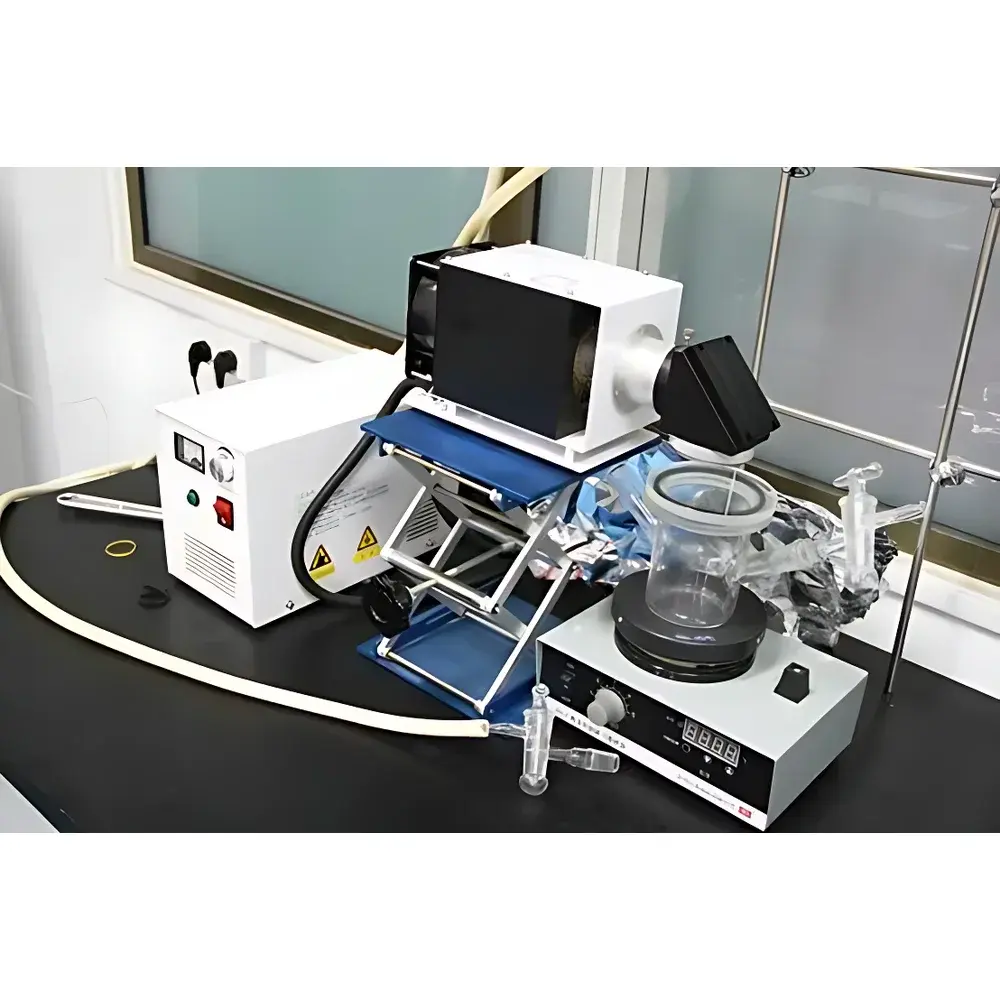
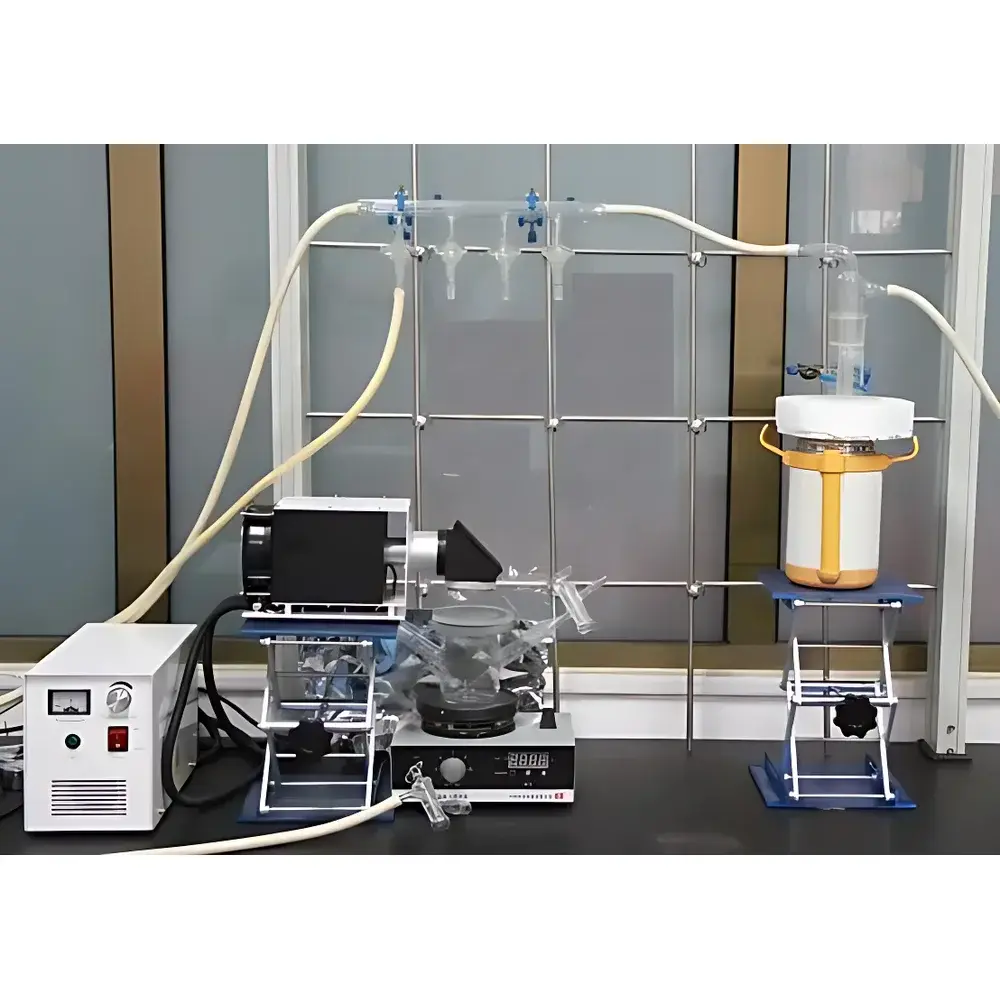
CEL-LPPC Liquid-Phase Photocatalytic Reaction System
| Brand | CEA (China Education Goldsource) |
|---|---|
| Origin | Beijing, China |
| Manufacturer Type | OEM/ODM Manufacturer |
| Country of Origin | China |
| Model | CEL-LPPC |
| Price | USD 11,400 (FOB Beijing) |
Overview
The CEL-LPPC Liquid-Phase Photocatalytic Reaction System is an engineered laboratory platform designed for quantitative evaluation of photocatalytic activity under controlled irradiation conditions. It operates on the fundamental principle of semiconductor photoexcitation: upon absorption of photons with energy equal to or greater than the bandgap (e.g., UV-A at 365 nm or visible light ≥420 nm), photocatalysts such as TiO₂, ZnO, WO₃, or CdS generate electron–hole pairs. These charge carriers migrate to the catalyst surface and drive redox reactions—oxidizing organic probe molecules (e.g., methylene blue, rhodamine B, phenol) or reducing protons in water-splitting studies. The system enables time-resolved monitoring of reactant depletion or product formation via external analytical instrumentation (e.g., UV-Vis spectrophotometer, HPLC, or GC-MS), supporting kinetic modeling and quantum yield estimation per ISO 10678:2010 and ASTM E2919–22.
Key Features
- Modular dual-mode architecture: supports both offline batch-mode and online continuous-flow configurations
- Standardized quartz reaction vessel (100 mL volume, Φ45 mm × 80 mm) with integrated cooling jacket for temperature stabilization (±0.5 °C)
- Collimated optical path design ensuring uniform irradiance distribution across catalyst surface (measured via calibrated photodiode sensor)
- Interchangeable LED or mercury-xenon lamp sources with optional bandpass filters (365 nm, 405 nm, 420 nm, 450 nm, 520 nm) compliant with ISO 10676:2011 spectral classification
- Integrated magnetic stirring with speed control (0–800 rpm) and real-time torque feedback to maintain homogeneous suspension of particulate catalysts
- Gas-tight sealing and optional N₂/Ar purging port for anaerobic or inert-atmosphere experiments
- CE-marked power supply and IP20-rated enclosure meeting IEC 61010-1 safety requirements for laboratory equipment
Sample Compatibility & Compliance
The CEL-LPPC accommodates heterogeneous photocatalysts in four physical forms: (i) suspended powders (e.g., P25 TiO₂, mesoporous g-C₃N₄), (ii) immobilized thin films (sputtered, spin-coated, or dip-coated on quartz or FTO substrates), (iii) monolithic pellets or granules (e.g., TiO₂ beads, zeolite-supported catalysts), and (iv) structured mesh or foam supports. All testing protocols align with GB/T 23762–2009 “Test method for purification performance of photocatalytic materials in aqueous solution”, including standardized initial concentration (10 mg/L methylene blue), catalyst loading (1.0 g/L), light intensity calibration (≥10 mW/cm² at 365 nm), and sampling intervals (0, 15, 30, 60, 90, 120 min). Data generated are suitable for regulatory submission under GLP-compliant workflows when paired with validated analytical methods.
Software & Data Management
The system does not include embedded firmware or proprietary software. Instead, it is designed for seamless integration into existing lab informatics ecosystems. Experimental parameters—including irradiation start time, lamp operating hours, stirrer RPM, and ambient temperature—are manually logged or recorded via external data acquisition systems (e.g., LabVIEW, MATLAB, or ELN platforms such as Benchling or LabArchives). Raw concentration-time datasets exported from UV-Vis or HPLC instruments can be imported into kinetic analysis tools (e.g., OriginPro, KinTek Explorer) to calculate apparent rate constants (kapp, min⁻¹), half-life (t1/2), and Langmuir–Hinshelwood adsorption coefficients. Audit trails and electronic signatures comply with FDA 21 CFR Part 11 when used within validated ELN environments.
Applications
- Quantitative benchmarking of novel photocatalyst formulations against reference standards (e.g., Degussa P25)
- Structure–activity relationship (SAR) studies correlating crystallinity, surface area, and band alignment with degradation kinetics
- Stability and recyclability assessment over ≥5 consecutive reaction cycles under identical irradiation dose
- Scavenger experiments using EDTA (h⁺ trap), benzoquinone (•O₂⁻ trap), or isopropanol (•OH trap) to identify dominant reactive species
- Photoelectrochemical coupling studies when interfaced with potentiostats for simultaneous current measurement
- Development of ISO/IEC 17025-accredited test methods for third-party certification of commercial photocatalytic products
FAQ
Does the CEL-LPPC include a built-in spectrophotometer or analytical detector?
No. It is a reaction platform only; quantification requires external instrumentation (e.g., UV-Vis spectrophotometer).
Can the system operate under vacuum or elevated pressure?
No. It is rated for ambient pressure operation only (0.8–1.2 atm); pressure-rated variants require custom engineering.
Is lamp spectral output certified and traceable to NIST standards?
Lamp irradiance is calibrated using a NIST-traceable photodiode sensor (Hamamatsu S1337 series); full spectral power distribution reports available upon request.
What maintenance is required for long-term reliability?
Quarterly inspection of O-rings, annual replacement of LED drivers or lamp housings, and biannual recalibration of stirrer torque sensors are recommended.
Are consumables such as quartz vessels or filters supplied with the system?
One standard quartz reaction vessel and two sets of bandpass filters (365 nm + 420 nm) are included; additional consumables are available as spare parts (P/N: CEL-LPPC-QZ-100, CEL-LPPC-FIL-365).
Related Products



