
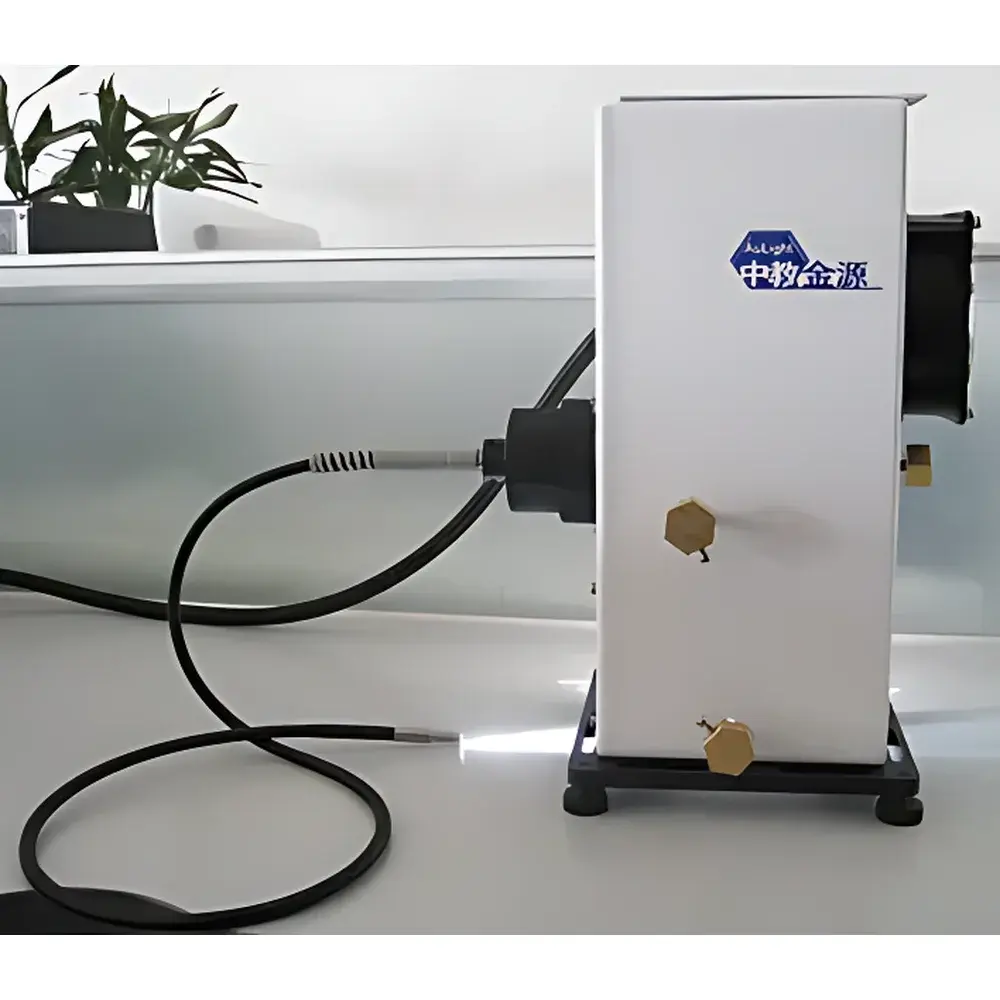
CEL-M350 Mercury Lamp UV Point Light Source System with Fiber Coupling
| Brand | CEAULIGHT |
|---|---|
| Origin | Beijing, China |
| Manufacturer Type | Manufacturer |
| Origin Category | Domestic |
| Model | CEL-M350 |
| Price Range | USD 0–720 (est.) |
| Optical Design | Single-Beam |
| Detector Type | CCD Array |
| Wavelength Range | 185–500 nm |
| Wavelength Automation | Motorized Wavelength Selection |
| Spectral Bandwidth | Fixed at 185–500 nm (UV–VIS) |
| Wavelength Accuracy | ±2.0 nm |
| Stray Light | <0.01% (typ. at 220 nm) |
Overview
The CEL-M350 Mercury Lamp UV Point Light Source System is a precision-engineered optical excitation platform designed for controlled, high-intensity ultraviolet and near-UV/visible irradiation in laboratory-scale photochemical and photophysical applications. Based on a stabilized spherical mercury vapor lamp, the system delivers intense line-emission spectra—dominated by strong peaks at 254 nm, 313 nm, 365 nm, and 405 nm—enabling reproducible activation of photocatalysts, polymerization initiators, and UV-sensitive biological probes. Unlike broadband sources, the CEL-M350 leverages the discrete spectral output of low-pressure Hg lamps to provide selective excitation without significant thermal load or broadband background interference. Its integrated fiber-coupled output enables flexible light delivery to reaction cells, microfluidic chips, or remote optical setups while maintaining spatial coherence and intensity stability (≤1% RMS over 1 h). The system operates as a single-beam source with motorized wavelength selection capability, supporting both fixed-band and quasi-monochromatic configurations when used with optional external bandpass filters.
Key Features
- High-efficiency optical train incorporating fused silica condenser lenses and rear-facing elliptical reflectors to maximize photon collection from the arc plasma and direct >75% of usable UV flux into the coupling interface.
- Integrated high-voltage electronic igniter housed within the lamp housing—eliminating exposed HV cabling between power supply and lamp chamber and complying with IEC 61010-1 safety requirements for Class II laboratory equipment.
- Motorized collimation and focusing mechanism enabling continuous adjustment of output beam geometry: selectable point-source mode (2–3 mm diameter at focal plane) or uniform parallel illumination (50 mm Ø, ±3% intensity homogeneity across 60 mm field).
- Dual-fan forced-air cooling system maintaining lamp envelope temperature below 120 °C during continuous operation, extending rated lamp lifetime to ≥500 hours under nominal current (5–10 A) and preventing thermal drift in spectral output.
- Fiber-optic coupling port compatible with SMA905 or FC/PC connectors; accepts core diameters from 200 µm to 1000 µm multimode UV-grade silica fibers (e.g., Ocean Insight QP400-UV-VIS or Thorlabs UV2000).
- Stable DC power supply with real-time current monitoring, soft-start ramping, and over-current shutdown—ensuring consistent arc ignition and minimizing electrode sputtering.
Sample Compatibility & Compliance
The CEL-M350 is routinely deployed in ASTM E2027-22 (Standard Practice for UV Exposure Testing of Photocatalytic Materials), ISO 10678:2010 (Photocatalysis – Determination of Photocatalytic Activity), and USP extractables testing protocols requiring defined UV irradiance profiles. Its 185–500 nm spectral coverage satisfies requirements for ozone-generating photolysis (185 nm), DNA crosslinking (254 nm), and TiO₂ bandgap excitation (365 nm). All optical components meet RoHS Directive 2011/65/EU restrictions on hazardous substances. The system’s mechanical design conforms to GLP-compliant instrument qualification standards—including documented IQ/OQ protocols available upon request—and supports 21 CFR Part 11–compliant data logging when interfaced with validated third-party acquisition software.
Software & Data Management
While the CEL-M350 operates as a stand-alone hardware unit, its analog voltage output (0–10 V) and RS-232 serial interface enable integration with LabVIEW, MATLAB, or Python-based control environments for automated irradiation dosing (J/cm²), time-resolved intensity logging, and synchronized shutter triggering. Optional OEM firmware upgrades support timestamped event logging, lamp-on runtime tracking, and fault-code reporting—facilitating audit-ready maintenance records per ISO/IEC 17025 Clause 6.4.2. No proprietary closed-source software is required; configuration and diagnostics are accessible via ASCII command set compliant with SCPI-1999 syntax.
Applications
- Quantitative photocatalytic degradation kinetics studies (e.g., methylene blue, phenol, NOₓ removal) under standardized UV flux conditions.
- In-situ UV-Vis spectroelectrochemistry using fiber-coupled flow cells equipped with optically transparent electrodes.
- Photoinduced polymerization initiation in acrylate and thiol-ene resin formulations under controlled 365 nm irradiance.
- Calibration and validation of UV radiometers, spectroradiometers, and solar-blind detectors.
- Microscale photolithography mask alignment and exposure testing on SU-8 and AZ-series resists.
- Accelerated UV aging of polymeric packaging materials per ISO 4892-3 cycles using 313 nm–dominant irradiation.
FAQ
What is the typical spectral irradiance output at 365 nm?
At 10 cm working distance and with a 600 µm core UV fiber, the system delivers ~12–18 mW/cm² at 365 nm (measured with calibrated NIST-traceable UV-A sensor).
Can the CEL-M350 be operated in pulsed mode?
No—this is a DC-stabilized continuous-wave source. Pulsed operation requires external mechanical or electro-optic shutters.
Is ozone generation a concern at 185 nm emission?
Yes; operation below 200 nm in ambient air produces ozone. Use only in ventilated fume hoods or inert-atmosphere gloveboxes when utilizing the full 185 nm range.
What fiber types are recommended for maximum UV transmission?
Fused silica fibers with high-OH content (e.g., Thorlabs FG200LCC, LEONI UV-FS-200/220) are required for >85% transmission at 254 nm; standard silica fibers exhibit rapid solarization below 300 nm.
Does the system include radiometric calibration documentation?
A factory spectral irradiance certificate (NIST-traceable, measured at 10 cm with cosine-corrected detector) is provided with each unit; full calibration services are available through authorized metrology partners.






