
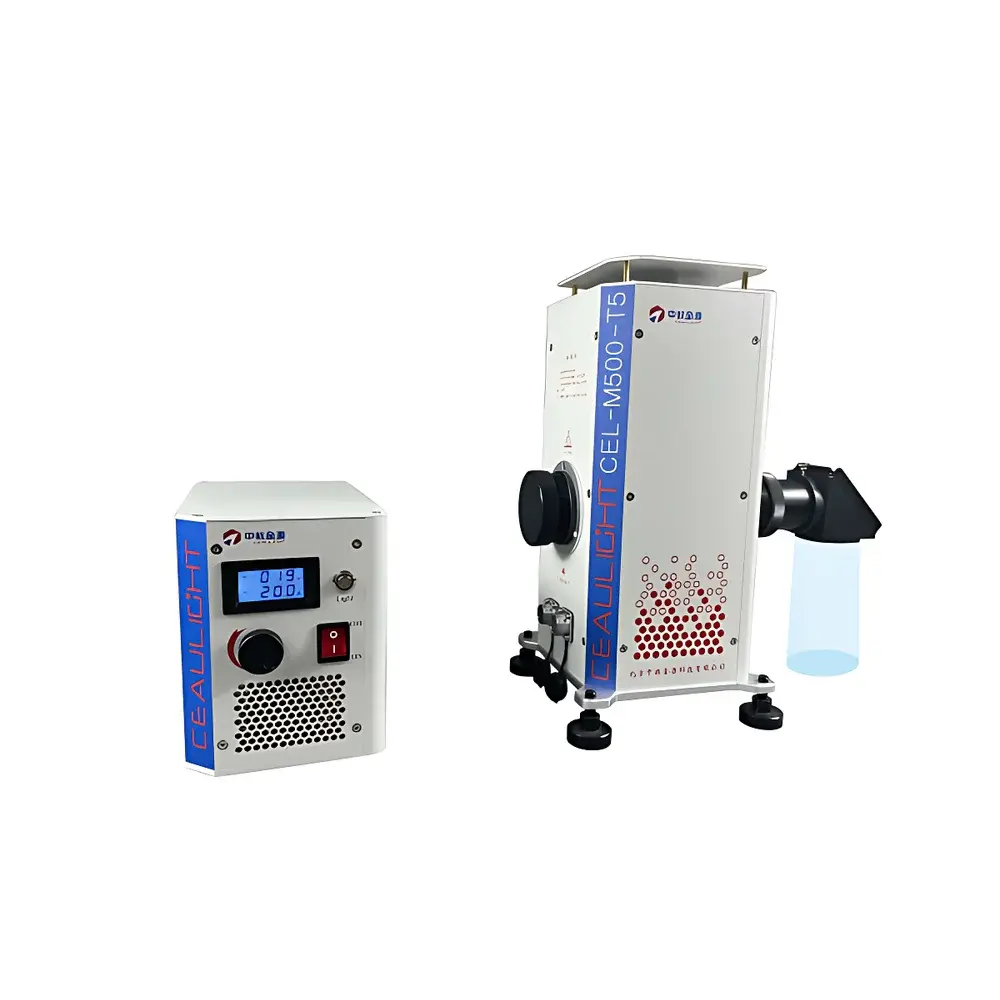
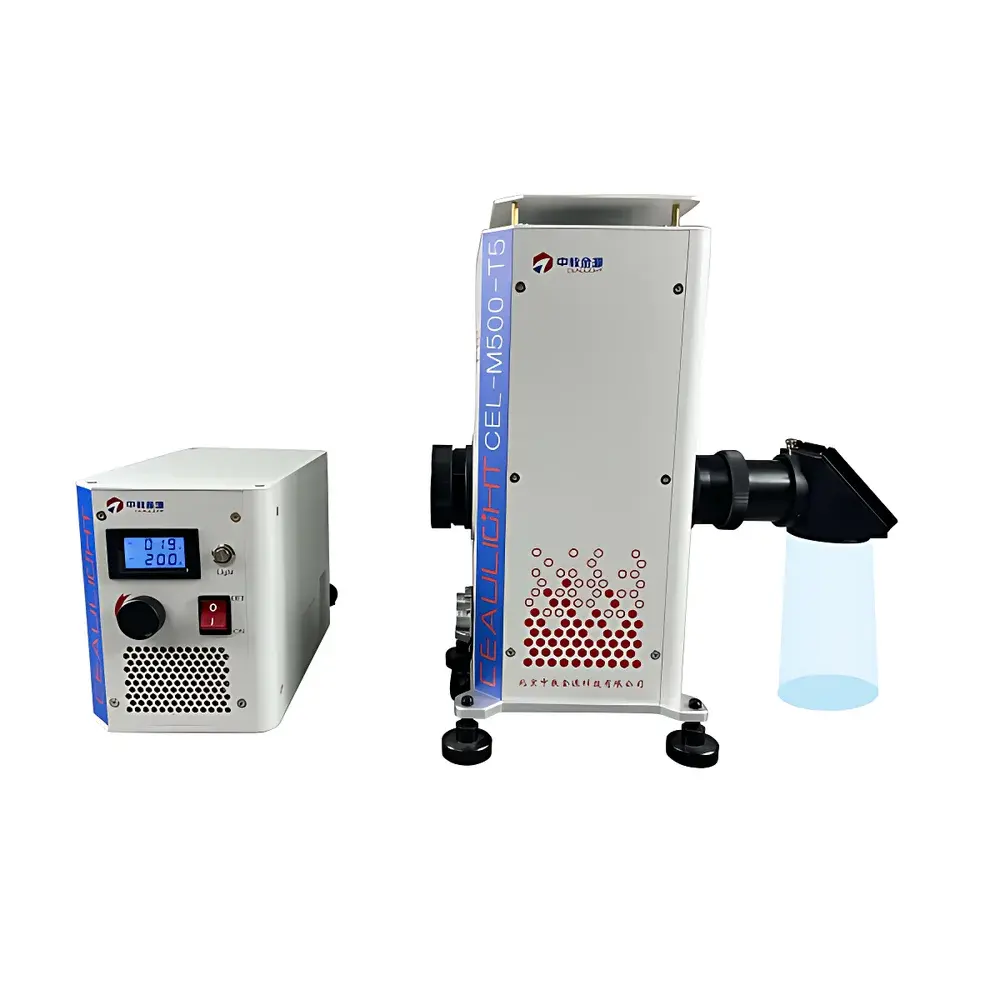
CEL-M500-T5 High-Uniformity, High-Stability Mercury Arc Lamp Light Source
| Brand | CEAULIGHT |
|---|---|
| Model | CEL-M500-T5 |
| Light Source Type | Medium-Pressure Mercury Arc Lamp |
| Illumination Mode | External Irradiation |
| Max Input Power | 500 W |
| Radiant Output | 15 W |
| Spectral Range | 185–1100 nm (Quartz Optics) |
| Beam Diameter | ≥60 mm (Circular) |
| Stability | ≤1% RMS over 8 h |
| Lamp Lifetime | >800 h |
| Cooling | Intelligent Fan-Controlled Air Cooling |
| Filter Compatibility | 25.4 mm, 50.8 mm, M52, M62 Mounts |
| Standard UV Bandpass Filters | 254, 313, 334, 350, 365, 380, 400, 405 nm |
| Optical Components | Fused Silica Lenses & Filters, K9 Glass Options Available |
| Power Density Tunability | 0.5–5 Sun (1 Sun = 1000 W/m²), Measurable via CEL-NP2000 Radiometer |
Overview
The CEL-M500-T5 is a research-grade medium-pressure mercury arc lamp light source engineered for high-fidelity ultraviolet (UV) photochemical experimentation. It operates on the principle of high-frequency, high-voltage arc discharge within a sealed quartz envelope containing mercury vapor — generating intense, spectrally rich emission across the deep UV to near-IR range (185–1100 nm). Unlike broadband xenon sources, the mercury spectrum features discrete, high-intensity emission lines — notably at 254 nm (resonance line), 313 nm, 365 nm (i-line), and 405 nm — making it uniquely suited for wavelength-selective photolysis, photocatalytic kinetics, UV lithography simulation, and accelerated photodegradation studies. The T5 designation denotes its optimized thermal and optical architecture: a thermally stabilized lamp housing, precision-aligned quartz condenser optics, and active airflow management ensure spatial uniformity (>95% across ≥60 mm diameter field) and temporal stability (≤1% RMS intensity drift over 8 hours under continuous operation).
Key Features
- Medium-pressure mercury lamp (350 W / 500 W selectable configuration) with fused silica envelope for optimal UV transmission down to 185 nm
- High-intensity UV output: 15 W total radiant power, tunable irradiance from 0.5 to 5 Sun (1000 W/m²) via integrated attenuators and distance calibration
- Optical homogeneity ≥95% across a minimum 60 mm circular working area — verified by NIST-traceable radiometric mapping
- Intelligent air-cooling system with variable-speed fans synchronized to real-time lamp power draw, minimizing thermal lensing and extending lamp lifetime beyond 800 operating hours
- Modular mechanical interface compatible with standard optical mounts (25.4 mm, 50.8 mm, M52, M62), enabling direct integration with commercial filter wheels, collimators, fiber couplers, and beam-shaping optics
- No external water cooling required; fully self-contained operation suitable for Class II biosafety cabinets and glovebox-integrated photoreactors
Sample Compatibility & Compliance
The CEL-M500-T5 supports diverse sample formats including Petri dishes, quartz cuvettes (1–10 cm path length), flat-panel photocatalytic reactors, and custom flow cells. Its external irradiation geometry permits unobstructed access to reaction vessels during illumination — critical for in situ spectroscopic monitoring (e.g., UV-Vis, Raman) or gas-phase product analysis. All optical components comply with ISO 10110-7 (surface quality) and ASTM E275 (spectral bandpass definitions for UV filters). When used with certified bandpass filters (e.g., 254 nm ±2 nm, OD₆ blocking), the system meets requirements for controlled UV exposure in ASTM D4329 (plastics weathering), ISO 4892-3 (fluorescent UV exposure), and USP (pharmaceutical packaging photostability testing). Full GLP-compliant operation is supported via optional radiometric calibration certificates (NIST-traceable, ±2% uncertainty at 254 nm).
Software & Data Management
While the CEL-M500-T5 operates as a standalone analog source, it integrates seamlessly with third-party radiometric instrumentation — particularly the CEL-NP2000 calibrated photodiode-based radiometer — for real-time irradiance logging, dose accumulation (J/m²), and stability trending. Exported CSV datasets include timestamped irradiance values, fan RPM feedback, and ambient temperature readings. For regulated environments, the system supports 21 CFR Part 11 compliance when paired with validated electronic lab notebook (ELN) platforms: audit trails, user authentication, and electronic signatures are managed externally through the host ELN software. No proprietary firmware or closed-loop control is embedded — ensuring full transparency and long-term maintainability.
Applications
- Photocatalytic degradation kinetics (e.g., TiO₂-mediated mineralization of organic pollutants under 365 nm excitation)
- UV-induced polymer crosslinking and photoinitiator screening (254/313 nm)
- Photochemical synthesis requiring narrowband UV activation (e.g., [2+2] cycloadditions, Norrish-type reactions)
- Accelerated aging of UV-sensitive materials (coatings, adhesives, OLED encapsulants)
- Calibration and validation of UV radiometers and spectroradiometers
- Microscale UV lithography process development using i-line (365 nm) or h-line (405 nm) illumination
FAQ
What safety certifications does the CEL-M500-T5 carry?
The unit conforms to IEC 61000-6-3 (EMC emissions) and IEC 61000-6-2 (immunity), with CE marking for laboratory equipment. UV radiation hazard classification follows IEC 62471:2006 (Risk Group 3 for unfiltered output); appropriate interlocks and UV-blocking eyewear are mandatory.
Can the lamp be operated continuously for >4 hours without performance degradation?
Yes — thermal management and arc stabilization circuitry enable stable continuous operation up to 8 hours, with ≤1% intensity drift measured per ASTM E2912. Lamp restart requires ≥15 min cooldown between cycles.
Is spectral calibration data provided with each unit?
A factory-measured relative spectral irradiance curve (185–1100 nm, 1 nm resolution) is supplied in ASCII format, acquired using an AULTT-P series fiber-coupled spectroradiometer traceable to NIST SRM 1935.
Are replacement lamps and quartz optics available as spare parts?
Yes — OEM mercury lamps (CEAULIGHT MP-Hg-500), fused silica condenser lenses, and certified bandpass filters are stocked globally with lead times <2 weeks. All consumables include batch-specific calibration reports.
How is beam uniformity verified during installation?
A 9-point radiometric grid measurement protocol is included in the operator manual, using the CEL-NP2000 radiometer and a motorized XY stage. Uniformity verification is required prior to GLP/GMP-compliant experiments.







