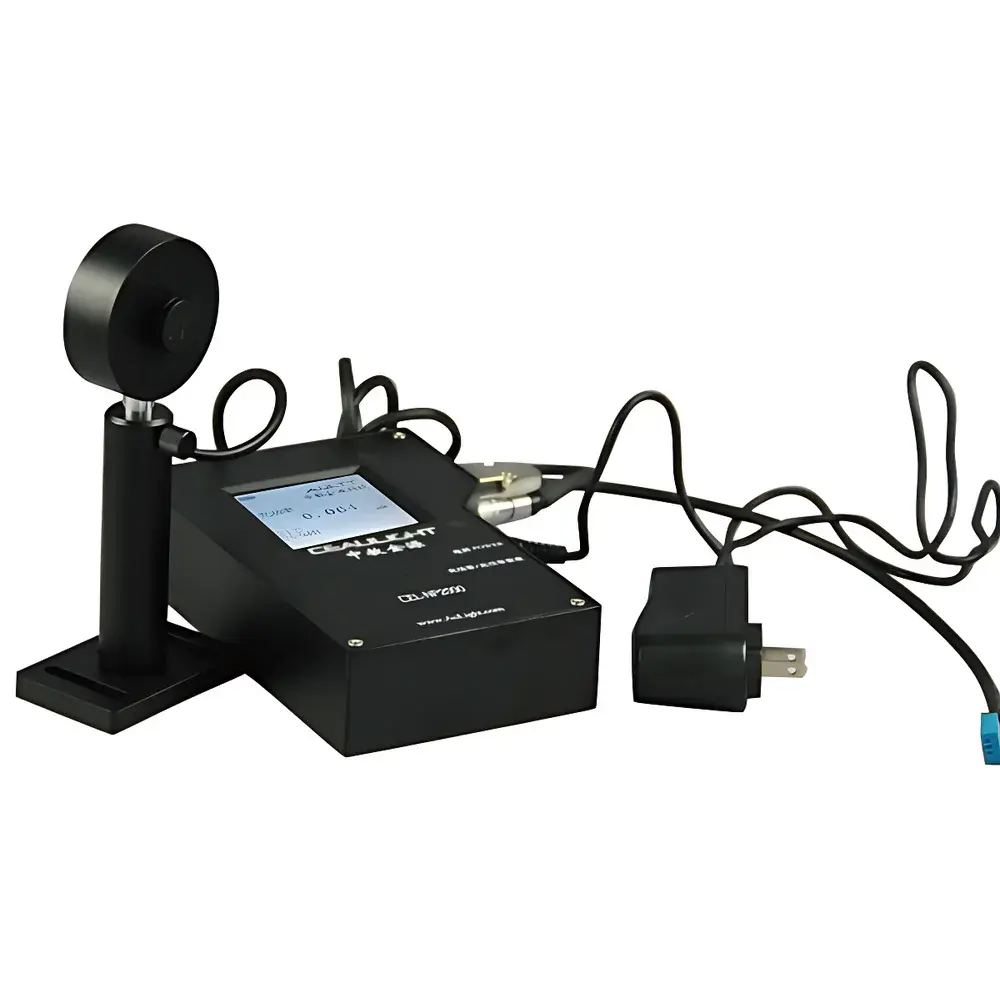
CEL-NP2000-10 High-Power Optical Power Meter (10 W)
| Brand | CEL |
|---|---|
| Origin | Beijing, China |
| Manufacturer Type | Direct Manufacturer |
| Product Category | Domestic |
| Model | CEL-NP2000-10 |
| Price | Upon Request |
| Wavelength Range | 190 nm – 11,000 nm |
| Power Density Range | 0–2,000 mW/cm² / 0–10,000 mW/cm² (auto-ranging) |
| Sensor Active Area | Ø20 mm (314 mm²) |
| Spectral Response | 0.19–2.5 µm (uniformity ±2.7%) |
| Max Continuous Irradiance | 200 W/cm² |
| Resolution | 1 µW |
| Response Time | <0.4 s |
| Thermal Drift | <±1% FS within 10 min |
| Uncertainty | ±5% |
| Analog Output | 1–1999 mV |
| Operating Environment | Standard optical lab, 25°C, ambient pressure, no direct airflow |
| Power Supply | Rechargeable Li-ion battery + 220 V / 50 Hz charger |
Overview
The CEL-NP2000-10 High-Power Optical Power Meter is a precision radiometric instrument engineered for quantitative measurement of continuous-wave (CW) optical irradiance across an exceptionally broad spectral domain—from deep ultraviolet (190 nm) to far-infrared (11,000 nm). Unlike conventional photodiode-based meters limited to visible or narrow NIR bands, the NP2000-10 integrates a thermopile sensor with spectrally optimized absorption coating and active thermal stabilization, enabling accurate, drift-compensated power density measurements up to 10 W total power (10,000 mW/cm² at Ø20 mm aperture). Its core architecture adheres to fundamental radiometric principles: incident photon energy is converted to heat in the absorber surface, and the resulting temperature gradient across the thermopile junctions generates a voltage proportional to incident radiant flux—ensuring wavelength-independent responsivity within its calibrated range (0.19–2.5 µm). This makes it especially suitable for characterizing high-intensity light sources used in photocatalysis, solar simulator calibration, laser safety assessment, and UV-curing process validation.
Key Features
- Auto-ranging dual-scale measurement: seamlessly switches between 0–2,000 mW/cm² and 0–10,000 mW/cm² ranges to preserve resolution for both low-intensity background signals and high-flux irradiation without manual gain adjustment.
- Thermopile-based detection with Ø20 mm active area (314 mm²), offering uniform spatial response and high damage threshold—capable of withstanding continuous irradiance up to 200 W/cm² without sensor degradation.
- Real-time environmental monitoring: integrated digital sensors display ambient temperature and relative humidity during measurement, supporting traceable environmental correlation per ISO/IEC 17025 requirements.
- High temporal fidelity: <0.4 s electrical response time enables dynamic monitoring of stabilized CW sources and transient overshoot evaluation during lamp warm-up or shutter actuation.
- Built-in rechargeable lithium-ion battery with AC adapter (220 V / 50 Hz), enabling portable deployment in gloveboxes, environmental chambers, or field calibration setups without tethered power.
- Analog output (1–1999 mV) compatible with external DAQ systems for synchronized data logging, PLC integration, or closed-loop irradiance control in automated reactor systems.
Sample Compatibility & Compliance
The CEL-NP2000-10 is designed for non-contact, collimated or diffused beam measurement under controlled laboratory conditions (25°C ±2°C, ambient pressure, minimal air turbulence). It accommodates standard optical mounts via its threaded M36×0.75 sensor housing and optional alignment fixtures. Calibration is traceable to national standards through NIM (National Institute of Metrology, China) reference detectors, with uncertainty reported as ±5% (k=2) across the 0.19–2.5 µm band. For wavelengths outside this range (e.g., mid-IR >2.5 µm or vacuum UV <190 nm), users must apply empirically determined spectral correction factors derived from source-specific spectral power distribution (SPD) data. The instrument complies with IEC 61000-4-3 (EMC immunity) and meets mechanical robustness criteria per IEC 60068-2-6 (vibration) and IEC 60068-2-27 (shock), ensuring reliability in shared instrumentation facilities.
Software & Data Management
The meter operates in standalone mode with an OLED display showing real-time power (mW), power density (mW/cm²), temperature, and humidity. Optional USB-C interface supports ASCII protocol communication for integration with LabVIEW, Python (PySerial), or MATLAB environments. Logged data includes timestamp, measurement mode, range status, and environmental metadata—enabling full audit trails required under GLP and GMP frameworks. Firmware supports user-defined zeroing routines and configurable averaging windows (1–10 s), facilitating compliance with ASTM E927-20 (solar simulator classification) and ISO 9050 (optical transmittance testing) reporting formats.
Applications
- Calibration and uniformity mapping of Class AAA solar simulators (IEC 60904-9)
- Quantitative irradiance profiling in photocatalytic reactors (e.g., TiO₂-driven H₂ generation, CO₂ reduction)
- Laser safety compliance verification (ANSI Z136.1) for CW UV-Vis-NIR sources
- UV-LED array output stability monitoring in industrial curing lines
- Reference-grade power measurement for optical filter characterization and transmittance validation
- Environmental chamber-based aging studies requiring long-term irradiance consistency tracking
FAQ
Is the CEL-NP2000-10 calibrated for absolute spectral irradiance?
No—it provides calibrated broadband power density values within 0.19–2.5 µm; spectral irradiance requires external monochromator-based calibration or correction using known source SPD.
Can it measure pulsed lasers?
It is optimized for continuous-wave sources; pulsed operation falls outside its specified response envelope due to thermal inertia limitations.
What is the recommended recalibration interval?
Annual recalibration is advised under routine use; more frequent verification is recommended after mechanical shock, exposure to excessive irradiance (>200 W/cm²), or environmental extremes.
Does it support NIST-traceable certification?
Yes—optional factory-issued calibration certificate includes NIM-traceable uncertainty statements and reference to ISO/IEC 17025-accredited procedures.
How is sensor uniformity verified?
Uniformity is characterized via raster-scanned aperture illumination at multiple wavelengths (254 nm, 405 nm, 850 nm, 1064 nm) and documented in the performance report with ≤±2.7% deviation over the central 90% of the Ø20 mm area.