
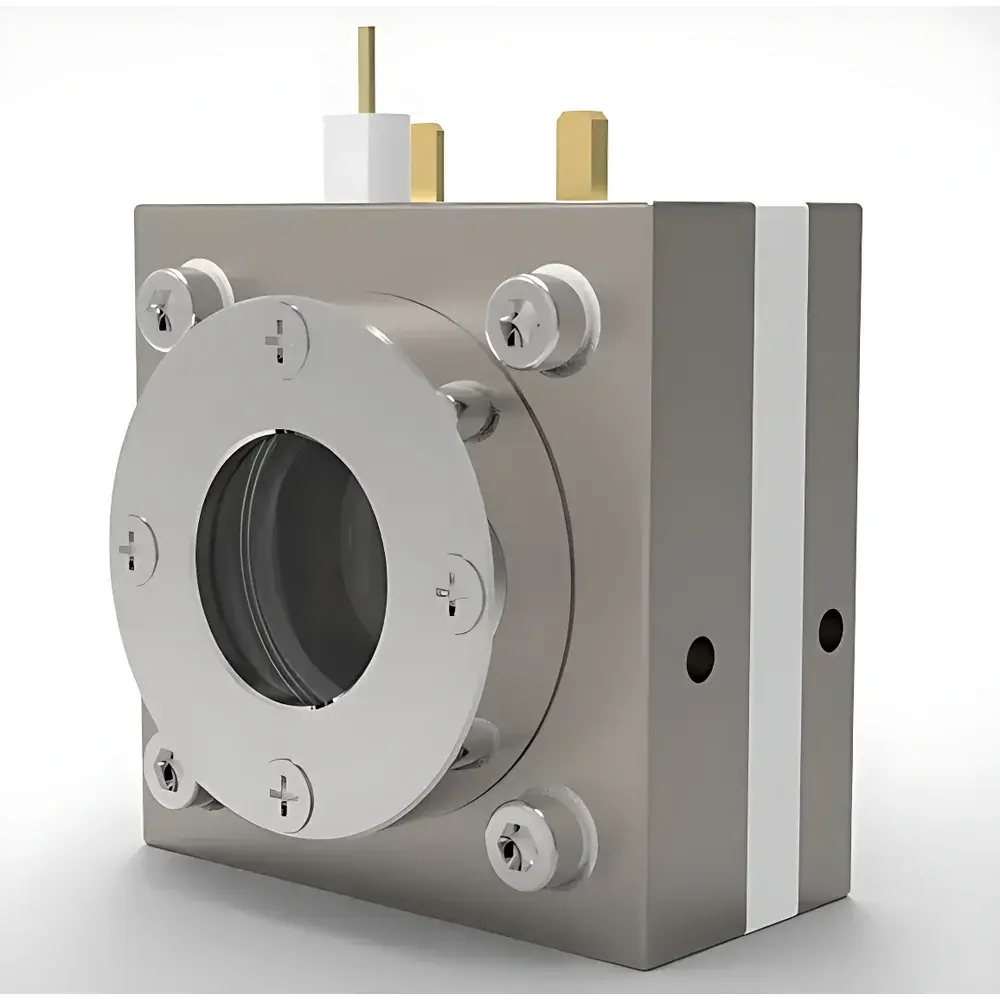
CEL-PECR-TFC10 Photoelectrochemical Flow Reactor by CEAULIGHT
| Brand | CEAULIGHT |
|---|---|
| Origin | Beijing, China |
| Manufacturer Type | OEM Producer |
| Model | CEL-PECR-TFC10 |
| Application | Dual-compartment two-electrode/three-electrode photoelectrochemical flow reactor for gas–solid–liquid triphasic catalysis |
| Construction Material | Grade 2 titanium (Ti) body, PTFE gasketing, gold-plated copper current collectors |
| Optical Window | Fused silica, Ø40 mm (effective Ø30 mm), rated to 1.0 MPa |
| Electrode Area | 20 mm × 20 mm square working electrode surface |
| Max Operating Pressure | ≤1.0 MPa |
| Volume | <10 mL |
| Compatible Electrodes | Pt counter, Ag/AgCl reference (optional), user-supplied photoanode/cathode |
| Gas Inlet | 3 mm OD stainless steel or PTFE tubing interface |
| Compliance | Designed for ASTM E2536, ISO 13485-aligned manufacturing practices |
Overview
The CEL-PECR-TFC10 Photoelectrochemical Flow Reactor is an engineered platform for quantitative evaluation of semiconductor-based photoelectrocatalysts under controlled gas–solid–liquid triphasic conditions. It operates on the principle of potentiostatically or galvanostatically driven interfacial charge transfer at illuminated semiconductor electrodes, where photon absorption generates electron–hole pairs that drive redox reactions—such as CO2 reduction or N2 fixation—at the catalyst/electrolyte/gas boundary. Unlike static H-cell configurations, the TFC10 implements a continuous-flow architecture enabling precise stoichiometric control over gaseous reactants (e.g., high-purity CO2 or N2), sustained mass transport to the electrode surface, and minimization of concentration polarization. Its dual-compartment design supports both two-electrode (photoanode + cathode) and three-electrode (with integrated Ag/AgCl reference) configurations, allowing rigorous kinetic analysis including Tafel slope derivation, Faradaic efficiency quantification, and incident-photon-to-current efficiency (IPCE) mapping.
Key Features
- Triphasic reaction environment: Simultaneous delivery of gaseous feed (CO2, N2), liquid electrolyte (aqueous or non-aqueous), and solid photocatalyst electrode under illumination.
- High-integrity sealing architecture: Eliminates gas leakage and electrolyte crossover through precision-machined titanium flanges and chemically inert PTFE gaskets.
- Optically optimized quartz window: Fused silica viewport (Ø40 mm, effective Ø30 mm) transmits UV–vis–NIR radiation (190–2500 nm) with >92% transmission and withstands up to 1.0 MPa backpressure.
- Corrosion-resistant conduction system: Gold-plated copper current collectors ensure low-contact resistance (<5 mΩ) and long-term stability in acidic, alkaline, or halide-containing electrolytes.
- Modular electrode integration: Standard 20 mm × 20 mm square electrode footprint accommodates spin-coated, drop-cast, sputtered, or CVD-grown photoelectrodes; optional reference electrode port enables uncompensated solution resistance correction.
- Flow-compatible interface: 3 mm OD tube fittings support seamless integration with peristaltic pumps, gas mass flow controllers, online sampling loops, and GC/MS inlet lines.
Sample Compatibility & Compliance
The CEL-PECR-TFC10 is validated for use with metal oxide (e.g., TiO2, BiVO4), chalcogenide (e.g., CdS, CuInGaSe2), perovskite, and molecular catalyst systems deposited on conductive substrates (FTO, ITO, carbon cloth, Ni foam). It complies with mechanical safety requirements outlined in ISO 10218-1 for pressurized laboratory reactors and meets material compatibility criteria specified in ASTM D471 for elastomer–chemical exposure. When operated with certified reference electrodes (e.g., reversible hydrogen electrode calibrated against NIST-traceable standards) and paired with electrochemical workstations supporting 21 CFR Part 11 audit trails (e.g., BioLogic SP-300, Pine Research WaveNow), the system supports GLP-compliant data acquisition for regulatory submissions.
Software & Data Management
The reactor itself is hardware-only and requires external instrumentation for control and acquisition. It is fully interoperable with industry-standard platforms: potentiostats offering chronoamperometry, linear sweep voltammetry, and impedance spectroscopy; gas chromatographs (e.g., GC-7920 with TCD/FID) equipped with automated loop injectors and calibration databases; and flow controllers with Modbus RTU or Ethernet/IP communication protocols. Raw sensor outputs (current, potential, pressure, flow rate, GC peak area) can be time-synchronized via TTL triggers or shared NTP clocks, enabling consolidated datasets for Faradaic efficiency calculation, product selectivity profiling, and long-term stability assessment (≥100 h operation demonstrated with TiO2-based cathodes under 0.1 M KHCO3 + CO2(g) flow).
Applications
- Quantitative screening of CO2 reduction catalysts for C1–C2 product distribution (CO, CH4, C2H4, ethanol) under simulated solar illumination.
- Photoelectrochemical nitrogen fixation studies using N2/Ar mixtures at ambient pressure and temperature.
- Stability testing of emerging photoanodes (e.g., α-Fe2O3, WO3) during oxygen evolution reaction (OER) in phosphate buffer.
- In situ/operando spectroelectrochemical coupling with Raman or ATR-FTIR probes via side-port optical access.
- Method development for ISO/IEC 17025-accredited laboratories performing catalyst performance certification per ASTM E2536 Annex A3.
FAQ
Can the CEL-PECR-TFC10 be used with non-aqueous electrolytes such as acetonitrile or DMF?
Yes—the titanium body and PTFE seals are chemically resistant to common organic solvents; however, quartz window compatibility must be verified for prolonged UV exposure in low-bandgap solvent systems.
Is the working electrode electrically isolated from the reactor body?
Yes—gold-plated copper current collectors are insulated from the titanium housing via ceramic washers and PTFE spacers, ensuring minimal background current and accurate potential control.
What is the maximum recommended light intensity for the quartz window?
The fused silica viewport supports continuous irradiation up to 1.5 suns (1500 W/m²) without thermal fracture when cooled via external jacketed flow; higher intensities require active thermal management.
Does the reactor include temperature control capability?
No—temperature regulation requires external integration with a recirculating chiller or Peltier stage; the reactor features 1/4″-28 UNF threaded ports for thermocouple insertion and coolant line attachment.
Are custom electrode geometries supported beyond the standard 20 mm × 20 mm format?
Yes—custom-machined electrode holders and gasket sets are available upon request for circular, annular, or micro-patterned substrates up to 25 mm diameter.






