
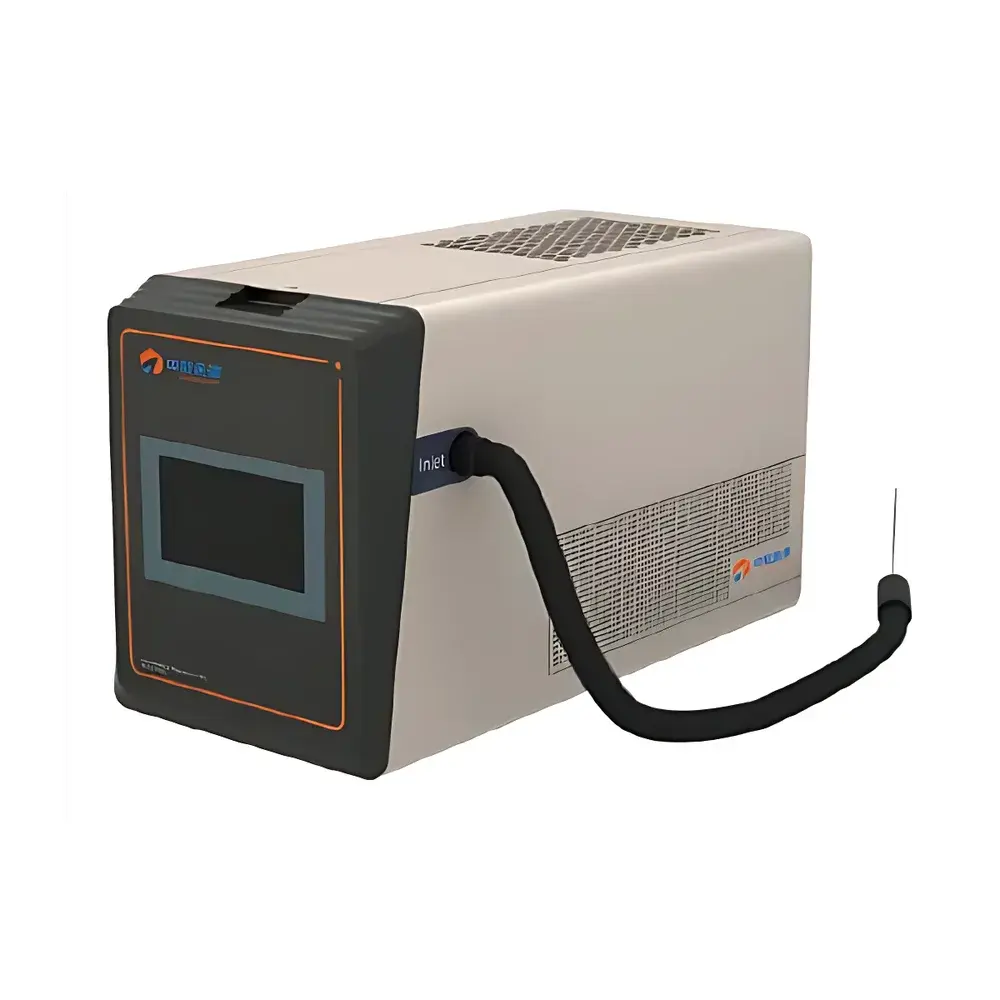
CEL-QMS1000 Online Quadrupole Mass Spectrometer
| Brand | CEL (Zhongjiao Jinyuan) |
|---|---|
| Origin | Beijing, China |
| Manufacturer Type | Original Equipment Manufacturer (OEM) |
| Regional Origin | Domestic (PRC) |
| Model | CEL-QMS1000 |
| Pricing | Upon Request |
| Mass Range (Configurable) | 1–100 amu (optional 1–200 amu / 1–300 amu) |
| Mass Analyzer | Quadrupole |
| Detector Options | Faraday Cup (detection limit: 4×10⁻¹³ mbar) or Secondary Electron Multiplier (SEM |
| detection limit | 3×10⁻¹⁵ mbar) |
| Ion Source | Open-type electron impact (EI) source with dual filaments |
| Resolution (10% peak height) | 0.5–2.5 amu |
| Scan Time per amu | 1 ms – 16 s |
| Inlet Pressure | Ambient (standard) |
| Inlet Temperature Control | 25–200 °C (capillary + filter assembly, dual-stage pressure reduction) |
| Vacuum System | Turbo-molecular pump + oil-free diaphragm dry pump |
| Mass Spectrometer Chamber | Stainless-steel construction with external heating jacket (max bake-out temperature: 200 °C) |
| Data Acquisition Interface | Ethernet (TCP/IP) |
| Measurement Channels | 128 parallel channels |
| Response Time | Millisecond-level |
| Detection Dynamic Range | 100% down to sub-ppb (v/v) |
| I/O Module | TTL/Analog-compatible digital input/output for synchronization with external instruments (TGA, electrochemical workstations, reactors, etc.) |
Overview
The CEL-QMS1000 Online Quadrupole Mass Spectrometer is an engineered solution for real-time, in situ gas-phase analysis in dynamic chemical and electrochemical environments. Operating on the principle of electron ionization (EI) quadrupole mass spectrometry, it enables high-fidelity qualitative and quantitative identification of volatile species based on their mass-to-charge ratio (m/z). The instrument maintains a high-vacuum environment (<10⁻⁷ mbar typical operating pressure) via a two-stage pumping system—comprising a turbo-molecular pump backed by an oil-free diaphragm dry pump—ensuring stable ion transmission and minimal background interference. Its open EI ion source features dual independently controlled filaments with integrated pressure-sensing protection to extend operational lifetime. The stainless-steel mass spectrometer chamber is equipped with a programmable heating jacket (up to 200 °C), enabling periodic in situ bake-out to reduce outgassing and improve signal-to-noise performance during long-duration experiments.
Key Features
- Millisecond-scale temporal resolution with configurable scan speeds (1 ms–16 s per amu), supporting transient event capture in fast-evolving reaction systems.
- Dual-detector architecture: selectable Faraday cup (for high-current, stable isotopic ratio measurement) or secondary electron multiplier (SEM) for ultra-trace detection down to 3×10⁻¹⁵ mbar partial pressure.
- Temperature-controlled capillary inlet system (25–200 °C), incorporating dual-stage pressure reduction and particulate filtration to prevent condensation and contamination during ambient-pressure sampling.
- Modular I/O interface with TTL and analog signal compatibility, enabling hardware-triggered acquisition synchronized with external instruments—including TGA, electrochemical potentiostats, catalytic reactors, and programmable temperature controllers.
- Full-range vacuum monitoring and closed-loop pressure regulation ensure reproducible ionization conditions across extended operation cycles.
- Bake-out capable mass spectrometer housing (200 °C max) minimizes residual water and hydrocarbon backgrounds, critical for low-abundance species detection in catalysis and battery off-gas studies.
Sample Compatibility & Compliance
The CEL-QMS1000 interfaces directly with a broad spectrum of analytical and process systems without requiring cryogenic trapping or pre-concentration. It supports direct coupling to thermogravimetric analyzers (TGA), pulse chemisorption units, fixed-bed reactors, electrochemical cells (including custom-designed Li-ion, Na-ion, Li–S, and PEM fuel cell test fixtures), fermentation bioreactors, and CVD chambers. Sample introduction occurs at ambient pressure; optional pressure-regulated inlets accommodate sub-atmospheric or elevated-pressure streams. The system complies with general laboratory safety standards for vacuum equipment (ISO 27427, IEC 61000-6-3) and supports audit-ready data handling when configured with timestamped, user-accessible raw data logs. While not pre-certified for GMP/GLP environments, its deterministic acquisition architecture and traceable calibration protocols align with FDA 21 CFR Part 11 requirements when deployed with validated software configurations and access-controlled user accounts.
Software & Data Management
The instrument is operated via a Windows-based control suite featuring real-time spectral visualization, multi-channel time-series plotting, and automated peak integration using centroiding and deconvolution algorithms. The software supports batch processing of sequential scans, library matching against NIST/EPA mass spectral databases, and customizable quantification workflows using internal or external standard calibration curves. All raw data (intensity vs. m/z vs. time) are stored in vendor-neutral ASCII or HDF5 format, ensuring long-term archival integrity and third-party analysis compatibility. Remote monitoring and configuration are supported over Ethernet using standard TCP/IP protocols; API access (via DLL or RESTful endpoints) allows integration into LabVIEW, Python, or MATLAB-based automation frameworks.
Applications
- Electrochemical Gas Evolution Monitoring: Real-time tracking of O₂, H₂, CO₂, SO₂, and volatile organic intermediates during battery cycling (Li-ion, Na-ion, Mg-ion, Li–S, Li–air), electrolyzer operation, and corrosion studies.
- Catalytic Reaction Kinetics: In situ identification of adsorbed intermediates and desorption products in TPD, TPO, and TPSR experiments coupled with chemisorption analyzers.
- Thermal Decomposition Analysis: TGA-MS hyphenated workflows for polymer degradation, MOF stability assessment, and additive decomposition profiling under controlled heating ramps.
- Fuel Cell & Hydrogen Purity Assurance: Continuous monitoring of stack exhaust gases for trace contaminants (e.g., NH₃, CO, siloxanes) affecting catalyst poisoning and membrane durability.
- Process Analytical Technology (PAT): Integration into CVD, ALD, and fermentation control loops for endpoint determination and feedstock purity verification.
- Isotopic Ratio Tracking: Quantitative ¹²C/¹³C, ¹⁴N/¹⁵N, or D/H monitoring in mechanistic studies involving labeled precursors.
FAQ
What mass ranges are available, and how is selection implemented?
The base configuration covers m/z 1–100 amu; optional firmware and tuning parameters extend coverage to 1–200 amu or 1–300 amu. Range selection is performed during instrument commissioning and requires recalibration of RF/DC voltages on the quadrupole rods.
Can the CEL-QMS1000 operate continuously for extended periods (e.g., >72 h)?
Yes—its robust thermal management, filament redundancy, and bake-out capability support unattended operation over multi-day campaigns when maintained under stable vacuum and temperature conditions.
Is synchronization with external instruments such as potentiostats or TGA units supported at the hardware level?
Yes—the built-in I/O module provides isolated TTL triggers and analog voltage inputs/outputs, enabling precise start/stop control and real-time temperature or current signal ingestion.
How is calibration performed, and what reference standards are recommended?
Calibration uses perfluorotributylamine (PFTBA) or air/nitrogen mixtures for mass axis alignment; sensitivity calibration employs certified gas standards (e.g., NIST-traceable CH₄ in N₂) introduced via a precision leak valve.
Does the system support quantitative analysis without internal standards?
Absolute quantification requires either calibrated leak standards or co-introduced internal standards; however, relative quantitation across time series is fully supported using normalized peak areas and response factor libraries.




