
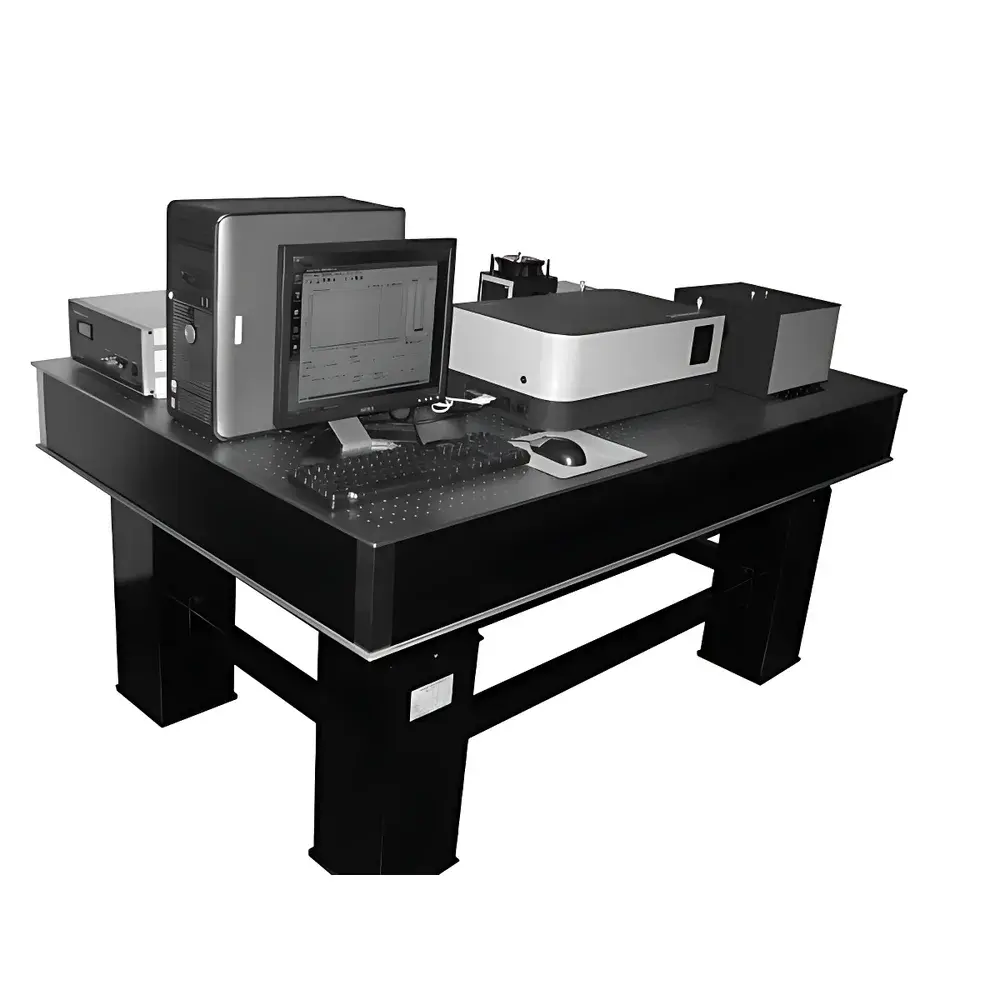
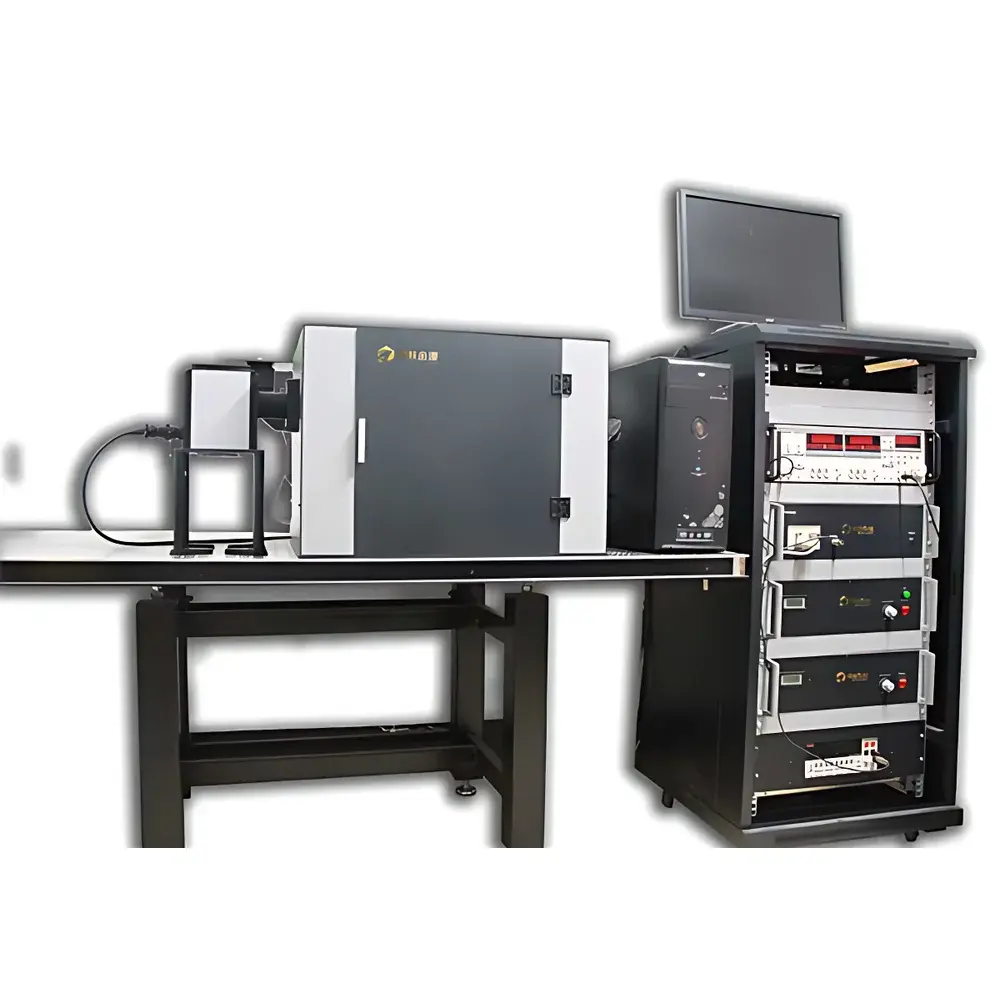
CEL-SPEC Surface Photovoltage Spectroscopy Upgrade Module for Photoelectrochemical QE/IPCE Analysis
| Brand | CEA (China Education Goldsource) |
|---|---|
| Model | CEL-SPEC |
| Origin | Beijing, China |
| Manufacturer Type | OEM Manufacturer |
| Product Origin | Domestic (PRC) |
| Light Source | 500 W Osram Xe Lamp (Germany) |
| Spectrometer | 300 mm Focal Length, Dual-Output Imaging Spectrometer |
| Spectral Range | 200–1100 nm |
| QE/IPCE Calibration Standard | NIST-traceable UV-enhanced calibrated photodiode |
| Optical Configuration | Dual orthogonal beam paths (vertical SPS + horizontal PEC) |
| Positioning System | Motorized Precision Translation Stage (horizontal sample exchange) |
| Data Acquisition Mode | Synchronized lock-in detection (AC mode) |
| Chopping Frequency | 5–1000 Hz |
| Short-Circuit Current Repeatability | <0.3% (RSD) |
| Software Platform | Windows 7/8/10 compatible proprietary acquisition & analysis suite |
| Recommended Electrochemical Workstation | Admesy Admiral or Ivium Squidstat Plus (optional) |
Overview
The CEL-SPEC Surface Photovoltage Spectroscopy Upgrade Module is an engineered integration solution designed to extend the functionality of the CEL-SPS1000 Surface Photovoltage Spectroscopy system into quantitative photoelectrochemical characterization. It implements a rigorously isolated horizontal optical path—orthogonal to the existing vertical SPS beam—enabling concurrent yet non-interfering operation of surface photovoltage and solution-phase photoelectrochemical measurements. The module operates on the principle of monochromatic photon-to-current conversion efficiency (IPCE) and absolute external quantum efficiency (EQE) determination via lock-in amplified photocurrent detection under modulated illumination. By leveraging a high-stability 500 W Osram xenon lamp and a dual-output 300 mm focal-length imaging spectrometer, the system delivers spectrally resolved, calibrated irradiance across 200–1100 nm. All optical components reside within fully enclosed, vibration-damped light-tight housings to eliminate ambient stray light and thermal drift—critical for sub-percent repeatability in low-signal photoelectrochemical quantification.
Key Features
- Dual-beam architecture: Independent vertical (SPS) and horizontal (PEC) optical trains with zero crosstalk, enabling simultaneous surface band-bending analysis and solution-phase charge-transfer kinetics.
- NIST-traceable spectral calibration: UV-enhanced reference photodiode with certified responsivity across 200–1100 nm ensures metrologically valid QE and IPCE values compliant with ASTM E1021 and IEC 60904-8 standards.
- Motorized precision translation stage: Enables automated, repeatable switching between calibration standard and test photoanode/cathode samples without realignment—reducing operator-induced variability.
- Lock-in synchronized acquisition: Integrated control of chopper frequency (5–1000 Hz), spectrometer scanning, and potentiostat triggering ensures phase-coherent signal recovery under AC bias conditions.
- Full enclosure design: Sealed optical pathways with black-anodized aluminum baffles and EMI-shielded electronics minimize environmental noise and thermal lensing effects.
- Automated spectral scanning: Continuous, step-free wavelength sweep from 200 nm to 1100 nm with <0.3% RSD in short-circuit current—validated per ISO/IEC 17025 internal reproducibility protocols.
Sample Compatibility & Compliance
The CEL-SPEC module supports standard three-electrode electrochemical cells (working electrode: FTO/ITO/glass-supported thin films; counter electrode: Pt wire/mesh; reference electrode: Ag/AgCl or SCE) as well as custom-designed optically transparent thin-layer cells. It accommodates solid-state photoelectrodes (e.g., BiVO₄, Fe₂O₃, g-C₃N₄), dye-sensitized systems, and emerging perovskite-based photoanodes. All hardware and firmware comply with CE electromagnetic compatibility (EMC) Directive 2014/30/EU and Low Voltage Directive 2014/35/EU. Data acquisition workflows support audit-ready metadata tagging and are structured to align with GLP-compliant laboratory practices—including timestamped parameter logging, user authentication, and electronic signature readiness for FDA 21 CFR Part 11–governed environments when paired with validated electrochemical workstations.
Software & Data Management
The proprietary acquisition software provides unified control over lamp power regulation, spectrometer grating positioning, chopper synchronization, and external potentiostat communication (via USB or Ethernet). Real-time spectral mapping of photocurrent density (mA/cm²), EQE (%), and incident photon-to-current efficiency (IPCE, %) is generated with automatic baseline subtraction and dark-current correction. Export formats include CSV, HDF5, and MATLAB-compatible .mat files—ensuring interoperability with third-party modeling tools (e.g., COMSOL Multiphysics for charge transport simulation). Raw lock-in outputs (X, Y, R, θ) and impedance spectra (Z’, Z”) are stored with full traceability: each dataset embeds instrument configuration, calibration certificate IDs, and environmental sensor logs (ambient temperature, humidity).
Applications
- Quantitative benchmarking of photoelectrode materials for solar fuel generation (water splitting, CO₂ reduction).
- Correlation of surface photovoltage transients (from SPS mode) with interfacial charge separation efficiency (from IPCE mode) under identical illumination conditions.
- Wavelength-dependent evaluation of recombination losses via IPCE onset shifts and spectral shape analysis.
- Electrochemical impedance spectroscopy (EIS) coupled with monochromatic illumination to resolve light-biased charge-transfer resistance and Helmholtz capacitance.
- Validation of optical modeling (e.g., transfer-matrix simulations) using experimentally derived absorption profiles and EQE spectra.
- Accelerated stability testing under controlled photon flux and applied bias, with automated degradation trend analysis.
FAQ
Does the CEL-SPEC module require modification of the existing CEL-SPS1000 base system?
No. The upgrade is mechanically and optically self-contained, interfacing via standardized optical mounts and digital I/O ports—no disassembly or recalibration of the original SPS platform is required.
Can the horizontal PEC path be used independently of the vertical SPS path?
Yes. Both optical paths operate as discrete subsystems; either may be engaged or disabled via software configuration without affecting alignment or stability of the other.
Is spectral calibration performed in situ or pre-installed?
A factory-installed, NIST-traceable UV-enhanced photodiode is integrated into the horizontal beam path, and full spectral responsivity mapping is executed during installation and documented in the calibration certificate.
What electrochemical workstation models are natively supported?
Native drivers are provided for Admesy Admiral and Ivium Squidstat Plus. Generic compliance with the Standard Commands for Programmable Instruments (SCPI) protocol enables integration with other GPIB/USB/Ethernet-controlled potentiostats.
How is data integrity ensured during long-duration IPCE scans?
The software implements watchdog timers, hardware-triggered fail-safes, and cyclic redundancy checksums on all acquired frames—automatically pausing and resuming scans upon interruption while preserving metadata continuity.



