
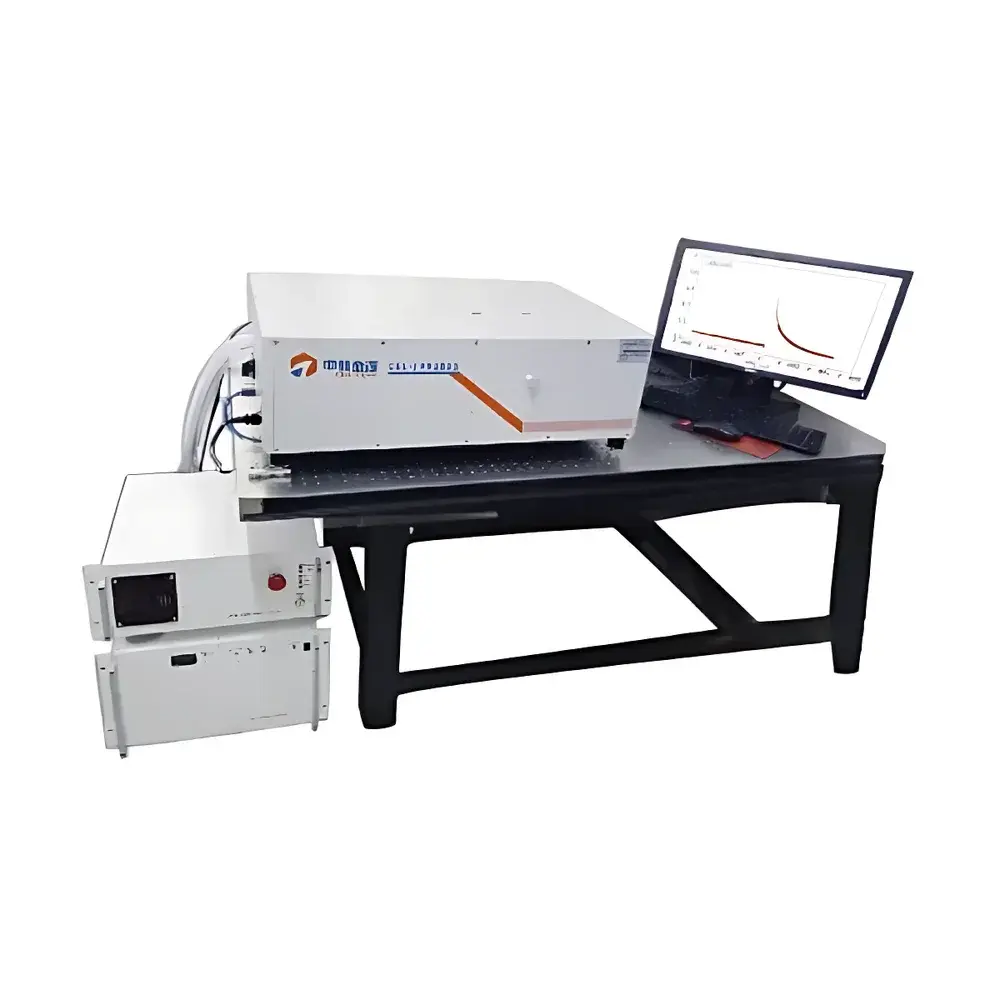
CEL-TPV2000 Transient Surface Photovoltage Spectrometer (TPV/TPC)
| Brand | CEL (China Education Goldsource) |
|---|---|
| Origin | Beijing, China |
| Manufacturer Type | Original Equipment Manufacturer (OEM) |
| Product Category | Domestic |
| Model | CEL-TPV2000 |
| Light Source Type | Pulsed Nd:YAG Laser System (1064/532/355/266 nm) |
| Illumination Mode | External Irradiation |
| Wavelength Range | 210–2200 nm (OPO-tunable, computer-controlled) |
| Pulse Width | 10–14 ns (at 1064 nm) |
| Energy Output | >20 mJ (peak, at tunable wavelengths) |
| Repetition Rate | 20 Hz |
| Time Resolution | 5 ns |
| Detection Sensitivity | 0.1 mOD |
| Data Acquisition | 12-bit / 16-bit Digital Oscilloscope |
| Temperature Control Precision | ±0.05 °C |
| Optical Path | Fully Enclosed, Horizontal/Vertical Switchable, EM-Shielded |
| Sample Compatibility | Solid (powder, film, wafer), Liquid (electrolyte-based cells), Customizable Sandwich Cell (FTO/Pt/Mica/Sample) |
| Software | Integrated Control for Laser, OPO, Synchronization, Amplification, Curve Fitting (mono-/bi-exponential), 2D/3D TPV Mapping, QE Calculation, Background Subtraction, Single-shot & Averaged Acquisition |
Overview
The CEL-TPV2000 Transient Surface Photovoltage Spectrometer is a high-precision, time-resolved optical instrumentation platform engineered for quantitative analysis of photogenerated charge carrier dynamics at semiconductor surfaces and interfaces. Based on the principle of transient surface photovoltage (TPV), the system detects minute voltage transients induced by pulsed laser excitation—reflecting real-time changes in surface band bending, charge separation, and interfacial electron transfer. Unlike steady-state techniques, TPV captures sub-nanosecond to millisecond kinetics, enabling discrimination between drift-dominated (short-time) and diffusion-limited (long-time) transport regimes. The instrument leverages a fully synchronized, electromagnetic-shielded architecture with a native Nd:YAG laser source (1064/532/355/266 nm), optically parametric oscillator (OPO) wavelength extension (210–2200 nm), and dual-path referencing (PMT-based trigger + sample signal acquisition). Its design adheres to fundamental requirements for surface-sensitive photophysics: non-contact, non-destructive, ambient- or controlled-environment operation, and minimal perturbation of native surface states.
Key Features
- Pulsed Nd:YAG laser system (imported, full-unit integration) with four harmonics: 1064 nm (320 mJ), 532 nm (180 mJ), 355 nm (60 mJ), 266 nm (40 mJ); pulse width <14 ns at 1064 nm
- Computer-controlled OPO wavelength tuning across 210–2200 nm; peak output energy >20 mJ; repetition rate fixed at 20 Hz
- 5 ns system time resolution enabled by low-jitter synchronization, high-bandwidth amplification, and 12-/16-bit digital oscilloscope acquisition
- Fully enclosed, EMI-hardened optical path with integrated neutral density filtering, adjustable beam focusing, and motorized horizontal/vertical light-path switching
- Modular sample chamber supporting standardized sandwich-type electrochemical cells (FTO substrate / active material / mica spacer / Pt counter electrode) and customizable configurations for cryogenic, high-field, or microspectroscopic environments
- Real-time optical power monitoring via calibrated broadband sensor (190–11000 nm, 0–2000 mW range) with software-synchronized data logging
Sample Compatibility & Compliance
The CEL-TPV2000 accommodates heterogeneous sample formats without requiring electrical contacting or vacuum processing: solid-state photocatalysts (TiO₂, g-C₃N₄, CdS, metal phosphides), dye-sensitized or perovskite solar cell devices, molecular sieves, conductive polymers, and liquid-phase photoelectrochemical cells. Its non-invasive detection mechanism ensures integrity of nanostructured morphology and avoids surface contamination—critical for GLP-compliant materials screening. While not certified to ISO/IEC 17025, the system’s hardware architecture and software traceability (timestamped raw waveforms, parameter logs, versioned analysis scripts) support audit-ready documentation per internal QA protocols. Data export formats (CSV, HDF5, MATLAB .mat) are compatible with third-party statistical modeling tools used in ASTM E2937-22 (standard guide for spectral data evaluation) and IEC 61215-2 (photovoltaic module qualification).
Software & Data Management
The proprietary acquisition and analysis suite provides end-to-end experimental control: laser firing, OPO wavelength selection, oscilloscope triggering, gain calibration, and background subtraction. It supports single-shot capture for irreversible processes and ensemble averaging (up to 10⁴ scans) for noise reduction. Core analytical functions include mono- and bi-exponential lifetime fitting of decay transients, 2D TPV maps (wavelength vs. time), and 3D volumetric rendering of transient response surfaces. Quantum efficiency (QE) is calculated directly from normalized TPV amplitude versus incident photon flux—using built-in NIST-traceable spectral responsivity curves. All processed datasets retain full metadata (laser fluence, spot size, sample temperature, filter position), satisfying FDA 21 CFR Part 11 requirements for electronic records when deployed in regulated R&D environments.
Applications
The CEL-TPV2000 serves as a primary tool for mechanistic studies in photoelectrochemistry and optoelectronic materials science. It quantifies charge extraction efficiency in perovskite solar cells by correlating TPV rise time with electron injection kinetics at TiO₂/perovskite interfaces. In photocatalysis, it discriminates surface trap-mediated recombination (fast decay component, τ₁ 1 µs) in metal oxide nanocomposites. Researchers apply it to determine majority carrier type in organic semiconductors via field-induced SPV polarity inversion, map energy-level alignment at heterojunctions using bias-dependent TPV sign reversal, and validate interfacial dipole formation in self-assembled monolayer-modified electrodes. Its compatibility with liquid electrolytes further enables operando investigation of corrosion-inhibited photoanodes under simulated AM1.5G illumination.
FAQ
What physical quantity does TPV directly measure?
TPV measures the transient change in surface potential (in volts or arbitrary units) resulting from laser-induced redistribution of surface charge—primarily reflecting upward/downward band bending due to photogenerated electron accumulation or depletion.
Can the CEL-TPV2000 distinguish between electron and hole dynamics?
Yes—through polarity analysis of the initial TPV signal (positive = electron accumulation at surface; negative = hole accumulation), combined with applied bias or field-effect modulation to isolate carrier-specific contributions.
Is external potentiostat integration supported?
Yes—the system includes analog I/O ports for synchronized voltage bias application and current monitoring, enabling concurrent TPV/TPC measurements under controlled electrochemical potential.
What is the minimum detectable surface voltage change?
With optimized signal averaging and low-noise preamplification, the effective detection limit is ~0.1 mV for typical semiconductor films (e.g., 500 nm TiO₂ on FTO) under 10 mJ/cm² 355 nm excitation.
Does the instrument comply with laser safety standards?
The fully enclosed optical path meets Class 1 laser product requirements per IEC 60825-1:2014; all accessible apertures are interlocked and labeled with appropriate warning indicators per ANSI Z136.1-2022.






