
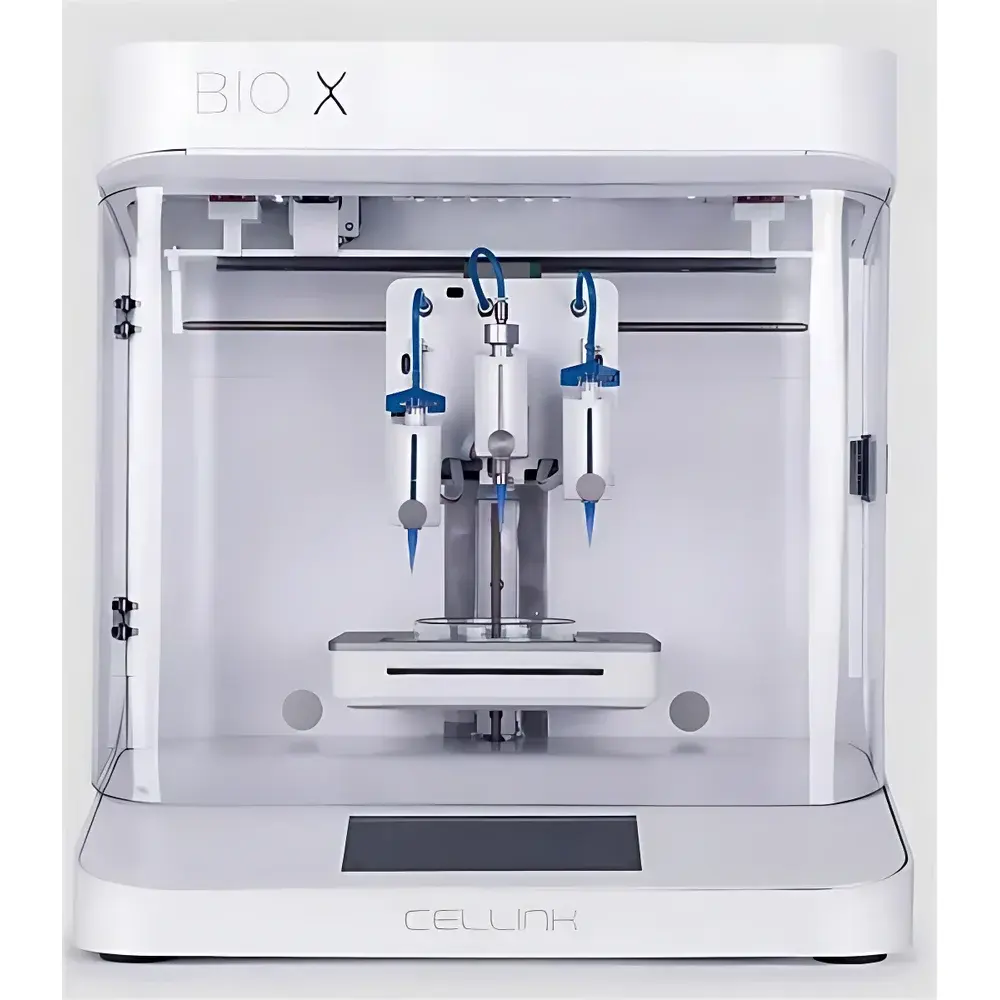
CELLINK BioX Biological 3D Printer
| Brand | CELLINK |
|---|---|
| Origin | Sweden |
| Model(s) | BioX, Lumen X, BioX6 |
| Build Volume | 130 × 90 × 70 mm |
| Layer Resolution | 1 µm |
| Positioning Accuracy | 1 µm |
| Print Head Temperature Range | 4–250 °C |
| Print Bed Temperature Range | 4–60 °C |
| Pressure Control Range | 0–700 kPa |
| Minimum Dispensed Volume | 5 nL |
| UV Curing Wavelengths | 365 nm & 405 nm (LED) |
| Filtration | HEPA H14 (99.995% @ 0.3 µm) + Pre-filter |
| Power Supply | 100–240 V, 50–60 Hz, 600 W |
| Dimensions | 480 × 440 × 355 mm |
| Weight | 17 kg |
| Enclosure | Aluminum frame with matte-finish enclosure |
| Integrated Features | Built-in air compressor, dual cooling fans, UV-C sterilization lamp (275 nm, 2 W), 7″ glove-compatible touchscreen, auto-calibration, Ethernet/Wi-Fi/USB connectivity |
Overview
The CELLINK BioX is a benchtop biological 3D printer engineered for precision extrusion-based bioprinting of living cells and biomaterials under sterile, controlled environmental conditions. It operates on the principle of microextrusion—where bioinks are pneumatically or thermally driven through calibrated nozzles to deposit spatially defined, layer-by-layer constructs with high structural fidelity and cellular viability. Designed specifically for translational research in regenerative medicine, drug development, and disease modeling, the BioX integrates hardware-level sterility assurance, multi-material dispensing capability, and real-time process monitoring into a single compact platform. Its architecture supports both soft hydrogel-based bioinks (e.g., alginate, gelatin methacryloyl, collagen I) and thermoplastic scaffolds (e.g., PCL, PLGA), enabling fabrication of heterogeneous tissue analogues—including vascularized adipose constructs, cartilage-mimetic matrices, and neural co-culture spheroids—as validated across peer-reviewed publications in Acta Biomaterialia, Biofabrication, and Biomaterials.
Key Features
- Modular Multi-Print-Head System: Standard configuration includes three interchangeable print heads: one heated pneumatic extruder, one syringe pump-driven extruder, and one optional photopolymerization tool head—enabling simultaneous deposition of cell-laden hydrogels, sacrificial materials (e.g., Carbopol), and photocrosslinkable bioinks.
- High-Fidelity Environmental Control: Independent thermal regulation of print bed (4–60 °C) and print heads (4–250 °C) ensures optimal rheological behavior across diverse bioink formulations; integrated HEPA H14 filtration (99.995% efficiency at 0.3 µm) and UV-C (275 nm) sterilization maintain ISO Class 5-equivalent air quality within the build chamber.
- Precision Microdispensing: Capable of dispensing as low as 5 nL per droplet with XYZ positioning accuracy of ±1 µm and layer thickness resolution down to 1 µm—critical for replicating native tissue microarchitecture such as capillary networks or osteochondral gradients.
- Glove-Compatible Human-Machine Interface: 7-inch capacitive touchscreen with haptic feedback allows operation while wearing standard laboratory gloves; intuitive graphical workflow guides users from STL import to print parameter optimization without requiring scripting expertise.
- Integrated Sterility Infrastructure: Onboard air compressor eliminates external gas supply dependencies; positive-pressure airflow prevents particulate ingress; dual-fan thermal management maintains stable internal temperature during extended print runs (>24 h).
Sample Compatibility & Compliance
The BioX accommodates over 300 validated bioink formulations—including natural polymers (collagen, hyaluronic acid, decellularized extracellular matrix), synthetic hydrogels (GelMA, PEGDA), and composite scaffolds (SiO₂-reinforced alginate, nanocellulose blends). All print head modules comply with ISO 13485:2016 design controls for medical device manufacturing environments. While the instrument itself is not an FDA-cleared device, its operational parameters align with ASTM F2792-12a (Standard Terminology for Additive Manufacturing) and support GLP-compliant documentation workflows when paired with CELLINK’s Bioprint Studio software, which includes full audit trail logging per 21 CFR Part 11 requirements.
Software & Data Management
Bioprint Studio v4.x serves as the native control and post-processing suite, supporting direct import of STL, OBJ, and 3MF files. The software features automated mesh repair, lattice generation, and multi-material path planning algorithms optimized for shear-sensitive cell suspensions. All print jobs are timestamped, user-authenticated, and stored with metadata including pressure profiles, temperature logs, and UV exposure duration—facilitating traceability in regulated preclinical studies. Export options include CSV-formatted sensor data, DICOM-ready volumetric reconstructions, and encrypted project backups compatible with institutional LIMS integration.
Applications
- Tissue Engineering: Fabrication of anatomically accurate osteochondral grafts with zonal mineralization gradients; vascularized liver sinusoid models using endothelialized fibrin channels.
- Drug Discovery: High-content screening platforms incorporating patient-derived tumor organoids embedded in stromal hydrogels; pharmacokinetic evaluation of sustained-release naftopidil tablets printed via semi-solid extrusion.
- Developmental Biology: In vitro spermatogenesis assays on alginate-based 3D scaffolds; neural-glial co-culture constructs mimicking white matter tracts using diamond-reinforced hydrogels.
- Immunomodulation Studies: 3D-printed bone marrow niche mimics supporting megakaryocyte maturation and platelet release; PDMS scaffolds engineered for enhanced macrophage adhesion in wound healing models.
FAQ
Is the BioX suitable for GMP-compliant manufacturing?
The BioX is intended for research use only (RUO) and is not certified for Good Manufacturing Practice production. However, its hardware architecture, calibration traceability, and software audit trails support qualification activities required prior to clinical-grade bioprinter validation.
Can I use third-party bioinks with the BioX?
Yes—the system accepts any extrudable material compatible with pneumatic or thermal extrusion principles. CELLINK provides viscosity and yield stress compatibility guidelines, and over 90% of commercially available bioinks have been successfully tested by end users.
Does the BioX support multi-material printing in a single run?
Yes—up to three distinct materials can be printed simultaneously using the standard triple-head configuration, provided they are chemically and thermally orthogonal (e.g., GelMA + Pluronic F127 + thrombin-activated fibrinogen).
What maintenance is required for long-term reliability?
Routine cleaning of nozzle tips and O-rings is recommended after each print session; HEPA filter replacement every 6 months under continuous operation; annual recalibration of pressure transducers and thermal sensors is advised per ISO/IEC 17025 guidelines.
How does the BioX compare to inkjet-based bioprinters?
Unlike thermal or piezoelectric inkjet systems, the BioX avoids cell-damaging cavitation and thermal shock by using gentle extrusion mechanics—resulting in >95% post-print viability for primary human hepatocytes and iPSC-derived cardiomyocytes across published benchmarks.



