
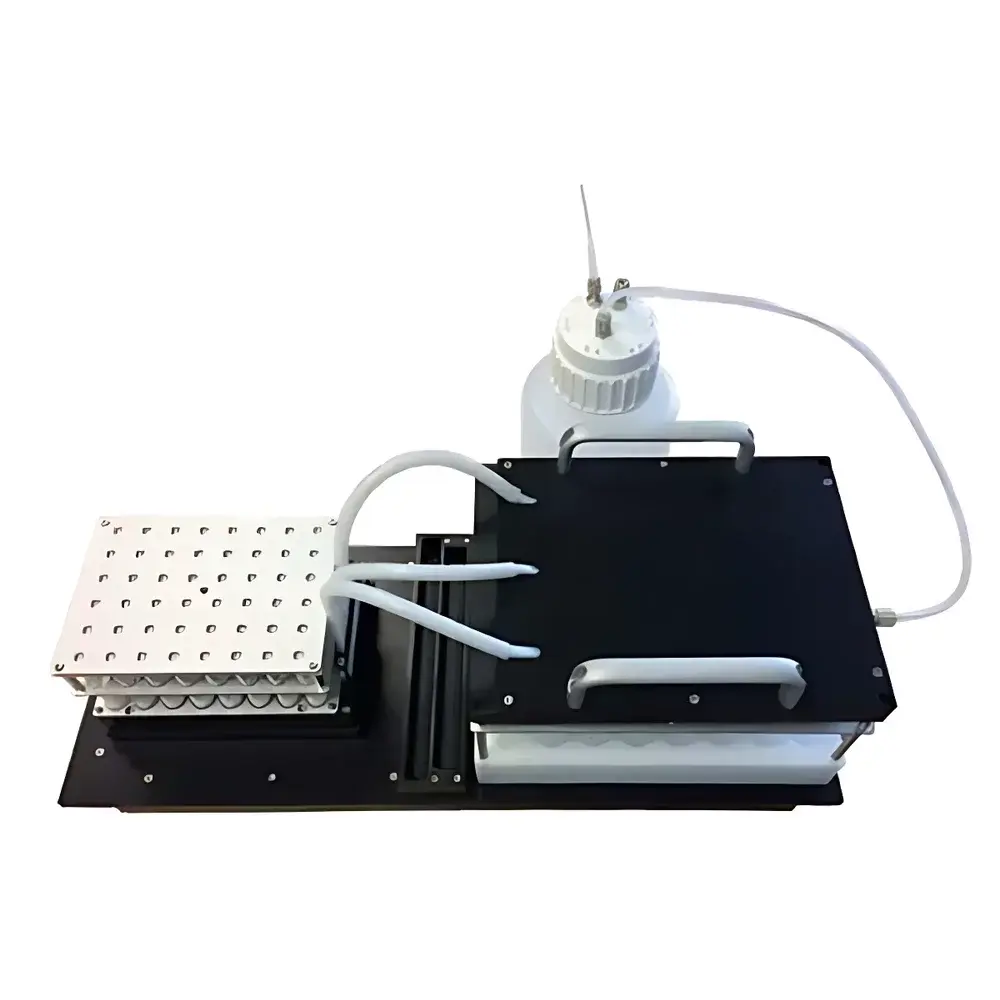
CEM CleavagePro High-Throughput Peptide Cleavage System
| Brand | CEM |
|---|---|
| Origin | USA |
| Manufacturer Status | Authorized Distributor |
| Origin Category | Imported |
| Model | CleavagePro |
| Amino Acid Addition | Automated |
| Reagent Addition | Automated |
| Synthesis Scale | 1–10 μmol |
| Reaction Vessel Count | 48 |
| Reaction Vessel Capacity Options | 15 mL / 50 mL |
Overview
The CEM CleavagePro High-Throughput Peptide Cleavage System is a dedicated, benchtop platform engineered for the controlled, parallel cleavage of resin-bound peptides following solid-phase peptide synthesis (SPPS). Unlike general-purpose shakers or manual cleavage workflows, CleavagePro implements a precisely regulated orbital agitation mechanism coupled with vacuum-assisted transfer—enabling quantitative, reproducible release of crude peptides from synthesis resins into standardized collection vessels. It is purpose-built to interface directly with CEM’s MultiPep™ I and MultiPep™ II automated peptide synthesizers, accepting their proprietary reaction columns (2 mL, 5 mL, and 10 mL formats) without intermediate handling. This seamless hardware compatibility eliminates manual transfer steps—reducing contamination risk, sample loss, and operator exposure to hazardous reagents such as trifluoroacetic acid (TFA), phenol, and scavengers. The system operates within standard laboratory fume hoods, featuring chemically inert construction (PTFE-coated components, fluoropolymer seals, and stainless-steel structural elements) to withstand aggressive cleavage cocktails over extended service life.
Key Features
- True parallel processing: Simultaneous cleavage of up to 48 individual peptide-resin samples in a single run.
- Direct column compatibility: Accepts MultiPep I/II reaction columns (2 mL, 5 mL, 10 mL) without decanting or repackaging—preserving integrity and traceability.
- Controlled orbital shaking: Programmable agitation profile (speed, duration, dwell time) ensures uniform resin suspension and efficient reagent penetration across all vessels.
- Vacuum-assisted transfer: Integrated vacuum manifold enables precise, drip-free transfer of cleavage solution from reaction columns to standardized 15 mL or 50 mL conical collection tubes.
- Chemically resistant architecture: All fluid-contact surfaces are constructed from PTFE, FFKM, and electropolished 316 stainless steel—fully compatible with TFA-based cocktails containing water, triisopropylsilane (TIS), ethanedithiol (EDT), and phenol.
- Minimal maintenance design: No solenoid valves, peristaltic pumps, or complex fluid routing—reliability is achieved through mechanical simplicity and robust component selection.
Sample Compatibility & Compliance
CleavagePro supports standard SPPS resin types—including Wang, Rink amide, 2-chlorotrityl chloride (2-CTC), and Sieber amide resins—across synthesis scales from 1 μmol to 10 μmol per vessel. It complies with GLP-aligned laboratory practices by enabling unambiguous sample tracking via position-mapped vessel racks and consistent process parameters. While not a regulated medical device, its operational repeatability and closed-transfer functionality support adherence to internal SOPs aligned with ISO/IEC 17025 requirements for testing laboratories. The system’s inert materials and sealed operation reduce volatile organic compound (VOC) emissions, facilitating compliance with OSHA permissible exposure limits (PELs) for TFA (2 ppm ceiling) when used inside certified fume hoods.
Software & Data Management
CleavagePro operates via an intuitive front-panel interface with dedicated controls for agitation speed (rpm), shake duration (min), vacuum activation timing, and pause intervals. No PC connection or proprietary software is required—making it suitable for GMP environments where software validation would otherwise necessitate 21 CFR Part 11-compliant audit trails. Process parameters are retained in non-volatile memory and can be recalled as user-defined protocols. For labs requiring documentation, optional USB logging (timestamped start/stop events, cycle counts, and error codes) is available—supporting retrospective review during internal audits or regulatory inspections.
Applications
- High-throughput peptide library production for structure–activity relationship (SAR) studies.
- Cleavage of combinatorial peptide arrays synthesized on MultiPep platforms for epitope mapping or antibody screening.
- Preparative-scale cleavage prior to HPLC purification and lyophilization in contract research and biopharma development labs.
- Automated workflow integration in peptide-based diagnostic reagent manufacturing under quality-controlled conditions.
- Method development for cleavage optimization—e.g., evaluating scavenger ratios, temperature effects (via external cooling plates), or alternative acid cocktails—across multiple samples in parallel.
FAQ
Can CleavagePro be used with synthesis columns from instruments other than MultiPep I/II?
CleavagePro is mechanically optimized for CEM’s proprietary MultiPep column geometry and sealing interface. Non-CEM columns may not achieve leak-tight engagement or consistent vacuum transfer; adapter kits are not available.
Is the system compatible with low-volume cleavage (e.g., <1 mL total volume)?
Yes—the vacuum transfer mechanism functions reliably down to 0.5 mL total cleavage cocktail volume, provided the column frit remains fully submerged during agitation.
Does CleavagePro include temperature control?
No. It operates at ambient laboratory temperature. For temperature-sensitive cleavages, users may place the entire unit inside a refrigerated or cooled fume hood, or pre-chill reagents and columns prior to loading.
What maintenance is required beyond routine cleaning?
Annual inspection of O-rings and vacuum manifold seals is recommended. No calibration or firmware updates are necessary—the system contains no sensors or microprocessors requiring recalibration.
Can the 15 mL and 50 mL collection tubes be interchanged mid-run?
Yes. The rack accommodates either tube size simultaneously; users may load mixed configurations based on downstream processing needs (e.g., 15 mL for analytical-scale cleavage, 50 mL for preparative batches).




