
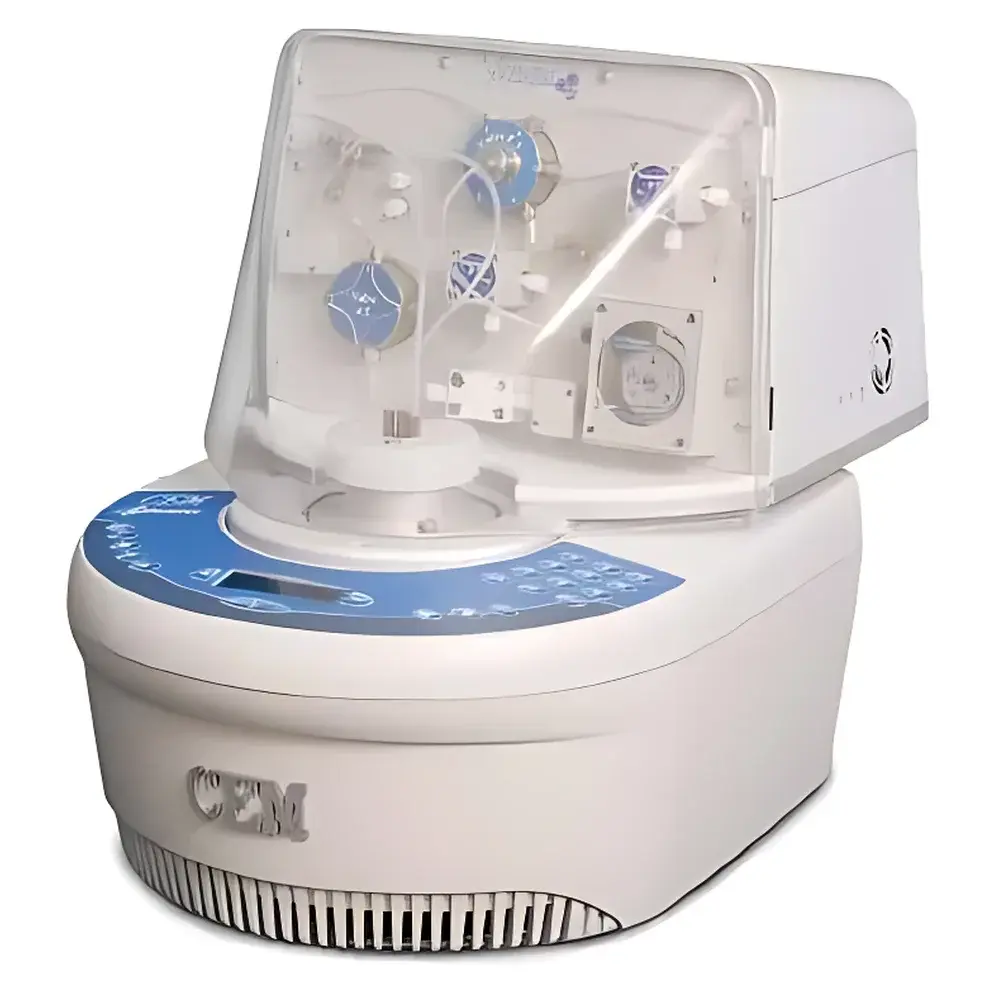
CEM Voyager Single-Mode Microwave Flow Reactor System
| Brand | CEM |
|---|---|
| Origin | USA |
| Model | Voyager (Single-Mode) |
| Temperature Range | −80 °C to 300 °C |
| Pressure Range | 0–500 psi with intelligent pressure-triggered microwave cutoff |
| Microwave Power | 900 W |
| Reaction Volume | 300 mL |
| Flow Cell Capacity | 80 mL glass vessel |
| Pump Type | Peristaltic pump |
| Temperature Sensing | Fiber-optic or IR-based real-time monitoring |
| Pressure Sensing | Direct inline transducer |
| Valve Configuration | Dual valves (4-position and 6-position options) |
| Reagent Sensors | Two integrated reagent presence detectors |
| Operating Limits | Up to 220 °C or 200 psi continuous operation |
| Compliance | Designed for GLP/GMP-aligned process development environments |
Overview
The CEM Voyager Single-Mode Microwave Flow Reactor System is the first commercially engineered platform specifically designed to bridge the gap between laboratory-scale discovery chemistry and kilogram-scale process development using focused microwave energy. Unlike conventional multimode batch reactors, the Voyager employs a true single-mode cavity architecture coupled with a precision-engineered intermittent flow configuration—enabling reproducible, scalable, and thermally homogeneous reaction conditions across orders of magnitude in material throughput. Its core principle relies on controlled microwave irradiation within a resonant waveguide cavity, where electromagnetic energy is concentrated into a defined volumetric zone, ensuring consistent field distribution and rapid, uniform heating kinetics. This architecture supports both kinetic-driven and thermodynamically constrained reactions—including heterogeneously catalyzed transformations, solid-phase syntheses, and high-viscosity media—without thermal lag or hot-spot formation. The system is purpose-built for pharmaceutical process chemists, fine chemical developers, and materials scientists requiring robust, auditable scale-up pathways from mg- to kg-scale under fully documented, repeatable conditions.
Key Features
- Intermittent flow architecture enabling seamless transition from discovery to pilot-scale synthesis without method re-optimization
- Single-mode microwave cavity delivering spatially uniform energy density and precise power coupling efficiency
- Integrated peristaltic pumping system with programmable flow rate control and real-time flow monitoring
- Dual valve manifold (4-port and 6-port configurations) supporting multi-reagent sequential addition and solvent switching
- Fiber-optic or infrared temperature sensing with sub-second response time and ±0.5 °C accuracy over full operating range
- Direct inline pressure transduction with active safety interlock: automatic microwave termination upon reaching user-defined pressure threshold
- Patented agitation mechanism ensuring homogenization of slurries, suspensions, and viscous reaction mixtures
- Leak detection circuitry with audible/visual alerts and automated system shutdown
- Reagent presence sensors enabling closed-loop reagent delivery verification and stoichiometric consistency
- Inert atmosphere compatibility via integrated gas purge ports and pressure-rated sealing interfaces
Sample Compatibility & Compliance
The Voyager accommodates diverse sample formats—including neat liquids, solid-supported reagents (e.g., resin-bound catalysts), slurries, and high-viscosity solutions—without modification to hardware or operational protocol. Its 80 mL borosilicate glass flow cell is rated for continuous operation up to 220 °C and 200 psi, while the overall system maintains integrity at transient peaks of 300 °C and 500 psi. All critical parameters—including temperature, pressure, microwave power, flow rate, and valve position—are logged with timestamped metadata, satisfying audit requirements under FDA 21 CFR Part 11, ISO/IEC 17025, and ICH Q5A/Q5B guidelines. The system’s firmware architecture supports electronic signature implementation, role-based access control, and immutable audit trails—making it suitable for regulated GMP environments during clinical-stage API process validation.
Software & Data Management
Voyager operates under CEM’s proprietary SynthOS™ software platform, which provides full experimental scripting, real-time parameter visualization, and automated sequence execution. Method files are exportable in XML format for cross-platform archival and third-party data integration (e.g., ELN systems such as LabArchives or IDBS E-WorkBook). All raw sensor data—including time-stamped temperature, pressure, power absorption, and flow profiles—are stored in HDF5-compliant binary format, ensuring long-term readability and computational reproducibility. Software logs include operator ID, method version, calibration timestamps, and hardware firmware revision—supporting full traceability per ALCOA+ principles. Remote monitoring via secure HTTPS interface enables off-site oversight without compromising network security protocols.
Applications
- Process intensification of API synthetic routes, particularly for thermally sensitive intermediates requiring narrow residence time control
- Development of continuous-flow Suzuki, Heck, and Buchwald–Hartwig couplings under microwave acceleration
- Scale-up of solid-phase peptide synthesis and polymer-supported catalysis
- Rapid optimization of reaction stoichiometry, solvent effects, and additive screening across multiple parallel conditions
- Thermal hazard assessment of exothermic transformations using controlled microwave ramping and quench capability
- Production of reference standards and labeled compounds (e.g., 13C, 15N) where isotopic integrity must be preserved under non-pyrolytic conditions
FAQ
Can methods developed on CEM Discover or Explorer platforms be directly transferred to Voyager?
Yes—Voyager shares identical microwave control algorithms, temperature/pressure feedback logic, and reaction vessel geometry conventions with CEM’s benchtop Discover and Explorer systems, enabling direct method portability without empirical re-optimization.
What safety certifications does the Voyager system hold?
The system complies with UL 61010-1, IEC 61000-6-3 (EMC), and IEC 61000-6-4 emission standards; pressure components meet ASME BPVC Section VIII Division 1 requirements.
Is the 300 mL total reaction volume achieved in a single pass or through cumulative cycling?
The 300 mL capacity refers to total processed volume per run via repeated intermittent flow cycles through the 80 mL flow cell—each cycle subject to identical microwave exposure parameters.
Does Voyager support external integration with HPLC or FTIR for inline analytics?
Yes—standard 1/8″ Swagelok ports and TTL-triggered I/O interfaces enable synchronization with third-party analytical modules for real-time reaction monitoring.
How is temperature calibrated and verified across the operating range?
Each system ships with NIST-traceable fiber-optic probe calibration certificate; users may perform in-situ verification using certified reference materials (e.g., indium, tin, zinc melting points) per ASTM E968.



