
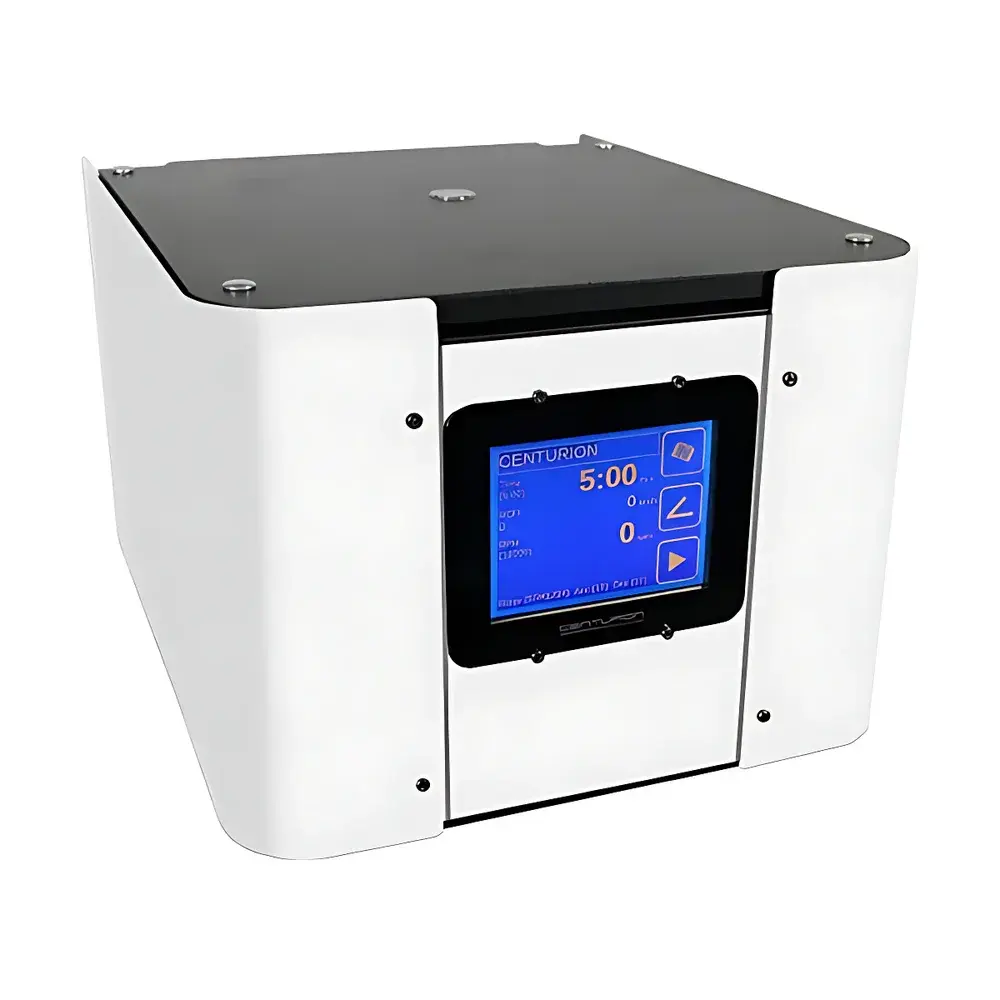
Centurion Scientific K241R Benchtop High-Speed Refrigerated Centrifuge
| Brand | Centurion Scientific |
|---|---|
| Origin | United Kingdom |
| Model | K241R |
| Instrument Type | Benchtop Centrifuge |
| Function | Refrigerated Centrifuge |
| Classification | High-Speed Centrifuge (10,000–30,000 rpm range) |
| Maximum Speed | 15,000 rpm |
| Maximum RCF | 22,000 × g |
| Maximum Capacity | 4 × 250 mL |
| Temperature Range | –9 °C to 40 °C |
| Dimensions (W×D×H) | 32 × 45 × 64 cm |
| Weight (without rotor) | 62 kg |
| Power Consumption | 690 W |
| Noise Level | <60 dB(A) |
| Timer Range | 0–9999 min (1-sec increment) |
| Acceleration/Deceleration | 10 selectable profiles |
| Programmable Methods | 108 stored protocols |
| Rotor Compatibility | Fixed-angle and swing-out rotors for microtubes, PCR strips, conical tubes, capillaries, microplates, and bottles up to 250 mL |
Overview
The Centurion Scientific K241R is a high-performance benchtop refrigerated centrifuge engineered for precision separation of biological macromolecules—including nucleic acids, proteins, organelles, and viral particles—in research, clinical diagnostics, and quality control laboratories. Utilizing a brushless DC motor coupled with active refrigeration and real-time rotor dynamics monitoring, the K241R delivers consistent thermal stability and mechanical reliability across extended operation cycles. Its design adheres to core principles of centrifugal force generation via angular acceleration (RCF = 1.118 × 10⁻⁵ × r × N2, where r = radius in mm, N = rotational speed in rpm), enabling reproducible pelleting, density-gradient fractionation, and rapid clarification of viscous or temperature-sensitive samples. The unit operates within a certified temperature range of –9 °C to +40 °C, maintaining setpoint accuracy ±1.5 °C under full-load conditions—critical for preserving labile biomolecular conformations during high-speed runs.
Key Features
- Intuitive 7-inch capacitive touchscreen interface with multilingual support and graphical real-time status display
- 10 programmable acceleration and deceleration profiles, minimizing shear-induced sample disruption and tube stress
- Pulse centrifugation mode (1–90 seconds) for gentle resuspension and homogenization of pellet interfaces
- Dual-speed display: simultaneous or independent selection of RPM or RCF (×g), adjustable in 1-rpm increments
- Stainless-steel centrifuge chamber with seamless welds and sloped floor for complete liquid drainage and ISO 14644-compliant cleaning
- Reinforced steel-alloy chassis and vibration-dampened base assembly ensuring operational stability at maximum rated speed
- Four-point positive-lock lid mechanism with integrated interlock sensors preventing operation unless fully engaged
- Multi-layer safety system: auto-resetting imbalance detection (±0.5 g mass differential), lid-open inhibition, overspeed protection, and motor overtemperature cutoff
- Integrated refrigeration circuit with eco-friendly R134a refrigerant and PID-controlled compressor modulation
Sample Compatibility & Compliance
The K241R supports a broad spectrum of sample containers—from 0.2 mL PCR tubes and capillaries to 250 mL centrifuge bottles—via interchangeable rotors validated per IEC 61010-2-020 (Safety Requirements for Laboratory Centrifuges). All standard rotors are CE-marked and certified for use under GLP and GMP-aligned workflows. The instrument meets EN 61326-1 for electromagnetic compatibility and complies with ISO 22870:2016 for point-of-care and clinical laboratory equipment. Temperature uniformity across the rotor chamber is verified per ASTM E2251–22, and RCF calibration traceability follows ISO/IEC 17025-accredited procedures. Optional rotors include fixed-angle configurations optimized for high-resolution subcellular fractionation (e.g., BRK5424, BRK5448) and swing-bucket variants (e.g., BRK1000) suited for density gradient applications requiring minimal convection.
Software & Data Management
The K241R embeds firmware supporting audit-trail-enabled operation logs compliant with FDA 21 CFR Part 11 requirements when paired with optional Centurion Connect™ software (v3.2+). Each run records timestamp, rotor ID, speed profile, temperature history, energy consumption, and fault events—including imbalance magnitude and thermal deviation alerts. Data export is available via USB 2.0 port in CSV and XML formats compatible with LIMS integration. User access levels (Operator, Supervisor, Administrator) enforce role-based parameter restrictions and method locking. All stored protocols undergo cyclic redundancy checksum validation to prevent corruption during power interruption.
Applications
- Isolation of plasmid DNA, genomic DNA, and RNA from bacterial, mammalian, and plant lysates
- Purification of exosomes and extracellular vesicles using sequential ultracentrifugation protocols
- Preparative separation of mitochondria, nuclei, and lysosomal fractions from tissue homogenates
- Routine serum/plasma separation in clinical chemistry and immunoassay workflows
- High-throughput processing of 96-well microplates in drug discovery screening pipelines
- Concentration and desalting of protein solutions prior to HPLC or mass spectrometry analysis
- Removal of cellular debris post-transfection or after CRISPR-Cas9 editing workflows
FAQ
What is the minimum temperature achievable with the K241R?
The K241R achieves a stable setpoint down to –9 °C under standard ambient conditions (23 °C, 50% RH) with no load; performance may vary slightly under continuous high-speed operation.
Can the K241R be used for radioactive or hazardous samples?
Yes—when equipped with sealed, autoclavable rotors (e.g., BRK5424) and operated inside certified fume hoods or containment cabinets meeting ISO 15195 requirements for radioisotope handling.
Is rotor calibration required before first use?
All factory-installed rotors ship with individual serial-numbered calibration certificates traceable to UKAS-accredited standards; field recalibration is recommended annually or after impact events.
Does the K241R support remote monitoring or network connectivity?
Native Ethernet and Wi-Fi modules are not included but can be added via the Centurion Network Interface Kit (CN-INKT-01), enabling SNMP-based device health telemetry and secure HTTPS API access.
How often should the refrigeration system be serviced?
Compressor oil and refrigerant integrity checks are advised every 24 months; filter-drier replacement is scheduled at 36-month intervals per manufacturer maintenance protocol CEN-K241R-MNT-REV7.



