
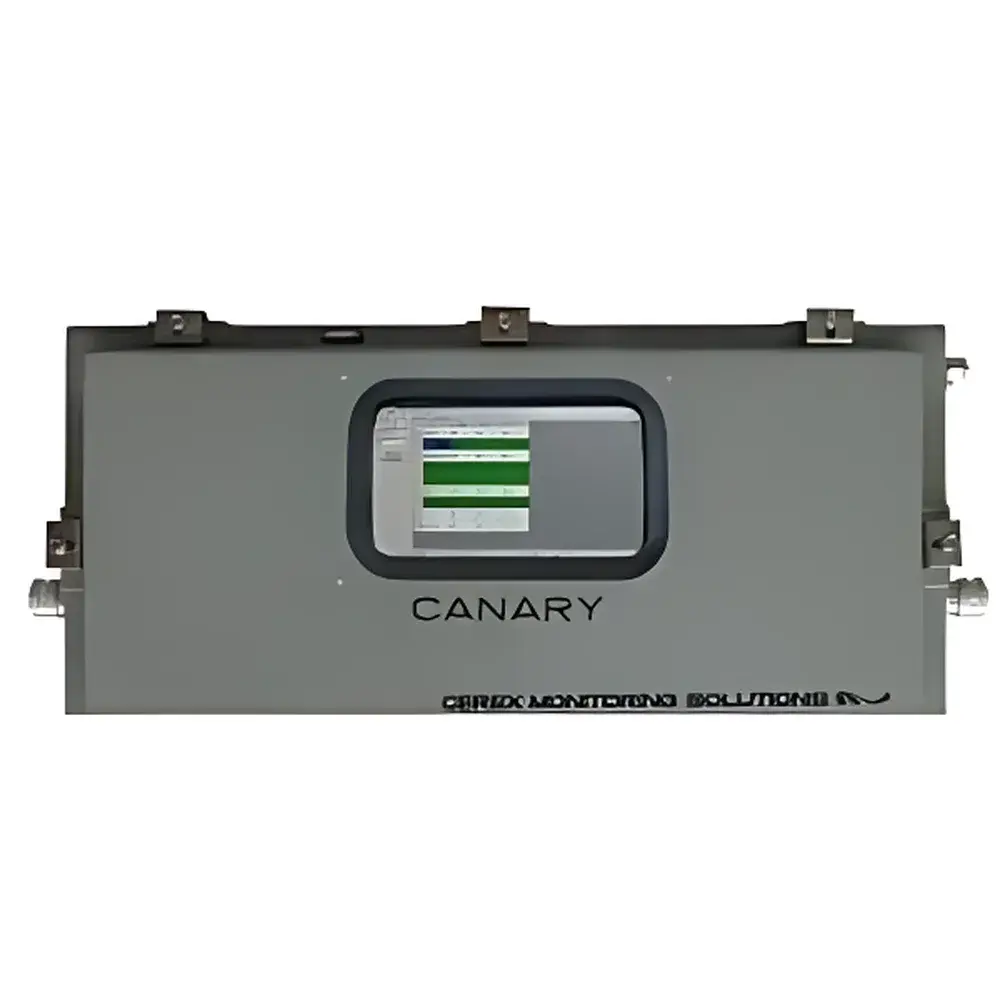
Cerex Canary Portable DOAS Gas Analyzer
| Origin | USA |
|---|---|
| Manufacturer Type | Distributor |
| Origin Category | Imported |
| Model | Canary |
| Price | Upon Request |
Overview
The Cerex Canary Portable DOAS Gas Analyzer is a field-deployable, optical absorption-based instrumentation platform engineered for quantitative multi-gas detection in ambient air, stack emissions, and process streams. It employs Differential Optical Absorption Spectroscopy (DOAS), a well-established spectroscopic technique that resolves trace gas concentrations by analyzing characteristic narrowband absorption features across ultraviolet (UV) and near-infrared (NIR) spectral regions. Unlike electrochemical or metal-oxide semiconductor sensors—whose performance degrades irreversibly upon exposure to interfering compounds—the Canary’s optical path design eliminates sensor poisoning, ensuring long-term calibration stability and measurement reproducibility. The system operates on the principle of Beer–Lambert law quantification, using high-resolution spectrometers (185 nm – 18 µm spectral coverage) coupled with broadband light sources and fiber-optic light delivery. Its dual configuration—NEMA-rated industrial enclosure and IP67-certified portable chassis—supports both fixed-site continuous monitoring and mobile survey applications in compliance with EPA Method TO-14/TO-15 conceptual frameworks and ISO 12039 for optical gas analysis.
Key Features
- True DOAS architecture with UV–NIR broadband spectral acquisition (185 nm – 18 µm), enabling simultaneous quantification of multiple gases without cross-interference compensation algorithms
- Two mechanically distinct enclosures: NEMA 4X-rated industrial housing (610 × 305 × 152 mm) for permanent installation; ruggedized portable unit (549 × 438 × 124 mm, 5.4 kg) certified to IP67 for dust/water ingress protection
- Optically inert sampling path constructed from 316 stainless steel, PVDF, or PTFE—compatible with corrosive, humid, or high-temperature sample matrices up to 200 °C
- In-situ probe option featuring titanium, Hastelloy, PEEK, or 316SS construction, rated for continuous operation at 0–140 °C and spectral range 200 nm – 18 µm
- Universal AC input (100–240 VAC, 47–63 Hz), ≤5 A max draw; operating temperature range: 0–45 °C; storage: −10–60 °C; non-condensing humidity <80% RH
- SMA-terminated fiber-optic interface for flexible probe integration; customizable sample line fittings per user specification
Sample Compatibility & Compliance
The Canary is validated for real-time detection of industrially relevant gases including chlorine (Cl₂), sulfur dioxide (SO₂), ammonia (NH₃), hydrogen fluoride (HF), fluorine (F₂), ethylene dichloride (EDC), and water vapor (H₂O) in complex matrices. Its optical design inherently rejects particulate scattering artifacts via spectral deconvolution, supporting reliable measurements in turbid or variable-humidity environments. The analyzer complies with fundamental requirements of ISO/IEC 17025 for testing laboratories and aligns with functional expectations of US EPA Performance Specification 18 (PS-18) for optical gas analyzers. While not pre-certified for specific regulatory submissions, its architecture supports audit-ready data logging essential for GLP/GMP-aligned environmental QA/QC programs and 21 CFR Part 11-compliant software validation when integrated with Cerex’s proprietary control suite.
Software & Data Management
The Canary operates under Cerex’s proprietary firmware and PC-based analytical software, providing real-time spectral visualization, automated baseline correction, and least-squares spectral fitting against reference absorption libraries. Raw spectral data (ASCII or HDF5 format), calibrated concentration time-series (ppm), and diagnostic logs—including lamp intensity, detector SNR, and optical path integrity metrics—are timestamped and exportable. Software supports configurable alarm thresholds, scheduled zero/span checks, and encrypted local storage. Audit trails record all user-initiated parameter changes, calibration events, and firmware updates—enabling traceability required for ISO 9001, ISO 14001, and internal quality management systems.
Applications
- Leak detection and fugitive emission surveys across petrochemical, chlor-alkali, and semiconductor manufacturing facilities
- Stack gas monitoring for SO₂, HF, and Cl₂ in compliance with local air quality regulations and permit reporting
- Process gas purity verification in ammonia synthesis loops or EDC production lines
- Emergency response deployment for hazardous material incident characterization (e.g., HF release at refineries)
- Research-grade atmospheric chemistry studies requiring speciated VOC and inorganic gas quantification in mobile laboratories
FAQ
Does the Canary require daily calibration?
No. Due to its inherent optical stability and reference-based DOAS quantification, the Canary typically maintains calibration for ≥30 days under normal operating conditions. Zero/span verification is recommended weekly for critical applications.
Can it measure gases in high-humidity samples?
Yes. Water vapor spectral interference is mathematically resolved during DOAS fitting; optional heated sample lines or Nafion dryers may be integrated for extreme dew-point conditions.
Is remote monitoring supported?
Yes. Ethernet and RS-485 interfaces enable integration into SCADA systems; Modbus TCP and OPC UA protocols are available via optional firmware modules.
What maintenance is required?
Annual spectrometer wavelength calibration and lamp replacement (typical lifetime >2 years); no consumables or reagents are used.
Is the system compliant with explosion-proof standards?
The standard Canary is not ATEX or IECEx certified; however, intrinsically safe (IS) variants and purged cabinet configurations are available upon engineering consultation.







