
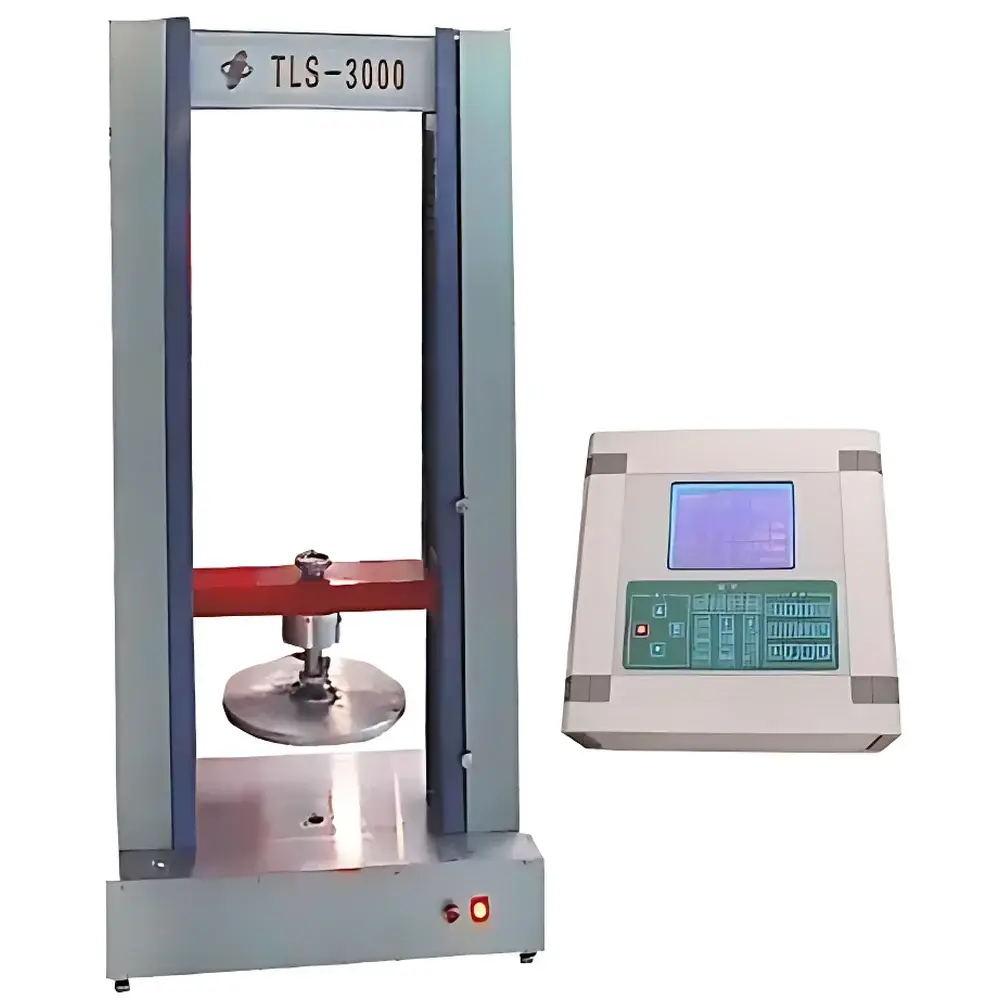
Changchun Intelligent LDS-3000 Digital Foam Compression Tester
| Brand | Changchun Intelligent |
|---|---|
| Origin | Jilin, China |
| Manufacturer Type | Authorized Distributor |
| Country of Origin | China |
| Model | LDS-3000 |
| Load Cell Capacity | 3000 N |
| Load Accuracy | ±1% FS |
| Load Resolution | 0.5 N |
| Test Speed Range | 5–300 mm/min |
| Speed Accuracy | ±5% |
| Effective Stroke | 300 mm |
| Displacement Measurement Range | 0–300 mm |
| Displacement Accuracy | ±1% FS |
| Platen Dimensions | 310 × 310 mm |
Overview
The Changchun Intelligent LDS-3000 Digital Foam Compression Tester is a precision-engineered mechanical testing instrument designed specifically for the quantitative evaluation of compressive behavior in low-density, viscoelastic polymeric foams—including flexible polyurethane (PU), ethylene-vinyl acetate (EVA), expanded polystyrene (EPS), and cross-linked polyethylene (XLPE) foams. Operating on the principle of controlled uniaxial compression under constant-rate displacement, the system applies a calibrated force via a motor-driven crosshead to a standardized platen assembly, while simultaneously recording load and displacement data in real time. This methodology conforms to core mechanical testing standards including ISO 1856, ASTM D3574 (Methods A, B, C, and E), and GB/T 6344–2022 for flexible cellular polymeric materials. The LDS-3000 is not a general-purpose universal tester; its structural rigidity, platen geometry, and control architecture are optimized for the unique deformation characteristics of foam—namely, nonlinear stress–strain response, pronounced hysteresis, and time-dependent recovery.
Key Features
- High-stability 3000 N load cell with ±1% full-scale accuracy and 0.5 N resolution—engineered for repeatable measurement across low-force regimes typical of foam indentation and compression set testing.
- Digital PWM-controlled servo motor system enabling precise speed regulation from 5 to 300 mm/min, with closed-loop feedback ensuring consistent strain rate application per ASTM D3574 Method B (compression hardness) and Method C (compression deflection).
- Large-area rigid compression platens (310 × 310 mm) minimize edge effects and ensure uniform stress distribution across standard test specimens (e.g., 150 × 150 × 50 mm blocks per ISO 1856), reducing localized buckling artifacts.
- 300 mm effective stroke accommodates full compression to 90% strain for high-compliance foams without mechanical interference or sensor saturation.
- Modular digital architecture supports integration with external PC-based data acquisition systems via RS-232 or USB interface, enabling synchronized logging of load, displacement, and time stamps at user-defined sampling intervals.
- Compliant with industrial calibration traceability requirements: load cell certified to ISO/IEC 17025-accredited laboratories; displacement transducer verified against laser interferometry standards.
Sample Compatibility & Compliance
The LDS-3000 is validated for use with flat, isotropic foam specimens meeting dimensional tolerances specified in ISO 1856 and ASTM D3574. Compatible sample types include slabstock foams, molded cushioning components, automotive seat cores, packaging inserts, and acoustic damping layers. Specimen conditioning must follow ISO 291 (23 ± 2 °C, 50 ± 5% RH, ≥16 h equilibration) prior to testing. The instrument’s mechanical design and software logic support compliance workflows aligned with GLP (Good Laboratory Practice) documentation protocols, including operator ID tagging, test method versioning, and raw data export in CSV and XML formats for audit-ready archival. While not FDA 21 CFR Part 11–validated out-of-the-box, the system architecture permits integration with third-party electronic lab notebook (ELN) platforms supporting audit trails and electronic signatures.
Software & Data Management
The LDS-3000 operates with embedded firmware that captures and displays real-time load–displacement curves, calculates key metrics—including initial modulus, compression hardness (at 25%, 40%, and 65% deflection), compression set (after 22 h at 70 °C per ISO 1856), and resilience—and exports ASCII-formatted datasets. Optional PC-based software provides advanced analysis modules: hysteresis loop quantification, creep-recovery modeling, and statistical batch reporting per QC/QA requirements. All data files retain embedded metadata (test date, operator, environmental conditions, calibration certificate ID), satisfying traceability needs for internal quality audits and customer-facing material certifications.
Applications
- Quality control of foam batches in rubber and plastic manufacturing facilities—verifying consistency of compression hardness and recovery performance.
- R&D characterization of novel foam formulations, including bio-based PU variants and nanocomposite elastomeric foams.
- Validation of foam behavior under simulated service conditions—e.g., seating comfort assessment (ISO 24407), packaging shock absorption (ASTM D1596), and gasket compression sealing performance.
- Supporting technical documentation for automotive OEM specifications (e.g., GMW14872, Ford WSS-M99P1111-A) requiring compression set and load-deflection data.
- Teaching laboratories delivering hands-on instruction in polymer mechanics, viscoelasticity, and standardized materials testing methodology.
FAQ
What standards does the LDS-3000 comply with for foam compression testing?
The system supports test execution per ISO 1856, ASTM D3574 (Methods A–E), GB/T 6344–2022, and DIN 53577, with hardware geometry and control parameters preconfigured for these methods.
Can the LDS-3000 perform compression set testing?
Yes—when used with optional environmental chamber integration (not included), it enables automated compression set measurement per ISO 1856 Clause 6.3 and ASTM D3574 Method D.
Is calibration documentation provided with the instrument?
Each unit ships with a factory calibration certificate referencing ISO/IEC 17025-accredited load cell and displacement transducer verification, valid for 12 months under normal operating conditions.
Does the system support GLP-compliant reporting?
Raw data export includes timestamps, operator IDs, and calibration metadata; full GLP compliance requires integration with validated ELN or LIMS software.
What maintenance is required for long-term accuracy?
Annual recalibration of the load cell and displacement sensor is recommended; routine verification using traceable dead-weight standards and gauge blocks should be performed weekly in production environments.




