
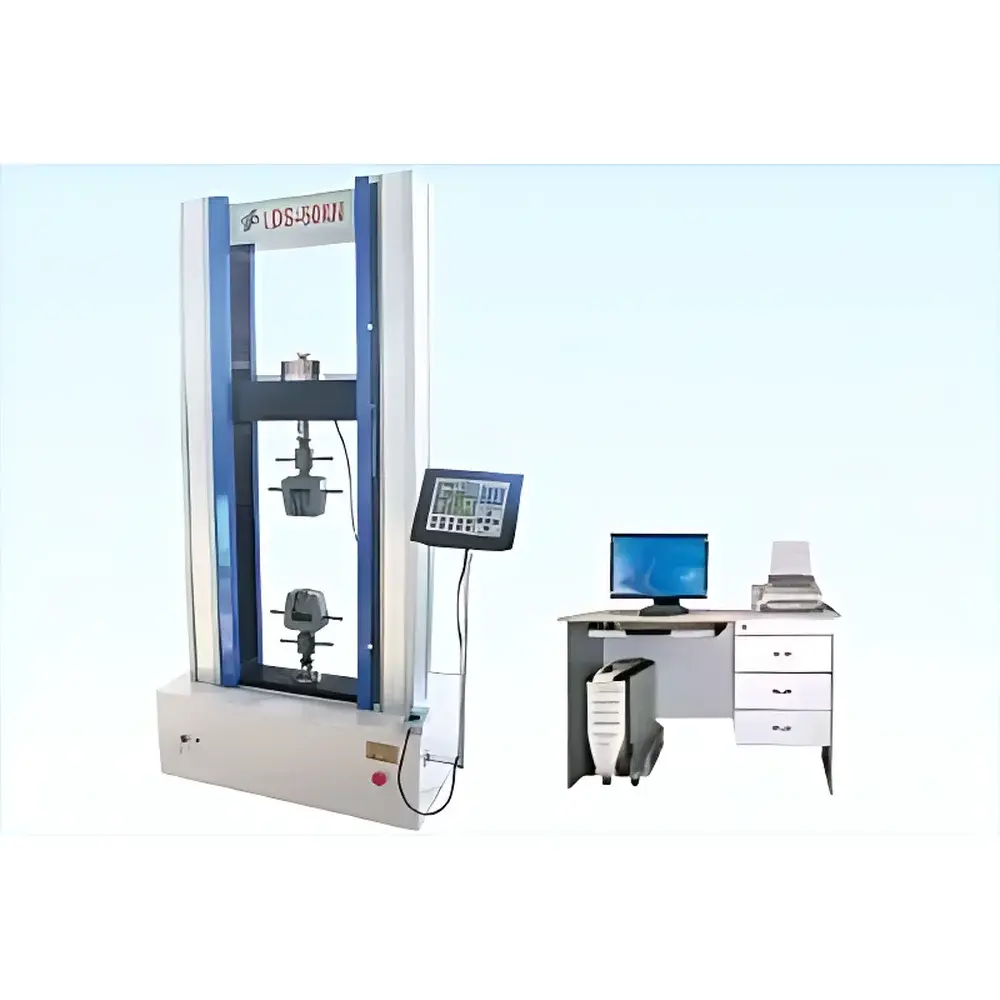
Changchun Intelligent LDS Series Universal Testing Machine for Plastics
| Key | Brand: Changchun Intelligent |
|---|---|
| Origin | Jilin, China |
| Model | LDS Series |
| Max Test Force | 5 kN |
| Load Cell Accuracy | ±0.5% |
| Load Accuracy | ±0.5% |
| Speed Accuracy | ±0.5% |
| Speed Range | 0.05–500 mm/min |
| Elongation Measurement Accuracy | ±0.5% |
| Large-Deformation Range | 0–1000 mm |
| Effective Crosshead Travel | 1160 mm |
| Effective Test Width | 420 mm |
| Jaw Spacing (Max) | 860 mm |
| Power Supply | AC 220 V, 2 kW |
Overview
The Changchun Intelligent LDS Series Universal Testing Machine is an electromechanical materials testing system engineered for precision tensile, tear, and peel characterization of polymeric and non-metallic materials. Based on servo-controlled electromechanical actuation and compliant with ISO 527, ASTM D638, ASTM D882, ASTM D1938, ISO 1184, and GB/T 1040 series standards, this machine implements quasi-static uniaxial force–displacement measurement using high-resolution load cells and linear displacement transducers. Its modular architecture supports interchangeable grips (pneumatic, wedge, roller, and custom fixtures), enabling standardized mechanical property extraction—including tensile strength, yield strength, elongation at break, Young’s modulus, and stress–strain hysteresis—under controlled strain rates from 0.05 to 500 mm/min. Designed for laboratory-based quality control, R&D validation, and incoming material inspection, the LDS platform delivers repeatable mechanical data traceable to national metrological standards.
Key Features
- High-fidelity load measurement via imported S-type load cell (capacity: 5 kN) with ±0.5% full-scale accuracy per ISO 7500-1 Class 1
- Dual-mode displacement sensing: integrated encoder for crosshead position (±0.5% accuracy) + optional extensometer or large-deformation clip gauge (0–1000 mm range)
- Precision ball-screw-driven crosshead with brushless servo motor and closed-loop speed regulation (0.05–500 mm/min, ±0.5% setpoint deviation)
- Digital real-time control interface supporting constant-rate-of-travel (CRT), constant-rate-of-extension (CRE), and load-controlled ramp modes
- Integrated safety architecture: overload cutoff, thermal protection, current/voltage anomaly detection, dual mechanical limit switches, and emergency stop circuitry
- Optical scale and digital crosshead position readout for rapid visual alignment and positional repeatability verification
- Multi-unit support: N, kN, kgf, gf, lbf, MPa, psi—automatically synchronized across display, plots, and reports
- Zero-point auto-calibration routine for load and displacement channels using certified reference weights and calibrated rulers
Sample Compatibility & Compliance
The LDS Series accommodates specimens conforming to standard geometries defined in ISO 527-2 (dog-bone bars), ASTM D638 Type I–V, ASTM D882 (thin films), and GB/T 1040.1–1040.5. It supports rigid thermoplastics (e.g., ABS, PC, PP), elastomers (e.g., TPE, silicone), fiber-reinforced composites, adhesives, packaging films, and wire insulation. All test protocols are fully compatible with GLP-compliant workflows: audit trails record operator ID, timestamp, calibration status, environmental conditions (optional sensor integration), and raw data checksums. Software-generated reports include metadata required for ISO/IEC 17025 accreditation and FDA 21 CFR Part 11 electronic signature readiness when deployed with validated user access controls.
Software & Data Management
The embedded Windows-based control software provides real-time visualization of up to six synchronized curves: Force vs. Displacement, Stress vs. Strain, Force vs. Time, Strain vs. Time, and comparative overlays of multiple specimens. Curve analysis tools include automatic yield point detection (0.2% offset method), tangent modulus calculation, area-under-curve integration for toughness estimation, and user-defined region zooming. Data export supports native .csv, .xlsx (Excel), and .docx (Word) formats without third-party dependencies. All test configurations, results, and graphical outputs are stored in a relational database with versioned backups; historical datasets remain searchable by batch ID, material grade, operator, or date range. Automated report templates align with internal SOPs or external regulatory submission requirements.
Applications
- Quality assurance of injection-molded plastic components against tensile strength and ductility specifications
- Evaluation of biodegradable polymer films under ASTM D882 for packaging applications
- Validation of adhesive bond integrity via 90° or 180° peel tests per ASTM D903 and ISO 8510-2
- Characterization of elastomeric seals and gaskets for automotive and medical device OEMs
- Comparative fatigue pre-screening through sequential tensile cycling with programmable hold segments
- Support for ISO 178 flexural testing when equipped with three-point bending fixtures (optional accessory)
FAQ
What international standards does the LDS Series comply with for plastics testing?
It supports full implementation of ISO 527, ASTM D638, ASTM D882, ASTM D1938, ISO 1184, and GB/T 1040 series standards—including specimen preparation, test speed selection, and data reporting conventions.
Can the system be validated for regulated environments such as pharmaceutical or medical device manufacturing?
Yes—when configured with role-based user authentication, electronic signatures, and audit trail logging, it meets foundational requirements for FDA 21 CFR Part 11 and ISO 13485 Annex A compliance.
Is extensometer integration supported for modulus measurement?
The LDS platform includes dedicated analog/digital ports for contact and non-contact extensometers; modulus calculations automatically switch to true strain input when enabled.
How is mechanical overload protection implemented?
Hardware-level current limiting, dynamic torque monitoring, dual physical end-stop switches, and software-configurable force ceiling thresholds operate in parallel to prevent damage during unexpected failure events.
Does the system support automated batch testing with minimal operator intervention?
Yes—predefined test sequences can execute unattended across up to 99 specimens, with auto-grip repositioning, specimen ejection prompts, and pass/fail logic based on user-specified tolerance bands.



