
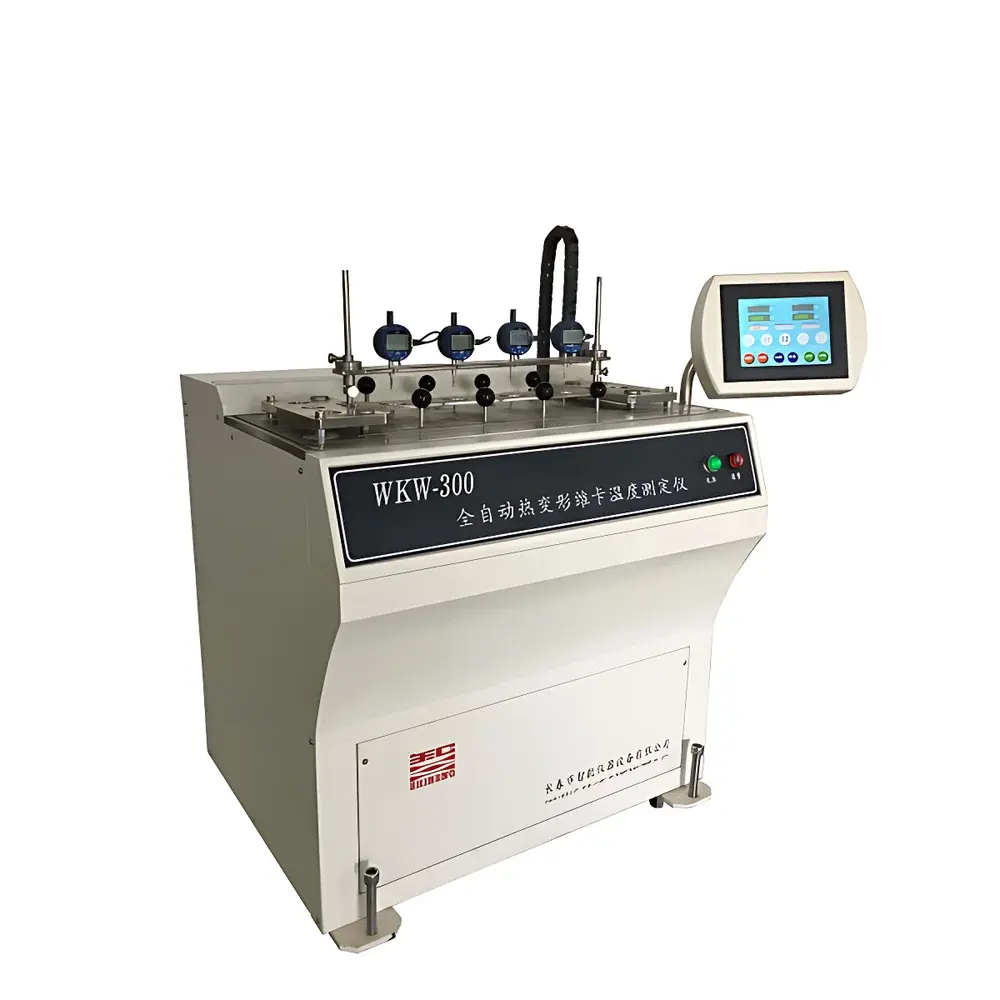
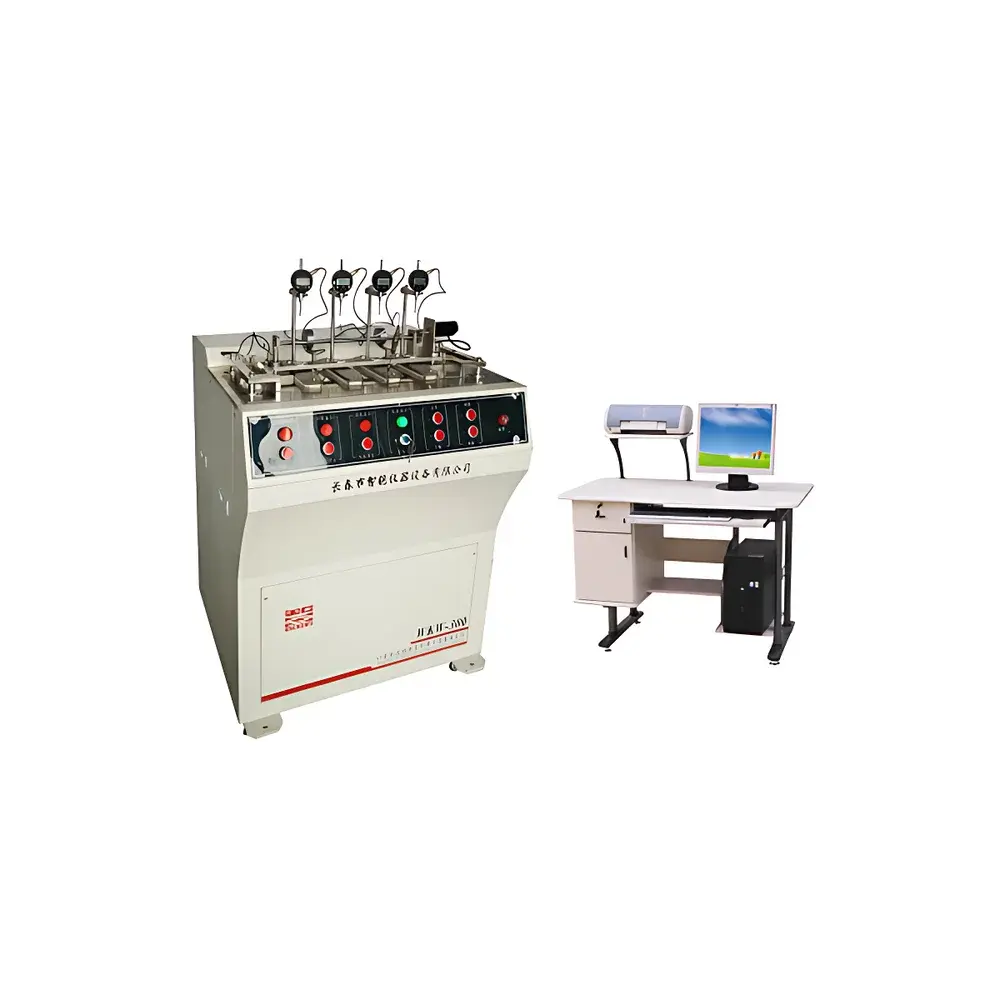
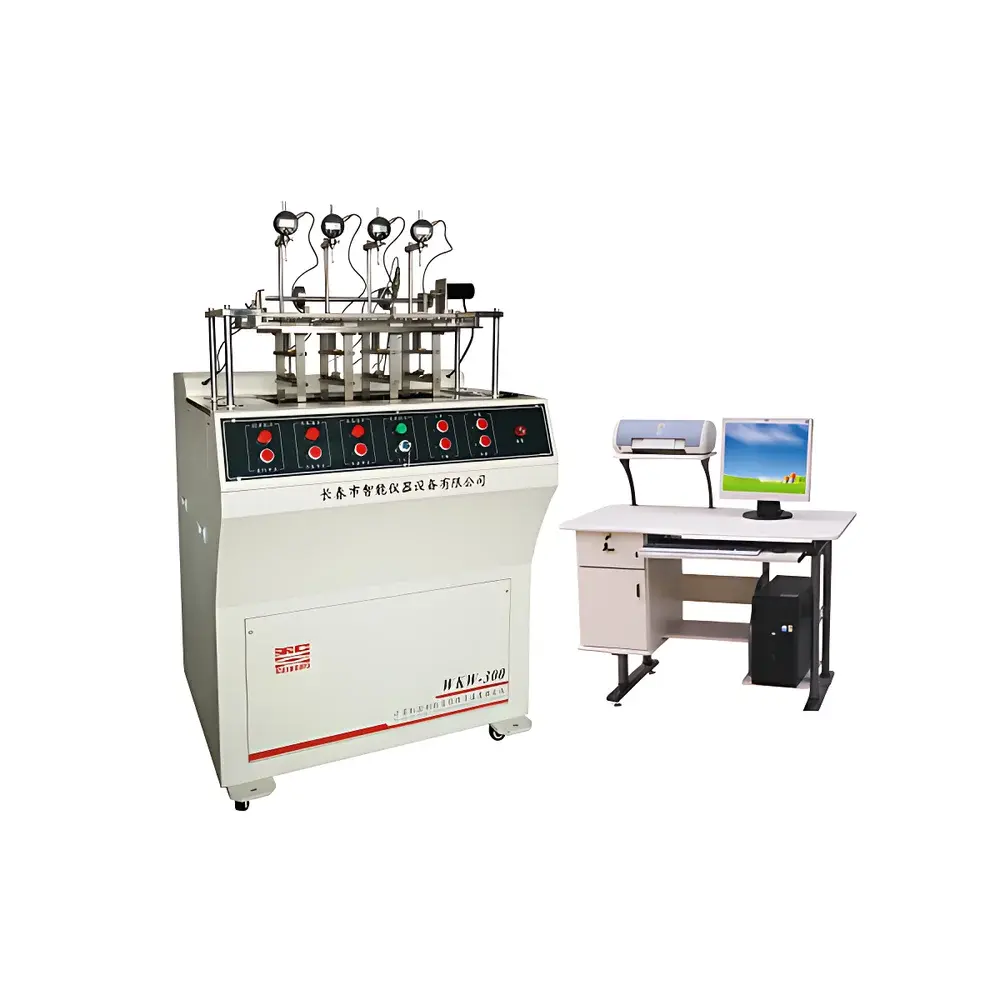
Changchun Intelligent WKW-300 Heat Deflection Temperature (HDT) and Vicat Softening Temperature (VST) Tester
| Brand | Changchun Intelligent |
|---|---|
| Origin | Jilin, China |
| Model | WKW-300 |
| Temperature Range | Ambient to 300 °C |
| Temperature Accuracy | ±0.5 °C |
| Heating Rates | 5 ±0.5 °C/6 min (Method A), 12 ±1.0 °C/6 min (Method B) |
| Deformation Measurement Range | 0–1 mm |
| Deformation Accuracy | ±0.005 mm |
| Dial Indicator Resolution | 0.001 mm (±0.003 mm accuracy) |
| Test Loads | 10 N ±0.2 N (VST Method A), 50 N ±1 N (VST Method B) |
| Bending Stress Levels | 0.45 MPa (HDT Method B), 1.80 MPa (HDT Method A), 8.00 MPa (HDT Method C) |
| Span Lengths | 64 mm and 100 mm |
| Heating Medium | Methyl silicone oil (kinematic viscosity ≤200 cSt, flash point ≥300 °C) |
| Cooling Options | Natural convection or water cooling |
| Power Supply | AC 220 V, 50 Hz |
| Rated Power | 4 kW |
| Accuracy Class | Class 1 (per GB/T 1633 & ISO 306) |
Overview
The Changchun Intelligent WKW-300 is a dual-function thermal analysis instrument engineered for precise determination of Heat Deflection Temperature (HDT) and Vicat Softening Temperature (VST) in thermoplastic polymers, rigid elastomers, and fiber-reinforced composite materials. It operates on standardized thermo-mechanical principles: for VST, a needle of defined geometry applies a constant load (10 N or 50 N) to a specimen while temperature rises at a controlled linear rate; softening is recorded when the needle penetrates 1 mm into the material surface. For HDT, a rectangular specimen is placed in three-point bending under specified flexural stress (0.45, 1.80, or 8.00 MPa), and the temperature at which deflection reaches 0.25 mm (or 0.32 mm per ASTM D648) is reported. The system complies with international test standards including ISO 306:2013, ISO 75-1:2013, ASTM D1525–17, ASTM D648–06, GB/T 1633–2000, GB/T 1634.1–2019, and GB 8802, ensuring data traceability and inter-laboratory comparability in quality control and R&D environments.
Key Features
- Modular electronic architecture with independent high-speed acquisition channels for temperature (PT100 sensor) and deformation (four precision digital dial indicators), minimizing cross-talk and enhancing signal integrity.
- Class 1 accuracy certified per GB/T 1633 and ISO 306—temperature control stability ±0.5 °C over full 0–300 °C range, deformation resolution 1 µm (±0.003 mm indicator accuracy, ±0.005 mm system-level measurement uncertainty).
- Dual heating rate capability: programmable 5 ±0.5 °C/6 min (ISO/GB VST Method A) and 12 ±1.0 °C/6 min (ISO/GB VST Method B), both validated per ISO 306 Annex B calibration procedures.
- Robust mechanical construction: high-strength, low-thermal-expansion stainless steel frame for minimal parasitic deformation; electrostatically coated enclosure for corrosion resistance and long-term dimensional stability.
- Four parallel test stations—each equipped with dedicated VST probe, HDT loading head, and calibrated load train—enabling concurrent execution of up to four specimens under identical thermal conditions.
- Flexible specimen support: adjustable span lengths (64 mm and 100 mm) accommodate standard GB, ISO, and ASTM geometries; specimens may be loaded flat or edgewise per standard requirements.
Sample Compatibility & Compliance
The WKW-300 supports standardized test specimens per ISO 306, ISO 75, ASTM D1525, and ASTM D648—including injection-molded bars (e.g., 10 × 10 × L mm), extruded profiles, and machined coupons from PVC-U pipe, ABS, PC, PP, PA6, and GF-reinforced thermoplastics. All load masses (1 g to 2 kg) are traceably calibrated to national metrology standards, and bending stresses are calculated using nominal specimen dimensions entered during test setup. The instrument meets the mechanical and thermal validation criteria outlined in ISO/IEC 17025:2017 for testing laboratories and supports GLP-compliant audit trails when used with documented SOPs. While not FDA 21 CFR Part 11–certified out-of-the-box, its VC++ software architecture allows integration with validated LIMS environments supporting electronic signatures and data integrity controls.
Software & Data Management
The proprietary Windows-based software, developed in ANSI C++ and compliant with IEC 62304 Class B safety guidelines, provides full test lifecycle management. Users select preloaded standard methods (e.g., “ISO 306 VST-A”, “ASTM D648 HDT-B”) or define custom protocols with user-specified start/stop temperatures, target deformation thresholds, and stress configurations. Real-time plotting displays synchronized temperature–deformation and temperature–time curves in multi-color overlay mode. Raw data (timestamped temperature, displacement, and load values at ≥10 Hz sampling) are stored in binary format with ASCII export options (.CSV, .TXT). Reporting includes automatic pass/fail evaluation against specification limits, statistical summary (mean, SD, CV%) across replicates, and direct export to Word-compatible templates. All test files embed metadata: operator ID, sample ID, preparation date, ambient lab conditions, and calibration certificate IDs for PT100 and dial indicators.
Applications
This instrument serves critical roles in polymer formulation development, incoming raw material verification, production lot release testing, and regulatory submission packages for medical devices and automotive components. In R&D labs, it quantifies the effect of plasticizer content, filler dispersion, or copolymer composition on thermal resistance. In QC settings, it validates batch-to-batch consistency of HDT/VST values against internal specifications or customer requirements (e.g., UL 746B, SAE J2334). Its dual-method capability streamlines comparative studies—e.g., evaluating how nucleating agents affect VST versus how fiber orientation influences HDT under 0.45 MPa loading. The 300 °C upper limit enables testing of high-performance thermoplastics such as PEEK, PEI, and PPS without medium degradation when using certified methyl silicone oil.
FAQ
What heating medium is required, and why is viscosity specification critical?
Methyl silicone oil with kinematic viscosity ≤200 cSt and flash point ≥300 °C must be used. Low viscosity ensures uniform convective heat transfer and minimizes boundary layer effects; high flash point prevents ignition risk during extended 300 °C operation.
Can the WKW-300 perform both HDT and VST tests simultaneously?
Yes—four independent test stations allow concurrent execution of mixed-mode testing (e.g., two VST + two HDT runs) under identical thermal ramp conditions, reducing total cycle time by up to 60% compared to sequential single-station instruments.
How is traceability maintained for applied loads and deformation measurements?
All weights are supplied with NIST-traceable calibration certificates; dial indicators undergo annual verification per JJG 2003–2022 (Chinese national metrology regulation); PT100 sensors are calibrated using a dry-block calibrator traceable to CNAS-accredited reference standards.
Is water cooling mandatory for high-temperature testing?
No—natural convection cooling suffices for routine shutdown between tests; however, water cooling is recommended when performing >10 consecutive cycles above 250 °C to maintain thermal mass stability and extend bath fluid service life.
Does the software support automated report generation for ISO/IEC 17025 accreditation?
Yes—the software exports structured XML and PDF reports containing all required elements: equipment IDs, calibration dates, environmental conditions, raw data arrays, operator signatures, and uncertainty budgets calculated per GUM (JCGM 100:2008) principles.
Related Products





