
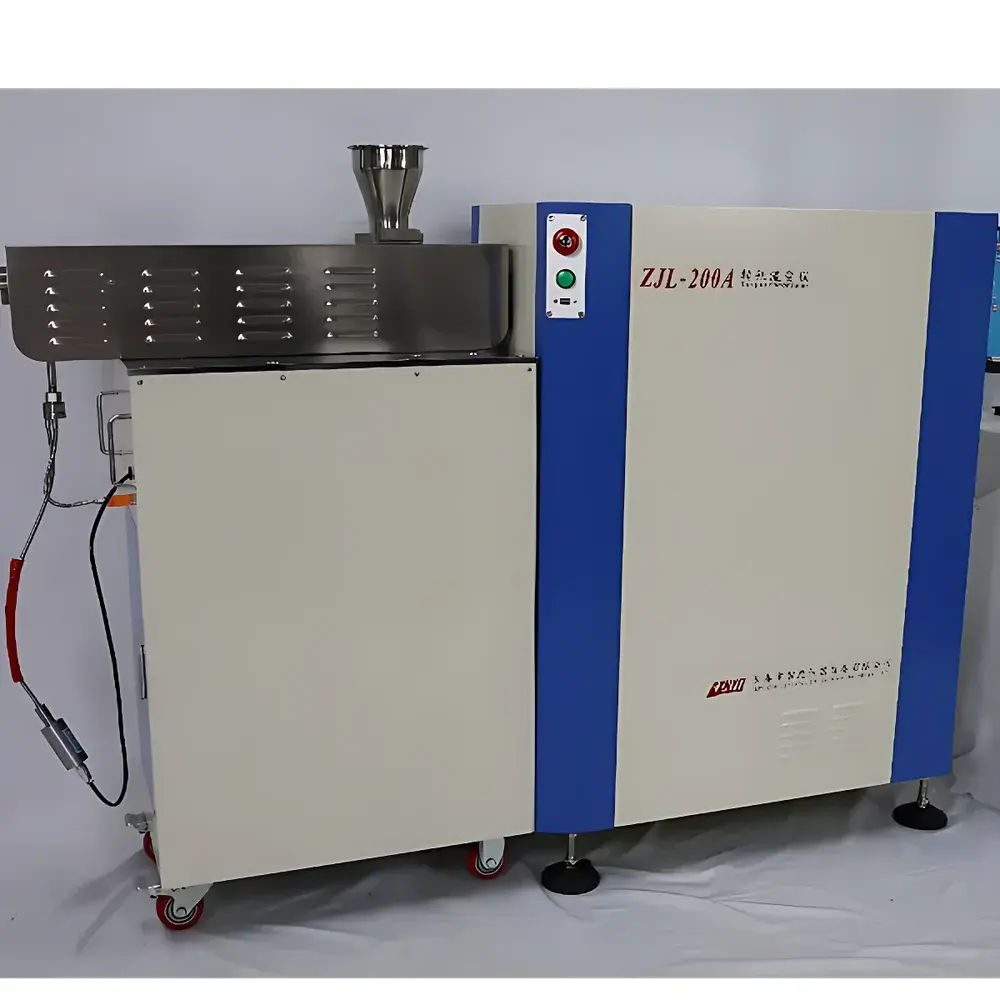
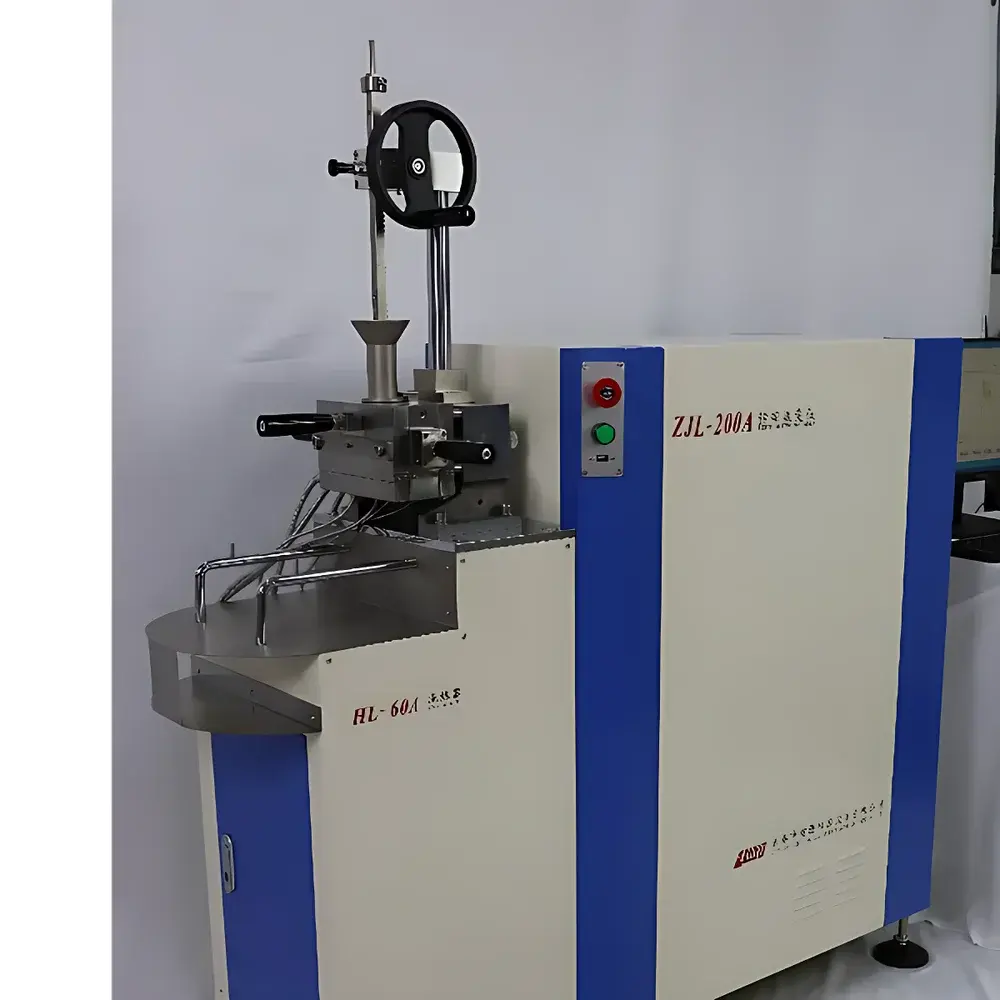
Changchun Intelligent ZJL-200A Torque Rheometer
| Brand | Changchun Intelligent |
|---|---|
| Origin | Jilin, China |
| Model | ZJL-200A |
| Max Temperature | 350 °C |
| Speed Range | 0.1–120 rpm |
| Torque Range | 0–300 N·m |
| Torque Accuracy | ±0.5% F.S. |
| Pressure Range | 0.1–100 MPa |
| Pressure Accuracy | ±0.5% F.S. |
| Temperature Control | 5-zone, ±1 °C |
| Temp Resolution | 0.1 °C |
| Motor | AC 380 V, 3.0 kW |
| Mixer Volume | 60 mL |
| Extruder Barrel | φ20 mm, L/D = 25:1, 4Cr13 steel |
| Capillary Dies | φ1.27 mm, L/D = 20/1, 30/1, 40/1, 38CrMoAl material |
Overview
The Changchun Intelligent ZJL-200A Torque Rheometer is a laboratory-scale, modular torque-driven rheological testing system engineered for dynamic characterization of thermoplastic polymers, thermosetting resins, elastomers, and multi-component compound systems under simulated processing conditions. It operates on the principle of controlled shear deformation in rotational geometries—specifically using co-rotating or counter-rotating mixing chambers and single-screw extrusion modules—to quantify real-time torque, melt pressure, temperature distribution, and viscoelastic response as functions of time, temperature, and shear rate. Unlike capillary or rotational viscometers designed for steady-state measurements, the ZJL-200A enables transient rheological profiling—including linear ramped shear rate experiments, entry pressure correction for non-Newtonian melts, and time-resolved curing/sulfurization kinetics—making it suitable for process-relevant development of polymer formulations, compounding protocols, and thermal stability thresholds.
Key Features
- Modular architecture supporting interchangeable test units: 60 mL intermeshing twin-screw mixer (with dual rotors), high-temperature single-screw extruder (φ20 mm, L/D = 25:1, 4Cr13 barrel), and precision capillary die assembly (three dies: L/D = 20/1, 30/1, 40/1; φ1.27 mm; 38CrMoAl)
- Five-zone independent temperature control with ±1 °C accuracy and 0.1 °C resolution across operating range (ambient to 350 °C), enabling precise thermal profiling during melt processing
- High-torque DC servo drive system delivering 0–300 N·m output with ±0.5% full-scale accuracy and speed regulation from 0.1 to 120 rpm
- Integrated melt pressure transducer (0.1–100 MPa, ±0.5% F.S.) mounted at extruder die entrance for real-time pressure monitoring and entrance loss correction
- Industrial-grade AC 380 V / 3.0 kW motor with robust thermal management, compliant with IEC 60034 mechanical and electrical safety standards
- Pre-installed software suite comprising three domain-specific modules: polymer melt rheology analysis, extrusion process data reduction, and mixer torque/time curve interpretation
Sample Compatibility & Compliance
The ZJL-200A accommodates solid pellets, powders, granules, and pre-compounded blends typical of polyolefins, engineering thermoplastics (e.g., PA6, PC, PBT), thermosets (epoxy, phenolic), and elastomeric systems (SBR, EPDM). Its design supports ASTM D3835 (standard test method for extrusion plastometer), ISO 11443 (determination of melt flow rate and melt volume rate), and ISO 6721-10 (dynamic mechanical properties of plastics) experimental frameworks. All temperature sensors meet IEC 60751 Class B tolerance, and pressure transducers conform to EN 837-1 for industrial process instrumentation. The system’s hardware and software architecture are structured to support GLP-compliant workflows, including user access levels, audit trails for parameter changes, and timestamped raw data export in CSV and HDF5 formats.
Software & Data Management
Control and analysis are executed via a dedicated Windows-based platform running on an included industrial-grade computer (pre-configured with Win10 IoT Enterprise). The software provides synchronized acquisition of torque, rotational speed, barrel zone temperatures, melt pressure, and time-stamped event markers (e.g., start-of-mixing, addition of additives, onset of crosslinking). Data processing includes automatic calculation of apparent viscosity, power law indices, activation energies (via Arrhenius fitting), and time-to-torque peak for cure/sulfurization studies. Export options include ASCII-compatible tables, publication-ready vector plots (SVG/PDF), and metadata-embedded binary files compatible with third-party statistical tools (e.g., MATLAB, Python pandas). The system supports optional 21 CFR Part 11 compliance packages—including electronic signatures, role-based permissions, and immutable audit logs—upon request.
Applications
- Thermal and shear stability assessment of polymer melts during extended residence time in extruders or mixers
- Optimization of screw speed, temperature profile, and feed rate for new formulations prior to pilot-scale trials
- Quantification of filler dispersion quality and polymer-filler interaction via torque decay profiles and energy input integration
- Time-resolved kinetic modeling of thermoset curing (epoxy, unsaturated polyester) and elastomer vulcanization (using torque rise curves and scorch time determination)
- Entrance pressure correction and Bagley end-effect compensation in capillary rheometry mode
- Teaching laboratory implementation for graduate-level polymer processing courses, emphasizing structure–property–process relationships
FAQ
What types of materials can be tested on the ZJL-200A?
Thermoplastics (e.g., PP, PE, ABS), thermosets (epoxy, phenolic), elastomers (NR, SBR), filled composites, and reactive polymer systems.
Is the system suitable for GLP or GMP-regulated environments?
Yes—the base configuration supports traceable calibration records and version-controlled software; 21 CFR Part 11 compliance features are available as an optional upgrade package.
Can the ZJL-200A perform true oscillatory rheology?
No—it is a rotational torque rheometer optimized for steady and transient shear under processing-like conditions; oscillatory measurements require a dedicated dynamic mechanical spectrometer.
What is the maximum recommended continuous operating temperature?
350 °C, validated for sustained operation up to 8 hours per cycle with proper thermal shielding and ambient ventilation.
Are replacement parts and calibration services available internationally?
Yes—original equipment manufacturer (OEM) spare parts, certified NIST-traceable calibration kits, and remote technical support are provided through authorized regional distributors.



