
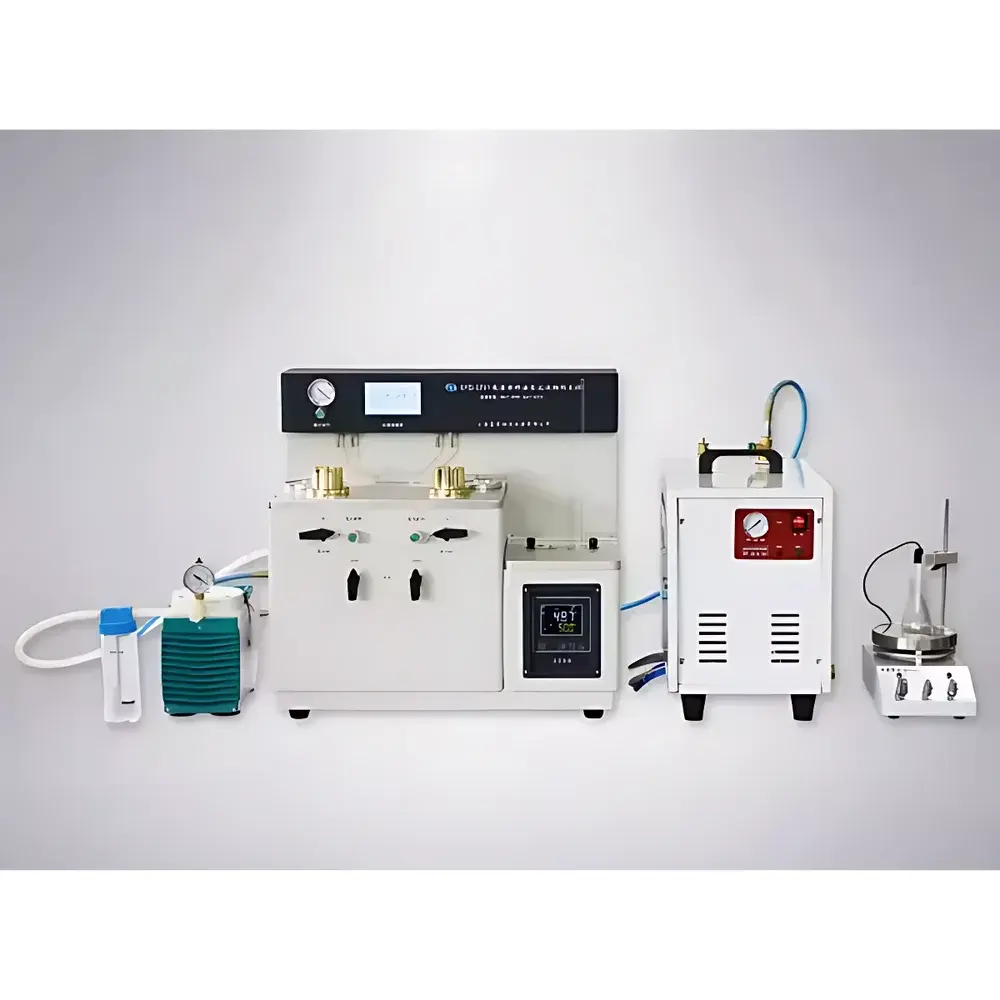
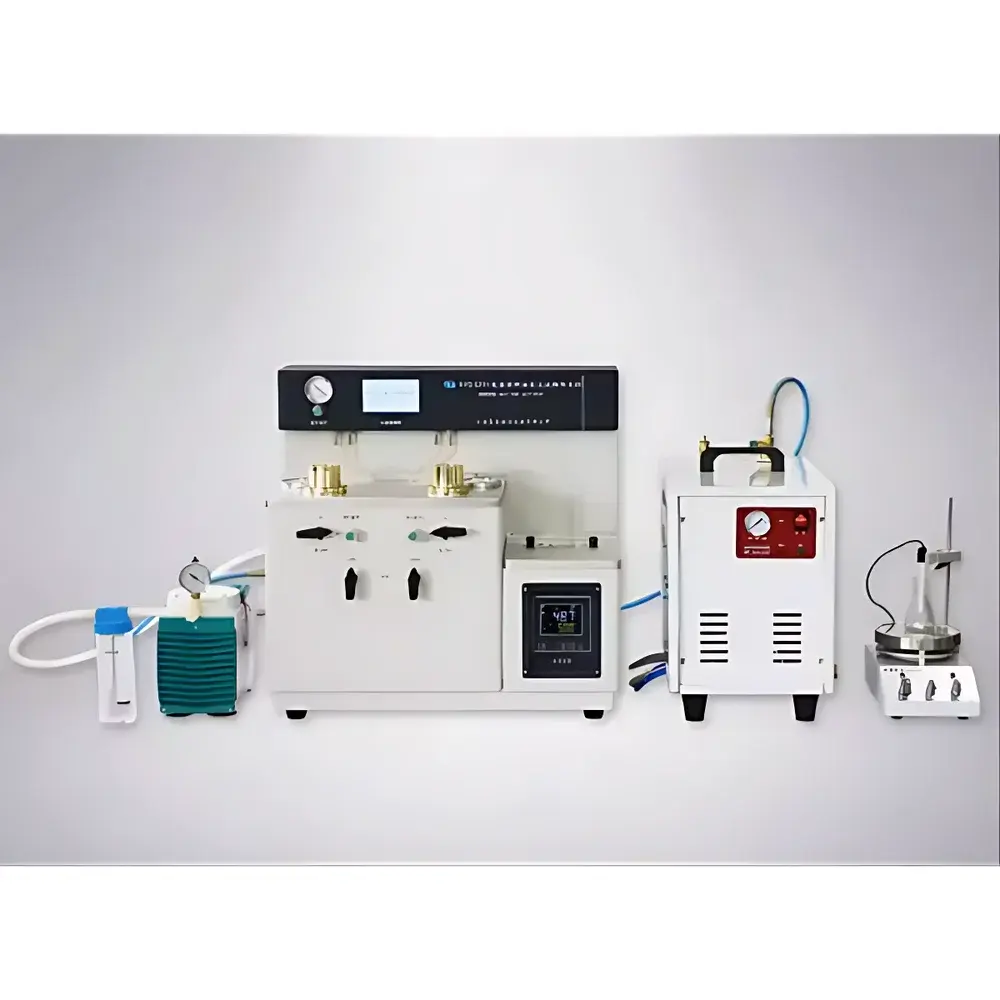
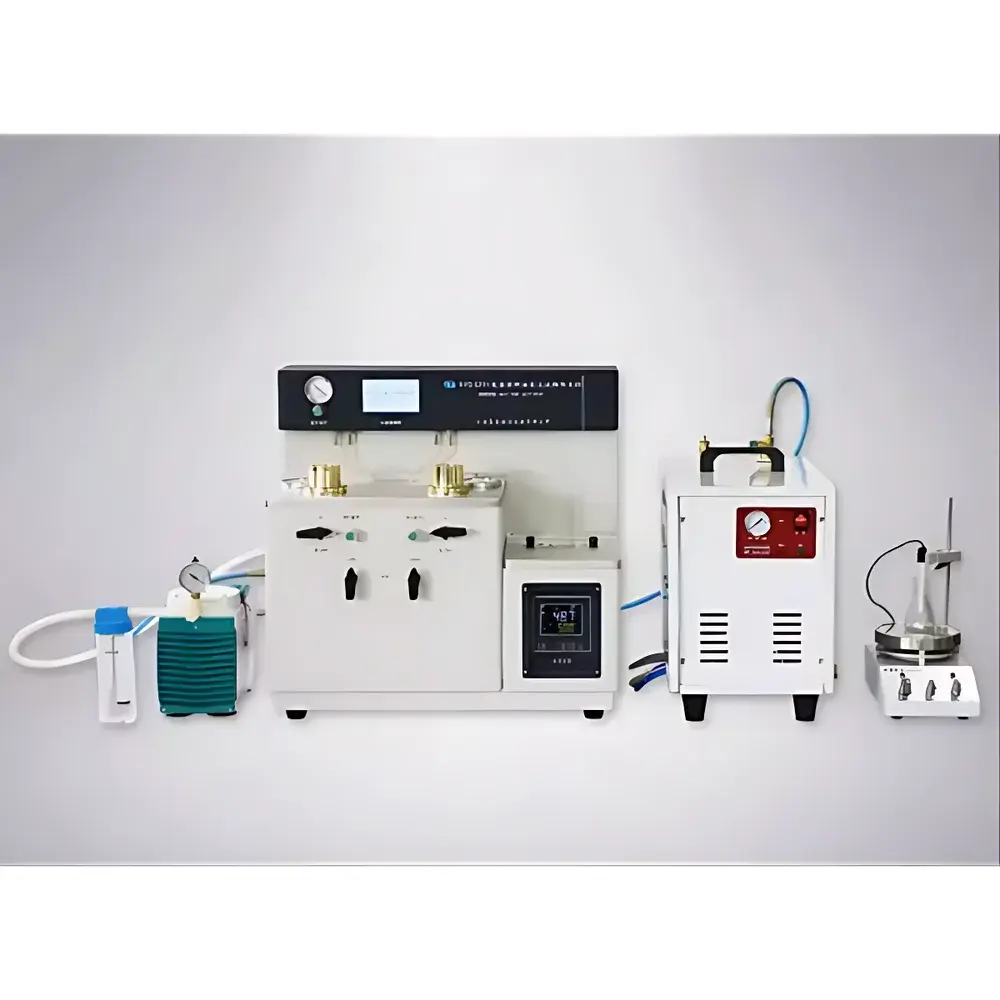
Changji Instruments SYD-0701 Total Sediment Tester for Residual Fuel Oils
| Brand | Changji Instruments |
|---|---|
| Origin | Shanghai, China |
| Model | SYD-0701 |
| Power Supply | AC (220 ± 10%) V, 50 Hz |
| Aging Bath Temp Range | Room Temp to 120 °C |
| Aging Bath Temp Accuracy | ±0.5 °C |
| Filtration Bath Temp | 10 °C ±1 °C |
| Steam Pressure Output | 0–0.4 MPa |
| Vacuum Pump Ultimate Pressure | 200 mbar |
| Magnetic Stirrer Speed Range | 0–2400 rpm |
| Magnetic Stirrer Temp Range | Room Temp to 99.9 °C |
| Dimensions (L×W×H) | 570 × 320 × 560 mm |
| Net Weight | 15 kg |
Overview
The Changji Instruments SYD-0701 Total Sediment Tester is a dedicated laboratory instrument engineered for the quantitative determination of total sediment in residual fuel oils and distillate fuels blended with residual components—specifically those exhibiting kinematic viscosity below 55 mm²/s at 100 °C. It operates in strict accordance with the Chinese petroleum industry standards SH/T 0701 (“Test Method for Total Sediment in Residual Fuel Oils”) and SH/T 0702 (“Test Method for Total Sediment in Distillate Fuels Containing Residual Components”), enabling laboratories to assess the propensity of fuel samples to generate insoluble deposits during long-term storage or transportation under elevated temperature conditions. The test principle centers on thermal aging followed by hot filtration and gravimetric analysis: a representative fuel sample is subjected to controlled oxidative aging at 100 °C for 24 hours inside an aluminum alloy heating bath, then immediately filtered through pre-weighed copper mesh filters maintained at 10 °C. The mass of retained residue—expressed as milligrams per 100 mL—is reported as total sediment, serving as a critical indicator of fuel stability, filterability, and compatibility with downstream combustion systems.
Key Features
- Integrated dual-function design compliant with both SH/T 0701 and SH/T 0702, eliminating need for separate instrumentation and reducing capital and operational cost.
- Compact modular architecture comprising main tester unit, electric steam generator, oil-free vacuum pump, and programmable magnetic stirrer—all coordinated for seamless workflow execution.
- Aluminum alloy aging bath with dual independent heating wells ensures uniform thermal distribution and simultaneous parallel testing of two samples with high reproducibility.
- Dual-mode thermal control system (heating/cooling) enables rapid bath temperature stabilization and precise maintenance within ±0.5 °C across the full 0–120 °C operating range.
- Steam generation subsystem features mechanical pressure regulation, dual-stage safety valves (integrated + external), and stable 0–0.4 MPa output—critical for consistent steam sparging during aging.
- Oil-free vacuum pump delivers reliable 200 mbar ultimate vacuum without lubricant contamination, supporting clean filtration and eliminating maintenance intervals associated with oil-sealed units.
- Programmable magnetic stirrer provides adjustable heating (up to 99.9 °C) and variable-speed agitation (0–2400 rpm in 99-step digital increments), facilitating standardized dispersion prior to aging.
Sample Compatibility & Compliance
The SYD-0701 is validated for use with residual fuel oils (e.g., RMG, RMK grades per ISO 8217), marine distillates containing residual fractions, and refinery blendstocks meeting the specified viscosity criterion. Its methodology aligns with internationally recognized stability assessment paradigms—while SH/T 0701/0702 are national standards, the underlying approach reflects principles analogous to ASTM D2274 (Oxidation Stability of Distillate Fuel Oil) and ISO 10307-1 (Measurement of Total Sediment in Residual Fuel Oils). The instrument’s construction, electrical safety (IEC 61010-1), and thermal control architecture support routine operation in GLP-compliant environments; data integrity is reinforced via manual recording protocols compatible with 21 CFR Part 11–aligned documentation practices when integrated into auditable lab workflows.
Software & Data Management
The SYD-0701 operates as a hardware-centric, manually supervised analytical platform with no embedded microprocessor or proprietary software interface. All parameter settings—including aging bath temperature, filtration bath setpoint, steam pressure, stirring speed, and heating duration—are configured via analog dials and mechanical timers. Temperature readings are displayed on calibrated digital indicators (±0.1 °C resolution) with NIST-traceable calibration options available upon request. Users maintain full control over procedural documentation: raw mass values (pre- and post-filtration filter weights), environmental conditions (ambient temperature/humidity), and operator annotations are recorded externally in laboratory notebooks or LIMS-compatible spreadsheets. This architecture ensures transparency, audit readiness, and minimal validation overhead for regulated fuel testing laboratories.
Applications
- Quality assurance of bunker fuels supplied to maritime vessels, verifying compliance with ISO 8217 Annex A sediment limits prior to delivery.
- Refinery process optimization—monitoring sediment formation trends across different feedstock blends, additive packages, and hydrotreating severity levels.
- Storage stability evaluation of aged inventory, identifying batch-specific degradation risks before dispatch to end users.
- Technical support for fuel suppliers responding to customer complaints related to filter plugging or injector fouling.
- Educational use in petroleum engineering curricula for teaching fundamental fuel aging mechanisms and gravimetric analytical techniques.
FAQ
What types of fuel can be tested using the SYD-0701?
Residual fuel oils (e.g., ISO 8217 RMG/RMK) and distillate fuels containing residual components—provided their kinematic viscosity at 100 °C is less than 55 mm²/s.
Is the instrument suitable for ISO or ASTM standard testing?
It is designed specifically for SH/T 0701 and SH/T 0702. While not directly equivalent to ASTM D2274 or ISO 10307-1, its thermal aging and hot filtration methodology shares conceptual alignment with those international procedures.
Does the SYD-0701 include automated data logging or PC connectivity?
No—it is a manually operated benchtop system with digital temperature displays but no built-in data export, USB ports, or software integration capabilities.
Can both test positions be used simultaneously under identical conditions?
Yes. The dual-well aging bath and paired 10 °C filtration assemblies allow concurrent processing of two independent samples with identical thermal and pressure parameters.
What maintenance is required for the vacuum pump?
The oil-free diaphragm pump requires only periodic inspection of intake filters and replacement of wear parts (e.g., diaphragms, valves) per manufacturer-recommended intervals—no oil changes or fluid handling.




