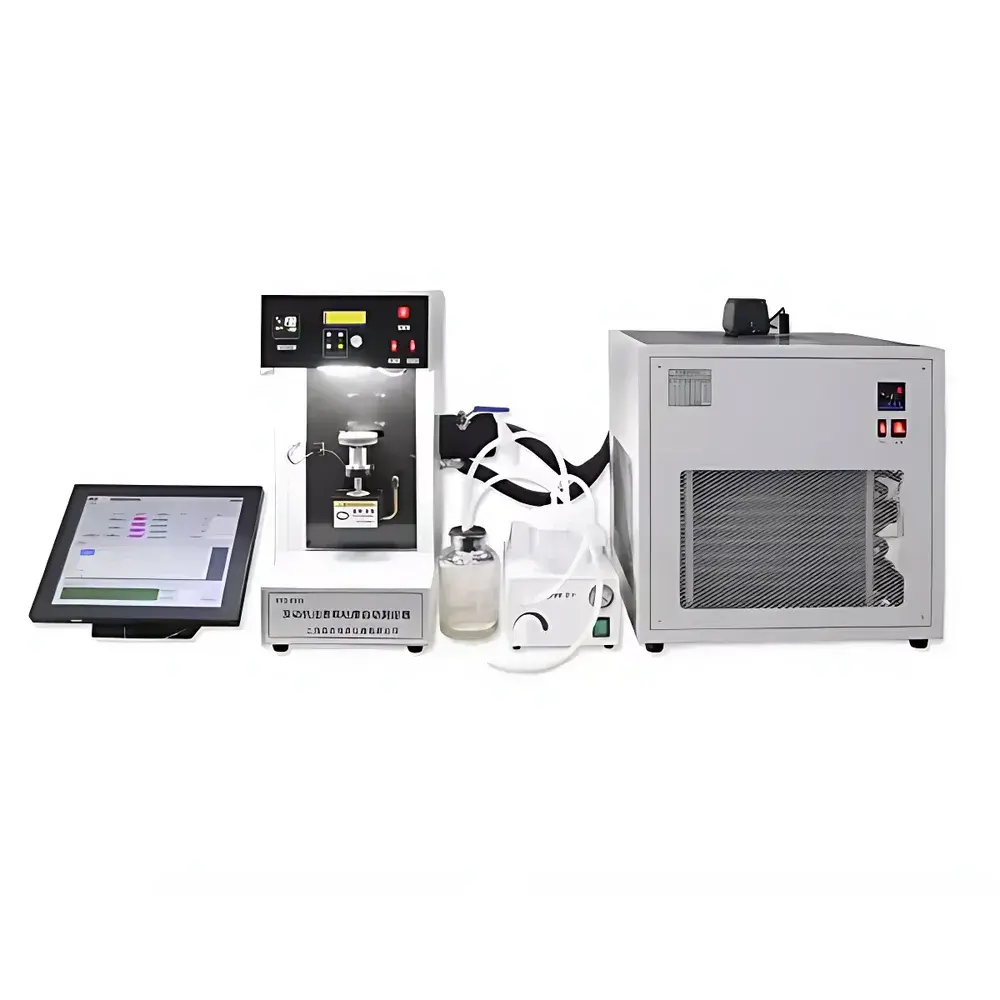
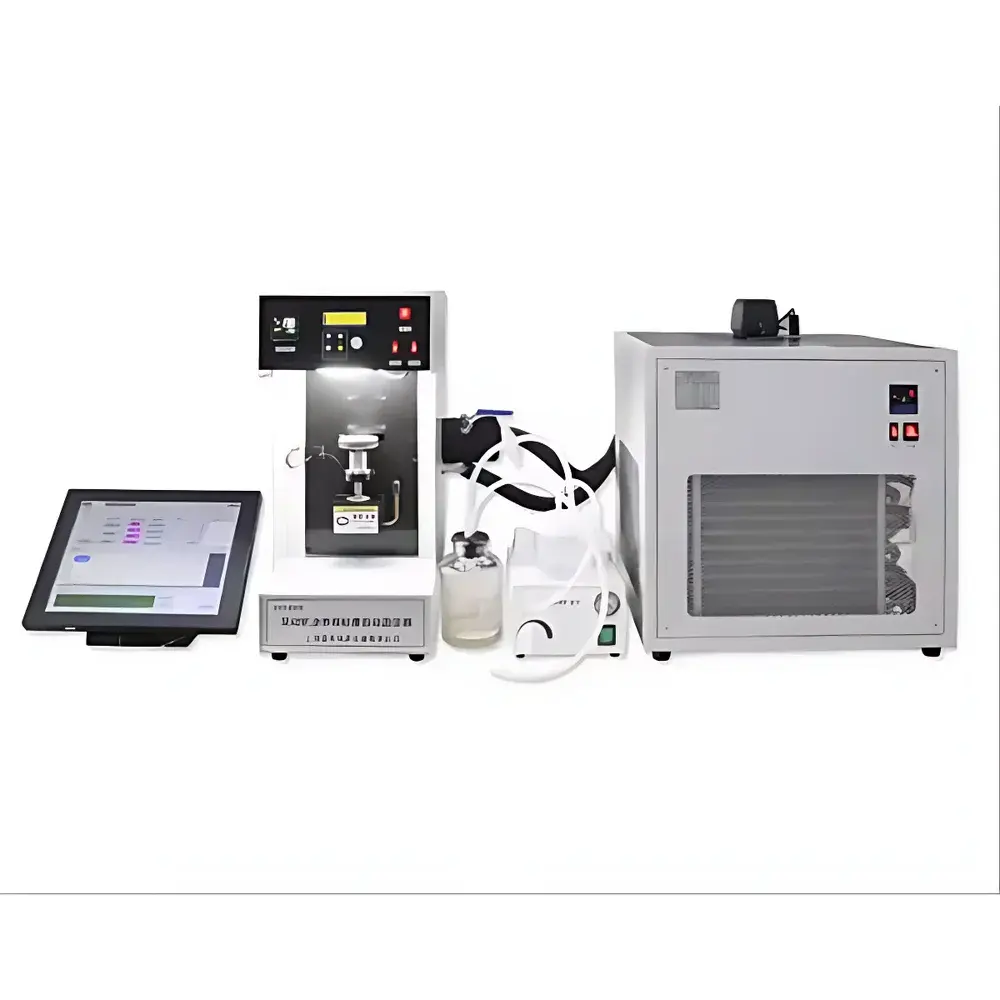
Changji Instruments SYD-6538 Cold Cranking Simulator (CCS) Apparent Viscosity Tester
| Brand | Changji Instruments |
|---|---|
| Origin | Shanghai, China |
| Model | SYD-6538 |
| Temperature Control Range | −50 °C to 100 °C |
| Temperature Accuracy | ±0.5 °C |
| Temperature Stability | ±0.05 °C |
| Viscosity Measurement Range | 1200–27000 mPa·s |
| Shear Rate Range | 10⁴–10⁵ s⁻¹ |
| Refrigeration Capability | −50 °C to ambient |
| Power Supply | AC 220 V ±10%, 50 Hz |
| Total Power Consumption | 2 kW |
| Dimensions (Main Unit) | 420 × 300 × 620 mm (L×W×H) |
| Dimensions (Cold Bath) | 500 × 530 × 615 mm (L×W×H) |
| Compliance | GB/T 6538, ASTM D5293 |
Overview
The Changji Instruments SYD-6538 Cold Cranking Simulator (CCS) Apparent Viscosity Tester is a precision-engineered laboratory instrument designed for the standardized determination of apparent viscosity of engine oils under low-temperature, high-shear conditions. It operates on the principle of rotational viscometry within a controlled cold bath, simulating the shear stress experienced by engine oil during cold-start cranking—specifically replicating the Couette flow regime between concentric cylinders under rapid angular acceleration. This method directly supports the Cold Cranking Simulator (CCS) test protocol defined in GB/T 6538 and ASTM D5293, enabling quantitative assessment of an oil’s ability to permit engine rotation at sub-zero temperatures. The instrument delivers reproducible, traceable results essential for formulation validation, quality control, and regulatory compliance in lubricant development and certification workflows.
Key Features
- High-stability temperature control system utilizing fuzzy logic algorithm, achieving ±0.05 °C thermal stability over extended test durations across the full operational range (−50 °C to 100 °C).
- Integrated industrial-grade touchscreen PC with intuitive graphical user interface (GUI), supporting fully automated test sequencing—from bath equilibration and sample loading to viscosity calculation and report generation.
- Dual-mode thermal management: high-efficiency refrigeration module capable of reaching −50 °C without external cryogens, combined with 800 W resistive heating for precise ramping and overshoot suppression.
- Onboard thermal sensor array with real-time feedback ensures accurate bath temperature measurement (±0.5 °C accuracy) and dynamic correction against ambient drift.
- Automated viscosity computation via curve-fitting algorithms compliant with CCS standard interpolation requirements, eliminating manual data reduction and minimizing operator-induced variability.
- Integrated thermal printer enables immediate hardcopy output of test reports—including date/time stamp, setpoint, measured viscosity, shear rate, and pass/fail status per specification thresholds.
Sample Compatibility & Compliance
The SYD-6538 is validated for use with conventional, synthetic, and semi-synthetic engine oils meeting SAE J300 viscosity classification requirements. It accommodates standard CCS sample volumes (typically 10–12 mL) in ASTM-compliant aluminum or stainless-steel sample cups. The instrument meets all mechanical, thermal, and procedural requirements of GB/T 6538 (identical to ISO 3104 Annex B) and ASTM D5293. Its design supports audit-ready operation in GLP- and GMP-regulated environments: all temperature setpoints, actual bath readings, viscosity outputs, and system events are time-stamped and stored locally with tamper-resistant logging. While not natively 21 CFR Part 11 compliant, its data export functionality (CSV/Excel) facilitates integration into validated LIMS or ELN platforms requiring electronic record integrity.
Software & Data Management
The embedded control software provides role-based access control (operator/administrator modes), configurable test templates, and multi-language UI support (English default). All measurement data—including raw torque vs. time profiles, interpolated viscosity values at specified shear rates (10⁴–10⁵ s⁻¹), and thermal history—are stored in non-volatile memory with automatic timestamping. Export options include USB flash drive transfer and network-enabled file sharing (SMB/CIFS). Audit trails record user logins, parameter modifications, calibration events, and test initiations—supporting internal QA reviews and external accreditation audits (e.g., CNAS, ILAC-MRA). Firmware updates are delivered via secure signed packages to ensure system integrity.
Applications
- Formulation screening of low-temperature viscosity improvers and base stock blends for SAE 0W-x and 5W-x grade engine oils.
- Batch release testing in lubricant manufacturing facilities to verify conformance with OEM specifications (e.g., GM dexos®, Ford WSS-M2C945-A, API SP).
- Research on shear-thinning behavior and thixotropic recovery kinetics under transient cold-start conditions.
- Third-party verification testing at national metrology institutes and accredited calibration laboratories.
- Academic studies in tribology, rheology, and petroleum engineering where standardized CCS data under controlled thermal gradients is required.
FAQ
What standards does the SYD-6538 comply with?
It is fully aligned with GB/T 6538 and ASTM D5293 for Cold Cranking Simulator testing of engine oil apparent viscosity.
Can the instrument operate continuously at −40 °C?
Yes—the refrigeration system maintains stable operation down to −50 °C; continuous testing at −40 °C is supported with adequate ventilation and ambient temperature ≤30 °C.
Is calibration traceable to national standards?
Temperature sensors are calibrated using NIST-traceable reference thermometers; viscosity calibration is performed with certified reference oils (CRM) traceable to NIM (China) or NIST (USA).
Does the system support automated calibration routines?
Yes—built-in calibration wizards guide users through temperature probe verification and zero-torque alignment; calibration logs are archived with metadata.
What maintenance is required for long-term reliability?
Routine tasks include periodic cleaning of condenser coils, inspection of bath fluid level and purity, and annual verification of thermal sensor drift using reference standards.